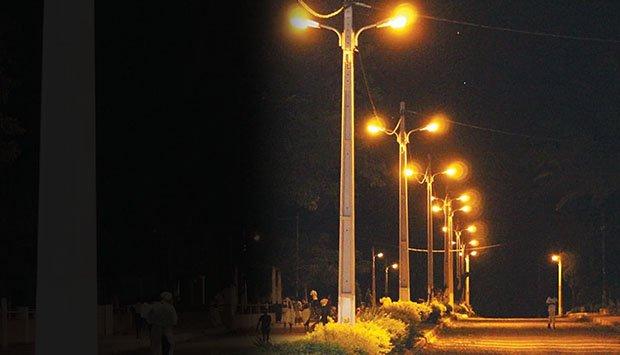
Africa-Press – Angola. In Cuanza-Norte, the authorities are making a strong commitment to complete the electrification of all ten municipalities, a strategy aimed at attracting investors, in a province with high potential in areas such as agriculture, livestock, minerals, tourism and fisheries.
Currently, nine of the ten municipalities in Cuanza-Norte are already connected to the national electricity distribution network. Only Ngonguembo remains, which could happen as early as December, with the completion of the respective electrification works, described as being “at a good pace”, as a government source in the city of Ndalatando explained.
More recently, energy from the national grid has reached the municipalities of Canhoca (Cazengo), Carriamba (Banga) and Dange-ya-Menha (Kambambe). Along the same lines, work continues in the municipality of São Pedro da Kilemba and the Zavula sector, located in the municipalities of Kambambe and Cazengo, respectively.
The conclusion of these projects should increase to 61,000 the number of household connections in the entire province of Cuanza-Norte.
As the “icing on the cake”, last February, by Presidential Order, the rural and local electrification project of the agro-industrial production center of Samba Lucala and neighboring towns was approved.
The project also includes the electrification of the municipalities of Cerca (Golungo Alto), Caculo Cabaça (Banga), Quiangombe (Lucala), Terreiro (Banga) and Camame (Ngonguembo), which will make it possible to reach 7,000 household connections.
The governor of Cuanza-Norte, Adriano Mendes de Carvalho, is particularly excited about the electrification program for the province, which will make it the first with all the municipalities connected to the national grid.
He told that one of the main priorities of his term, which is about to end, is precisely to bring energy to all the municipalities in the province.
“The investment in the energy sector because it is necessary to take it, immediately, to all municipalities. This is development and represents an important incentive for all potential investors in Cuanza-Norte”, Mendes de Carvalho said, in the interview given to us. granted at the Provincial Government Palace, one of the most striking buildings in the city of Ndalatando.
“We are doing everything, absolutely everything, so that by November or early December the municipality of Ngonguembo will also have energy from the electricity grid, joining nine others that already benefit. supply to some communes, such as Kilemba, Dange-ya-Menha, Samba Lucala and others”, he added.
“You can go there and ask the population about the work that is being carried out in this area”, challenged the governor, highlighting localities such as Luinga, an area with a strong tradition in the production of reindeer and sweet potatoes, rice and beans.
The governor explains that there is work to be done to bring energy to the main agricultural units and cites, as an example, the municipality of Kambambe, where there are large fields of citrus and palm oil production.
Mendes de Carvalho argues that the bet in this direction will have a significant impact on the prices of products, on the absorption of more manpower, increase in production and savings with the costs of diesel and lubricants.
“So, this is already a very significant gain for entrepreneurs”, he emphasizes, and then lists the actions that are being developed to improve the supply of drinking water, with “big projects”.
Essentially, the project to reinforce the water supply system to Ndalatan-do, a city where the water flows only between one and two hours a day, as the governor himself insisted on underlining.
The project is being carried out from the Lucala River and will also improve the water supply to the village with the same name. “Ndalatando is one of the few cities that does not have enough water and, therefore, we are going to improve the supply through a large pipeline that comes from the Lucala River, in addition to reinforcement from the Lússue River”, underlined the governor, indicating that the water supply system Golungo Alto’s water treatment facility is also being rehabilitated and expanded.
Samba Cashew Cereals
The municipality of Samba Lucala should be highlighted in this incursion that Jornal de Angola makes to the province of Cuanza-Norte. This is where the Samba Lucala Farm is located, an investment by the Government estimated at more than 52 million dollars, with which it is intended to transform the region into a kind of “corn triangle”, in northern Angola. Huíla province, southern Angola, with the municipalities of Chicomba, Chipindo, Caluquembe and Caconda.
This agricultural unit is managed by Ges-terra, a publicly-owned company responsible for the management of arable land, occupying an area of about three thousand hectares, for the production of maize (mainly), rice, soy and millet.
Governor Mendes de Carvalho speaks of Samba Caju, especially the commune of Samba Lucala, as a “special case”, due to its cereal potential. pleasant to cover the supply of corn flour and animal feed, as it has excellent conditions”, he said.
Cereal production is also very strong in the Planalto de Camabatela, as Mendes de Carvalho pointed out, who warns, however, of the existence of several arable land without effective use, which constitutes a major obstacle to attracting potential investors.
“The failure to take advantage of these spaces has hampered private investment in the agricultural sector, because there are strategic areas in which entrepreneurs want to invest”, according to the governor, who appeals to the “patriotic feeling” of citizens who own spaces to invest in the spaces they occupy.
He leaves an alert: “We are working to trigger a mechanism of expropriation, since the land must be given to those who have the spirit of mission and the will to develop the province”.
The governor insisted on creating a better business environment to attract investment, especially in the agricultural sector, appealing to the common sense of people who claim ownership of many agricultural spaces that remain idle.
“One of the things we have to do is to give investors the possibility, when they arrive in the province, to find, in addition to energy and water, land free of conflicts”, said Mendes de Carvalho, before appealing to the “sons of the land” to put aside the spirit of “this land belongs to my father or my grandfather”, without, however, making adequate use of it.
But what is the strategy to get out of this situation, which often generates conflicts? Mendes de Carvalho couldn’t be clearer: “We have to work, so that these investors come here, we are not going to expropriate land, but to reframe the children of the land in agricultural projects, because entrepreneurs have money and technology, so you can stay, for example, with three or four hectares”.
The Provincial Government is in talks with the BNA to transform its former facilities in Ndalatando into an area for bidding for coffee and other cereals. Another step in the valorization of the agricultural chain of Cuanza-Norte.
Animal Repopulation In Progress
He emphasizes the animal repopulation, which is in progress, with the reception, to cite just one example, of 1,500 cattle, distributed to farmers and families.
“It is there (Camabatela) where there is a large center for raising cattle. We are saying that this year and the next we are going to start taking, in a first phase, through a private company, about 80 thousand pigs annually, in order to reduce the importation of meat”.
Animal repopulation is carried out in detail. Health checkpoints were built in the municipalities of Lucala and Ambaca, something that is boosting livestock activity, at a time when the province has the registration of more than 217,000 animals, including pigs, sheep, goats and cattle.
A revealing data is that, of this number, about 39,450 refer to cattle.
Industrial Development Poles
The revitalization of the Cuanza-Norte industrial park is also at the top of the Government’s priorities, which is capitalizing on the province’s strategic location, which serves as a hub for the Central and Southern regions of Angola.
Here, the authorities emphasize the importance of the Industrial Development Poles, created in the municipalities of Kambambe and Lucala. In the first case, it is, strictly speaking, the rescue of a sleeping giant, which in the past came to occupy the fourth place in the industrial parks of Angola, as stated above in this piece.
Here, particular importance is given to the implementation of fruit processing units, fruit-based alcoholic beverages, soft drinks, preserves, peeling, packaging of fruits and palm oil, of which Kambambe was once one of the main producers in the country.
The province’s industrialization program also involves processing cassava to produce bombó fuba and musseque flour, in addition to industrial slaughterhouses and the production of eggs and chickens.
“We are working to recover the industrial units, starting with SATEC. We have already spoken with the Ministry of Commerce and Industry to see the case of Vinelo”, reveals Mendes de Carvalho, who is very concerned about large quantities of fruit deteriorate in the vast orchards of the municipalities for lack of a market.
In fact, huge quantities of oranges, lemons, tangerines, passion fruit and other fruits in the small markets set up along the road and being sold at “rain price” give the dimension of the importance of montagam processing units in Cuanza-Norte.
Something they can do with a bolder bet, to counter the importation of different pulps, as is currently the case, which would result in gains from foreign exchange savings.
The former governor of Luanda even says that, with fruit processing units in Kambambe and taking advantage of the province’s full potential, Angola can aspire to high levels in this field in Africa, in a first phase.
“We have the possibility of doing all this production, what is not lacking is raw material”, words of Mendes de Carvalho, who highlights the EKA brewery, in addition to the energy potential of the province, with the Kambambe dam, which joins the of Caculo Cabaça, soon.
The two dams are located in the middle Kwanza, just over 200 kilometers from Luanda, with the latter representing only the largest public investment in Angola, with a value of US$5 billion.
According to the governor’s explanations, the availability of electricity from the grid in Dangeya-Menha will accelerate iron exploration in the mountains of Kassala and Kitungo, in the locality of Cachiça. “We have a lot of power, we want to compete with other provinces and, perhaps, even with other countries”, says, optimistically, Mendes de Carvalho.
Improved Access To Fields
Considered to be some of the main bottlenecks in agricultural activity, due to the difficulties of marketing, in Cuanza-Norte, as in most provinces, access routes to productive areas are on the Government’s agenda, as Mendes made clear. de Carvalho in this conversation.
At this time, and according to data we had access to, 184 kilometers of earthen roads are accounted for, for access to the various production fields in different municipalities.
Here, the sections Bolongongo-Terreiro-Quiquiemba, with sixty kilometers, Banga-Aldeia Nova, Açude-Cerca, in Golungo Alto, are highlighted. The Quilessa-Lucala and Quididi-Ambaca roads also received earthworks, in addition to new bridges.
These are works that please the governor, when he says that “we are going to have more roads”, emphasizing the connection with Ngonguembo, which is being paved. de Carvalho, indicating that this is a considerable gain.
It is, at this time, one of the most critical sections in the entire territory of Cuanza-Norte. Currently, it takes between three and three and a half hours to travel just over 105 kilometers between Ndalatando and the municipal seat of Ngonguembo.
In parallel with the rehabilitation of access roads to agricultural fields, the flow of products to consumption centers has been facilitated with the introduction of medium-sized vans, within the framework of the Integrated Program for the Development of Rural Commerce, which provides, also the delivery of cargo motorcycles and the construction of warehouses.
At this time, as far as we know, more than a thousand producers are registered on the National Production Portal, while 750 million kwanzas were made available to the province to finance agricultural cooperatives, trade and distribution operators, as well as projects in the wake of the PAC (Project Credit Support).
Here, Governor Mendes de Carvalho highlights the PDLCP (Program for Local Development and Fight against Poverty), with which tractors are distributed to agricultural cooperatives of former military personnel.
Contract for Massangano
With a length of thirty-six kilometres, a public tender has already been launched for the rehabilitation of the forty-seven kilometer EN 321-1, which gives access to Massangano, a town in the municipality of Kambambe, known for its tourist potential and which became the provisional capital of Angola.
There are structures such as the old Forte de Massangano, Palace, fortress, courts, slave sales area, the first Church of Nossa Senhora da Muxima, where large pilgrimages and other historical infrastructures are held annually.
These are just some of the infrastructures of incalculable historical value that justify the authorities’ bet on the rehabilitation of the connecting road to Massangano.
Between Cambondo and Ngonguembo, construction work is also underway on a thirty-six kilometer road, while funds from the Integrated Plan for Intervention in Municipalities (PIIM) were invested in asphalting the towns of Lucala, Quiculungo, access to hospitals in Ambaca and Samba Cashew.
In yet another “breath of fresh air”, most recently the conservation and maintenance contract for the Maria Teresa/Caxilo section, on the EN 230, which is fifty-eight kilometers long, saw the opening of the respective public tender approved. It’s a bed of roses”, Mendes de Carvalho said, revealing the stoppage, “for financial reasons”, of the contract to build the Samba Caju/-Banga/Quiculungo/Bolongongo road.
The governor is, however, optimistic about the resumption of this undertaking of capital importance for the connection with these municipalities, highlighting the commitment of the Ministries of Finance and Public Works and Territorial Planning. The rehabilitation of this road is seen by the governor as crucial for the development of these municipalities, with high agricultural potential, located in the northern axis of the province.
PIIM Created More Than A Thousand Jobs
When asked about the PIIM projects in Cuanza-Norte, the governor, who has been in office since January 2019, indicated that the province received eighty-six actions. Seventy-five belong to the province and eleven to the Central Government.
Mendes de Carvalho, who has a degree in Public International Law and a Master’s in International Maritime Law, later shared abundant data with Jornal de Angola, illustrating the implementation of the PIIM: He said that the works have a degree of physical execution of 82 percent and 78 percent financial and that 1,276 jobs were created, a number that could reach 3,153 in the end.
Forty provincial works are completed, twenty-six are in progress and nine are awaiting the validation of the respective tender documents. As we could see, the Social sector leads the portfolio of projects in Cuanza-Norte, with Education taking 30 actions.
The governor says that 25 primary schools, five secondary schools, five Medium Polytechnic Institutes were built in that term, one of which has 30 classrooms, being the largest built in the province after Independence.
What’s more: There was an increase of over 520 classrooms, with 2,275 now available, something that was reflected in the integration of 46,800 students into the education system, in a province that has 447 public schools and three private schools, served by 4,430 teachers.
It is gains like these that pave the way for putting Cuanza-Norte on a par with other regions of Angola, especially in the South, Center and Coast. Perhaps, for this reason, Mendes de Carvalho emphasizes the focus on education: “One of the things I have been fighting for is the installation of higher education in some municipalities. I would like to have a Higher Agrarian Institute in Camabatela and a Higher Polytechnic Institute of the Energy Sector in Kambambe”, he says.
New General Hospital
In the North direction, for those going to the municipality of Lucala, the works of what could become the new General Hospital of Cuanza-Norte are already visible. The health unit was designed to have a capacity of 200 beds.
But there are others: Cuanza-Norte currently has 139 health units, with a capacity for 869 beds, 173 doctors, 702 nursing technicians and 245 diagnostic and therapeutic units.
It is expected that by the first quarter of next year, the number of hospital beds will reach 1,269, as a direct result of the construction and rehabilitation works for another five units.
These data were provided by the governor, who emphasizes the acquisition of equipment such as X-ray machines, laboratories for various clinical analyzes and ultrasounds.
Cambambe Hospital, a municipality in which a Mother and Child Center will also be built, already approved by the Head of the Executive Branch, is almost completed and the Samba Caju Hospital is in the equipping phase.
In total, 19 health centers were built and/or rehabilitated throughout the province, 84 new doctors were trained and another 1,224 professionals were hired.
Reflecting social concerns, PIIM reserved 17 actions for the Health area and 12 for basic sanitation and solid waste collection. Administrative and municipal infrastructures, security and public order, housing, consultancy and community services are covered.
Kwanza-Norte has about 500,000 inhabitants, spread across the municipalities of Ambaca, Banga, Bolongongo, Cambambe, Quiculungo, Samba Cajú, Cazengo, Ngonguembo and Lucala. The possible portrait of a province that definitely wants to enter a spiral of growth, with more roads, cereals, industries, schools, hospitals, centers, health posts and other basic social services for the populations. “We are going to present a Kwanza-Norte in full development. It may take three, four or five years, but it is possible, later, for people to see that there is actually growth”, underlined the governor.
A detail: Ndalatando, today with its more than 260 thousand inhabitants, no longer has the possibility to grow as a city, as Mendes de Carvalho recognized.
“We would like to grow, yes, but outside of here, going to the area of 11 or Camuachi, because we have to think, over time, of building another city, which is effectively saturated”, concluded the provincial governor of Cuanza Norte.
For More News And Analysis About Angola Follow Africa-Press