Africa-Press – Angola. After visiting South Africa on Monday and Eswatini on Tuesday, Russia’s Foreign Minister Sergey Lavrov travelled to Angola’s capital. Lavrov’s current African tour comes roughly half a year after he visited the Republic of the Congo, Uganda, Ethiopia and Egypt.
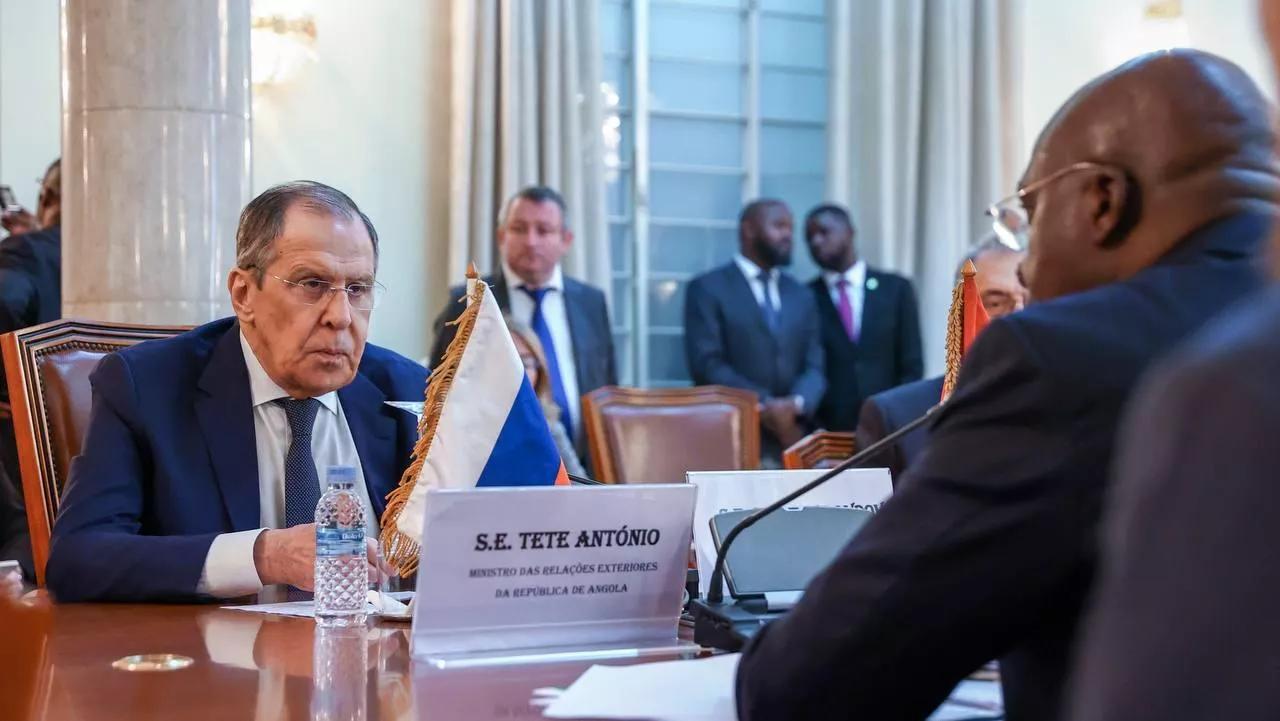
Russia’s Foreign Minister Sergey Lavrov has drawn attention to ongoing positive tendencies in Russian-Angolan relations, speaking at the joint press conference with his Angolan counterpart Tete Antonio on Wednesday after bilateral talks.
The conference followed the ministers’ discussion on building up cooperation in the trade, economic, military-technical and humanitarian fields. During the talks in Luanda, the two sides also committed to further cooperation on preparation on the follow-up summit, which will take place in July 2023 in Saint Petersburg.
Russia’s and Angola’s presidents met during the 2019 Russia–Africa Summit. According to Lavrov, Russia also expects that a meeting of the intergovernmental commission on trade, economic, scientific and technical cooperation with Angola will be held at the end of April.
The Intergovernmental Russian-Angolan Commission for Economic, Scientific and Technical Cooperation was established in 2003, following the 1998 agreement on trade and economic cooperation between the countries. Since then, the commission has held regular meetings.
Lavrov argued that the two sides confirming the prioritization of trade and economic partnership was the main outcome of the talks. The two ministers outlined mining, energy, agriculture, telecom as well space exploration as crucial spheres of cooperation, with Lavrov recalling the launch of Russo-Angolan satellite Angosat-2 in October 2022.
In 2020, Russia’s and Angola’s governments agreed on cooperation in the field of exploration and use of outer space for peaceful purposes. The humanitarian sphere is also among the priority ones, Lavrov underlined, welcoming Angolans’ significant interest in the Russian language and declaring that Moscow has agreed to double quotas for Angolans to study in Russia next year.
The two ministers discussed regional and international issues, with Lavrov praising Angola’s role in cooperation on African security and peacekeeping as part of South African Development Community and the African Union.
Lavrov and Antonio exchanged opinions in the conflict in Ukraine, with the Russian minister saying that the Kiev regime is used to implement an “openly colonial policy” towards the Russian-speaking population. Tete Antonio, in his turn, expressed hope for possible dialogue between Russia and Ukraine and the resolution of the conflict.
Lavrov stressed Russia’s and Angola’s commitment to the spirit of the UN Charter, its principles of non-interference in internal affairs and respect for sovereign equality of states.
The Russian minister confirmed his country’s support for the UN Security Council reform in order to increase the representation of developing countries there, African in particular.
Earlier, Multiple countries in Africa and beyond, including Russia and the US, voiced their support for UN Security Council reform. However, there no agreement has been reached yet on how it should be implemented.
In order to continue the development of cooperation between Russia and Angola, Lavrov invited his counterpart Antonio to visit Russia “at any time convenient for him.”
Foreign Minister Antonio, in his turn, confirmed that the meeting had helped them uphold frank dialogue, discuss bilateral, regional and international issues as well as key fields for cooperation. According to him, Russia and Angola will continue to deepen bilateral cooperation in multiple spheres of interest, such as industry, geology and telecommunications.
Russia and Angola have had a long history of cooperation in the post-Soviet era, as well as during Soviet times, when military experts from the USSR supported the People’s Movement for the Liberation of Angola (MPLA) during the Angolan Civil War. The MPLA is currently the ruling party in Angola.
For More News And Analysis About Angola Follow Africa-Press