Africa-Press – Angola. The “Girabola” National Football Championship starts on Saturday, with a history that dates back to 1979, when the debut edition was played, with a widespread mobilization of 16 provinces at the time – before the division of Lunda into the North and South and the creation of Bengo.
There were 24 teams present, divided into four series of six each, involving semi-finals and the final, in a different format to the current one, played in an all-against-all system over two rounds.
The top 14 qualified for the II edition, in 1980, already played in traditional model, where the last three are relegated and the three winners of the qualifying tournament are promoted to the first division.
The best founding teams were: 1.o de Agosto, Nacional de Benguela, TAAG, Palancas do Huambo, Mambroa, FC and Construtores do Uíge, Académica do Lobito, Desportivo da Chela, Ferroviário da Huíla, Diabos Verdes, Santa Rita, Sassamba da Lunda Sul and Sagrada Esperança.
The others classified between 15th and 24th were: Luta SC de Cabinda, FC Mbanza Congo, Ginásio do Kuando Kubango, Xangongo do Cunene, Naval do Porto Amboim, Diabos Negros, Makotas de Malanje, Vitória do Bié, Juventude do Kunje and April 14th.
1o de Agosto holds the first national champion trophy, with a 2-1 victory over Nacional de Benguela in the final. To reach the first and only final in the history of the event, the “military” eliminated TAAG and Palancas do Huambo.
In history, Girabola was marked by TAAG’s 11-0 rout of Desportivo de Xangongo do Cunene, in what is considered one of the most significant results of the competition.
1.o de Agosto was the first three-time champion (1979, 1980 and 1981). The “military” are the only totalists, after the ASA, currently out of competition due to financial problems.
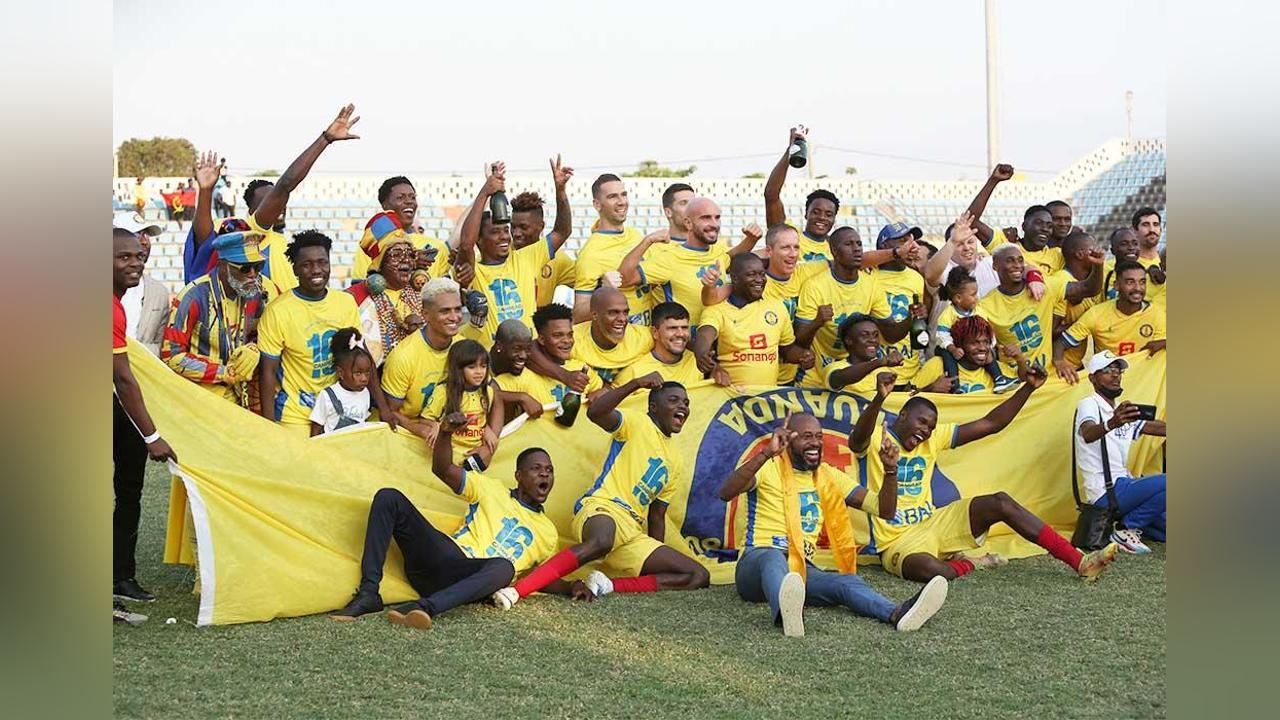
The championship saw the entry of Petro de Luanda in 1981, which ended up dominating national football, having won 17 titles so far, compared to 13 for 1.o de Agosto, its main opponent.
Luanda is thrashing in triumphs, as the national champion’s cup has only been won eight times in 45 editions – Petro (17), 1o Agosto (13), ASA (3), Interclube (2), 1o de Maio de Benguela (1) and Kabuscorp (1).
The provinces outside Luanda that took the “mug” include Recreativo do Libolo do Cuanza Sul (4), 1.o de Maio de Benguela (2) and Sagrada Esperança da Lunda Norte (2).
As a result of the armed conflict that the country experienced, the province of Huambo saw its clubs removed from the competition in 1993 and 1994, when Girabola was played by just 12 teams, while the three-point system (instead of two) by Triufo was implemented in 1995.
The team with the longest winning streak is Petro de Luanda, with five (1986-1990). João Machado (18 goals) from Diabos Verdes was the opening scorer. The record for goals, however, so far belongs to Carlos Alves (1980) with 29, with 1.o de Agosto.
The Portuguese Bernardino Pedroto, playing for ASA, holds the most titles and the best sequence of triumphs (2002, 2003 and 2004).
For 2023-24, the competition sees the return of Kabuscorp do Palanca and two debuts, namely São Salvador do Zaire and União de Malanje. These three teams replace the relegated teams from the previous edition, Sporting de Benguela, ASK Dragão do Uíge and Cuando Cubango FC.
Girabola stubbornly without VAR
The new edition of the first division National Championship, known as Girabola, will kick off this Saturday, the 24th, and once again without the right to use the video assistant referee (VAR, from the English Video Assistant Referee).
Implemented for the first time 5 years ago in the World Cup in Russia with the aim of helping to clarify doubtful moves, VAR is still far from the Angolan reality, with the high cost of the apparatus being the basis, in addition to the lack of technicians for the its handling.
The purchase of the complete equipment is estimated to cost three million euros (one euro is equivalent to 878.82 – eight hundred and seventy-eight Kwanzas ), a value far from being subsidized by the Angolan Football Federation (FAF).
In addition to the financial issue, the process also requires the training of more than 30 professionals, including referees and observers, to handle the equipment so that disputes can be resolved in record time.
Due to its effectiveness in moves that may be subject to doubt (whether or not it was a penalty, inside or outside, the ball crossed the line or not, there was some type of infraction), a second generation of the device was already used in the 2020 Qatar World Cup. from November to December 18, 2022.
The International Football Association Board (IFAB), the body that defines the rules of the sport, announced that the new technology reduces the time to define an offside to three or four seconds, which previously took around four minutes.
Due to the amounts involved, on the African continent only South Africa and Egypt have opted to use this electronic referee. Mozambique used the technique only for an experimental period.
For More News And Analysis About Angola Follow Africa-Press