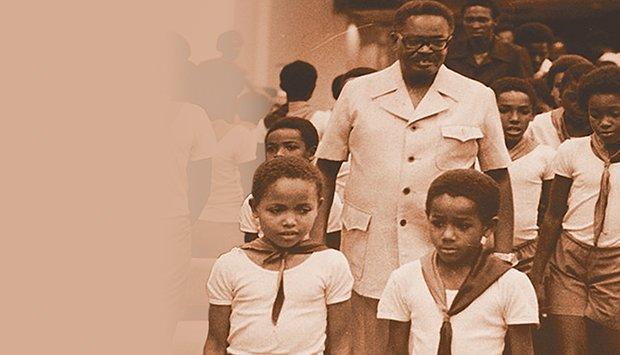
Africa-Press – Angola. In allusion to the centenary, the life and work of the first President of the Republic, António Agostinho Neto, was praised this Saturday in the city of Sumbe, province of Cuanza-Sul, with emphasis on the political-ideological thinking that guided the Liberation Struggle. National and culminated with the proclamation of the Independence of Angola.
The approach to Neto’s achievements was promoted by the provincial government, within the framework of the figure of National Hero, a title that Agostinho Neto won thanks to his dedication to the national cause and the African continent. In this perspective, the university professor, Francisco Mendes Lopes, underlined some of the outstanding aspects in the political and cultural field.
Francisco Mendes Lopes, a specialist in History, collected interesting details of Agostinho Neto as a young man, which, according to the speaker, serve as a testimony that he was always linked to causes such as political and social justice, but also to the development of families and societies.
In this sense, he highlighted the attitude carried out by Neto towards the colonial authorities and at the level of the international community, which, from now on, expressed the need to end colonial exploitation on the oppressed peoples of Angola and other African countries. The Austral Region, for reasons of proximity, gained more space in this intervention, said the speaker.
Professor Francisco Mendes Lopes said that Agostinho Neto as a statesman was a precursor of the ideals of freedom, but also played a role in elevating literature and culture in Angola. In fact, the historian advanced, taking into account the literary dimension, it is essential to deal with the insertion of the life and work of Agostinho Neto in the teaching and learning system, so that the legacy can be transmitted from generation to new generation.
Thus, he highlighted, the performance in the liberation of the country and the Southern Region, the solidarity with the oppressed peoples of the world are present in the national collective thought. “His dedication to the cause of the liberation of African peoples, resulting from the fight against colonialist supremacy, the commitment that led him to the most diverse international political stages, where he raised the voice of the oppressed peoples, are more valued”, said the historian.
Francisco Mendes Lopes mentioned, on the other hand, that, in addition to completing his high school course with high marks, Agostinho Neto was a student at the Faculty of Medicine of the University of Coimbra, where he met Lúcio Lara, one of his long-term companions, having been a member founder of the Center for African Studies, together with Amílcar Cabral, Mário Pinto de Andrade, Marcelino dos Santos and Francisco José Tenreiro.
“Due to his tenacity and active participation in youth movements, Neto was arrested by the PIDE, giving rise to international solidarity campaigns for his release”, he said. The speaker also highlighted Neto’s influence at an international level, which grew in the 60’s, having the opportunity to participate in conferences such as in Tunis, Léopoldville, Addis Ababa.
Agostinho Neto also participated in the constitutive Conference of the Organization of African Unity (OAU), currently the African Union (AU), held in Brazzavile, and later in other events such as those in Paris, Geneva, the World Congress of Peace and ILO, among others.
The speaker highlighted the role played by Neto in the 1970s, in which he led the political and guerrilla activities of the MPLA, until the recognition of the three national liberation movements, which culminated in the signing of the Alvor Accords, Portugal. Along these lines, the Founder of the Nation remained committed to consolidating the struggle, a path that led to the proclamation of National Independence on November 11, 1975.
Professor Francisco Mendes Lopes made it known that the life and work of Agostinho Neto intensified, ending up dividing his time between family and politics, a condition that did not change until the day of his death, on 10 September 1979 , victim of illness, in Moscow.
The provincial government of Cuanza-Sul announced that the activities to celebrate the centenary will include moments of reflection on his life and work, an opening of an exhibition of photographs, plastic and literary arts, lectures, among others.
In the opening act of the centenary day, the governor of Cuanza-Sul, Job Capapinha, said that the promotion of activities of this kind aim to raise the patriotic education of the citizens, with a view to consolidating their growth, within a framework that emphasizes the sacrifice consented to achieve the National Independent.
Job Capapinha underlined that the life and work of the Founder of the Nation must continue to be a reason for study, as a way of benefiting future generations, increasing knowledge among youth. “We will mark the beginning of a cultural journey, which will take us until the 17th of this month, following the slogan “The most important thing is to solve the people’s problems”, concluded the governor.
For More News And Analysis About Angola Follow Africa-Press