Africa-Press – Angola. In Camabatela, in the triangle connecting the provinces of Uíge, Malanje and Cuanza -Norte, which forms the plateau with the same name, there are, at this time, high cereal crops, especially corn, soybeans and sorghum, with the production of feed, intended for feeding cattle and pigs, at a time when the country is focusing on reducing meat imports.
Capeca Farm is located there, considered today an important player in the production of corn, soybeans and sorghum. Strictly speaking , these days, any approach to cereal production in the Ambaca region will be incomplete if it does not involve this agricultural unit, which employs more than 500 people, mostly from local communities.
And that’s what press did, walking along the paths of agriculture in Ambaca. Going directly from the city of Ndalatando and walking along the National Road (EN 140(, passing through the towns of Lucala and Samba Caju, we ended up in Capeca, not far from the town of Camabatela, heading towards Negage, Uíge territory.
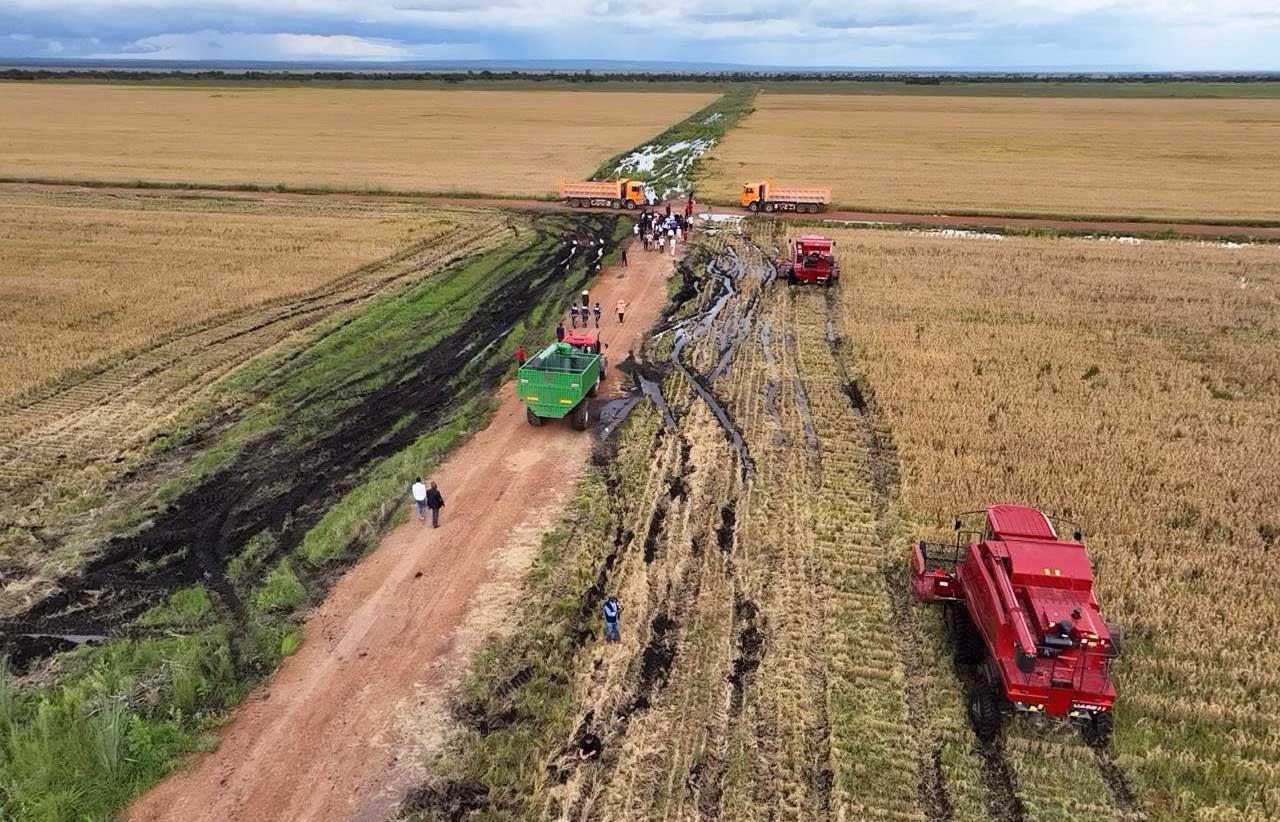
Here, we found expanses of land as far as the eye could see, completely covered in corn and soybeans, as a guarantee for the availability of cornmeal and animal feed.
Our guide was its manager, Francisco Golão. He welcomed us into his tiny and relatively modest office. With all the informalism, in fact, the mark of the “countrymen”, he began by describing what is, today, what could be called an “empire”, Capeca, which includes several shareholders.
Short in stature and quite energetic, Francisco Golão, more precisely, went into detail, saying that last year around 600 hectares of corn and 800 of soybeans were worked and that this season, for both rows, the number rose to 1,000 acre.
And this is something that is not surprising, since, as the manager explained, the work is uninterrupted. “We are always exploring, sowing and harvesting. Some of these hectares have already been sown and others harvested, production does not stop, as we use the rainfed and irrigation system”, he explained, before inviting the report to go through part of the vast agricultural property.
In Capeca, there are three corn fields. When we passed by, they were all fully worked on. One, with 110 hectares, had just been sown, another, with 140 hectares, had already been sown in December, while the last, with 100, was ready for harvest.
Agricultural engineer Gaspar Luvumbu is directly linked to the success of crops at Fazenda Capeca. He was particularly optimistic about the results in these fields, estimating harvests of at least 10 tons of corn per hectare, which speaks well of the quantity of grain expected at this time.
The director of Agriculture in Ambaca, Olívio Lucas, with whom we went to Fazenda Capeca, agrees with the estimate put forward by Gaspar Luvumbu. “It is not the first time that these quantities have been taken, the technicians have prepared the soil well and, when this happens, it usually results in good harvests,” he said.
Afterwards, we went directly to the extensive fields destined for soybean production. There are two, totaling 140 hectares each. In March, the soybean harvest should begin, according to Gaspar Luvumbu, who, maintaining the same optimism in relation to corn, estimates three tons of soybeans per hectare. “We are also very confident of good results in relation to soybeans”, said the young agronomist.
The focus on large-scale cereal production is in line with a pig farming development program that this farm is developing, in one of its associated units, to supply the quality meat market. “In the future, as this is a unit destined for agricultural production, all the grain we will produce here will be for animal feed”, revealed Francisco Golão.
The farm manager does not reveal specific numbers, out of “respect for the shareholder structure”, but lets it slip that this is a “very large set of investments that are being made” and which should lead to assembly, later this year. , dryers, silos and feed mills.
Market leadership
The numbers we were faced with at Capeca seem to fully reflect our commitment to a project destined for success. These are brutal figures, at a time when Angola is working to achieve cereal production levels compatible with the availability of natural resources, starting with abundant land and water.
During the 2023/2024 harvest, around 2,510,500 tons of corn were harvested at Fazenda Capeca, in a total area of 395 hectares, while 4,250,000 tons of silage were used to feed livestock on 173 hectares.
Also for animal feed, this agricultural unit produced more than 728 tons of soybeans, in an area of around 500 hectares, with sorghum accounting for almost 780 tons, for which at least 76 hectares were prepared.
To these figures are added the productions of other Telegeste Group units in the provinces of Bié, Huambo, Cuanza-Sul, Cunene and Huíla.
The focus on high-scale cereal production at Fazenda Capeca is in line with the development of a pig farming project in the Camabatela region, which is being developed by the BicAgro Group, in the wake of rescuing the region’s role in leadership of meat supply to Northern Angola.
Referring to these numbers, a well-placed Capeca source told that the consolidation of these agricultural projects has long placed this unit at the top of cereal production in the country. “We are the main producer of rice, corn, soybeans and sorghum”, she said, indicating that there is perfect alignment with the Executive’s strategy to increase grain production.
One detail of the report was the difficulty in obtaining data on the real potential of the so-called large agricultural units established in the Ambaca region. But there are some exceptions, such as Fazenda Sorte and Gemac. The first, with 3,000 hectares, invested “heavily” in the cultivation of corn, soybeans and massambala, both for commercialization and for animal feed, while the second, with 1,000 hectares, also invests in cereals.
Harvests at Fazenda Samba Lucala
In the corridor between Lucala and Ambaca, there is the Samba Lucala Farm, which, after initial tests, presents relevant figures in grain production, with more than 14 thousand tons being discussed here, of which 9,498 are corn and 4,637 of soybeans, in the 2022/2023 agricultural season.
These are data revealed by agronomist Carlos Paim, president of the Gesterra Board of Directors, indicating that in the experimental phase, around two years ago, 4,637 tons of corn and 1,070 tons of soybeans were collected. For the current agricultural season, harvests are expected to rise to more than 21 thousand tons, with corn at 2,950 tons and soybeans at 6,324, an increase of 30 percent compared to the last harvest.
On this farm, which covers 10,000 hectares, 2,000 of which have already been worked, a significant part of the production is carried out under rainfed conditions, something that is favored both by the quality of the soil and the regularity of the rain. This allows, for example, more than four tons of soybeans and around 10 tons of corn to be produced from each hectare.
Carlos Paim said that Fazenda Samba Lucala entered, this year, what he considers the “full production” phase and is, therefore, in a position to contribute significantly to the increase in the supply of corn and soybeans to the market national.
But if the large-scale production of corn and soybeans is already a winning bet, the difficulties of access, along a 50-kilometer stretch, still represent an obstacle to be removed, for the safe transport of technical equipment, fertilizers, in addition to the transport itself. distribution to the main marketing centers in towns and cities.
Support for peasant families
In this unit, social responsibility is also seen as a priority. An example of this is the preparation, during this agricultural season, of 200 hectares for 120 families in the village of Kixina Bamba and another nearby one, technical assistance and distribution of inputs, as well as the construction of 30 social houses, a school and a health center.
Water from the Lucala river is little used by projects
In the municipality of Lucala, close to the provincial capital of Cuanza-Norte and whose headquarters we visited, the river, with the same name, is still far from being used for agricultural purposes, as is the case with other watercourses in the region.
The director of Agriculture, Gildo Manuel Barão, couldn’t be clearer when we asked him about the availability of water in Lucala. “This area has several water resources, most notably the Lucala River, but, unfortunately, only thirty percent is used on some farms, such as Lucalagro, Los Compadres, Diogo e Irmãos and small and medium producers, for the irrigation of agricultural fields”, he replied.
The agricultural engineer, trained at Kimpa Vita University, explained to us that only thirty percent of current farms are legalized and with a degree of exploitation of around thirty-five percent. He reveals that, sometimes, conflicts arise caused, fundamentally, by the delimitation of agricultural spaces, which have been resolved by the authorities, with the collaboration of traditional entities. “This is something that doesn’t surprise us, especially in an area with very fertile land, which is therefore highly coveted”, says Gildo Barão.
In the 2022/2023 agricultural campaign, more than 5,215 hectares were prepared, 552 of which were mechanized and handed over to the family sector. “Our perspective, for this campaign, is to double the 3,750 tons of various products, harvested in the previous harvest, as mentioned by the director of the Agriculture sector”, adds the head of Agriculture, indicating that 1,744 families are involved in this agricultural season.
This optimism is based on investments, to which PEDAC, FADA, SREP and PRODESI are not unrelated. “The strategy involves continuous support for cooperatives, associations and families, in agricultural inputs, to produce on a large scale”, highlighted Gildo Barão.
In Lucala, peasants also receive hoes, machetes, files, fertilizers, seeds and vegetables.
Concern about access to agricultural fields is permanent
As in Ambaca, in Lucala, the critical situation in which the access roads to agricultural fields are found , with consequences for the flow of products, continues to “keep sleep” for farmers, combined with other constraints, such as difficulties in acquiring inputs and agricultural inputs.
Rural men’s hands are tied and many products have spoiled in the fields. Most farmers choose to rent vehicles to take products from the field to the markets, but the prices are too high. A significant part of the products ends up deteriorating in agricultural fields.
In Lucala, agricultural activity is mainly concentrated in the Cacala, Correia 1, Quilessa and Canguari areas. It is here where we find some of the 11 cooperatives, associations and farms such as Los Compadres, Lucalagro, JWCatering and Irmãos Chaves, in a total of 178 farms.
Aware of the population’s concerns, the Municipal Administration placed the rehabilitation of bridges on the roads connecting the main productive areas at the top of its priorities. This is the case, for example, of the village of Kissuba, considered the “queen of beans” in Lucala.
The irrigated perimeters of Cacala and Correia 1 were included, last year, in a rehabilitation project , within the framework of the Commercial Agriculture Development Program (PDAC), to increase the cultivation of corn, beans, soybeans, coffee, fruits and vegetables.
The aim, as explained to us in Lucala, is to improve water capture, create dams and reservoirs to retain water, in addition to improving access roads. “These infrastructures have deteriorated over time and this, naturally, has caused serious difficulties for farmers”, said Gildo Barão, indicating that the lack of places to store products in the village is also a concern for men in the village. field.
Good news
But there is good news for producers in the municipality of Lucala. Recently, in the town of Pamba de Baixo, the first public consultation was held on a project that will involve the earthmoving of all access roads to the main agricultural areas of the province of Cuanza-Norte. In addition to municipal entities, traditional authorities and the civil community attended the meeting in large numbers.
The project is financed by the World Bank and, in the first phase, the locations of Cacala, Correia 1 and Pamba da Ração were selected.
Initiatives like this are also seen as the way to help Lucala regain its role as an important agricultural hub in Cuanza-Norte and even for other regions of Angola, such as Malanje and Uíge.
And the municipal administrator, Maria Mafuta, could not be more optimistic when referring to future projects. “Improving access roads to agricultural production areas and increasing the flow of products, which is still difficult to achieve in this region, will continue to be the priority of government action,” she said.
Farmers in the municipality of Lucala, in the province of Cuanza-Norte, organized into cooperatives and associations, expect good harvests in the current agricultural year, as a result of the rains that fall with some regularity.
Jornal de Angola
For More News And Analysis About Angola Follow Africa-Press