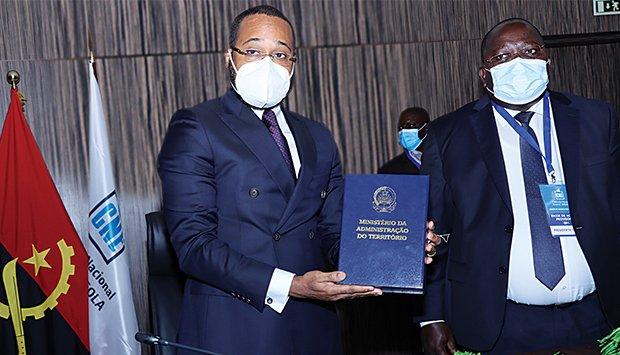
Africa-Press – Angola. More than 14 million voters are entitled to vote in the General Elections of August 24 this year, the Minister of Territory Administration said this Monday in Luanda in the act of final delivery of the Computer File of Senior Citizens (FICM) to the National Electoral Commission (CNE).
Marcy Lopes added that, out of a total of 14,399,391 voters, 22,560 citizens updated their voter registration in 12 countries and 26 cities, namely, South Africa, Germany, Belgium, Brazil, France, Great Britain, Namibia, the Netherlands, Portugal , Democratic Republic of Congo, Congo and Zambia.
The final delivery of the FICM to the CNE ends a cycle of Official Electoral Registration, carried out from September 2021 to April 2022, configuring a legal obligation for the correct and updated registration of voter data, whose process was conducted by the Ministry of Administration of the Territory (MAT).
Minister Marcy Lopes explained that citizens with an Identity Card entered the database, both those residing in national territory and those residing abroad, whose calculations point to around 10 million. The database also includes citizens who turned 18 after the General Elections of 23 August 2017.
The process also made it possible to eliminate duplicate records from the database. In this case, 501,768 queries were made using the digital application created for this purpose, where 2,139 complaints were received, of which 1,287 were answered and authorized, and 852 were rejected for not falling within the legal scope of the complaints. Marcy Lopes explained the time-consuming tweaking and correction process.
Regarding the reliability of the data, the minister stated that there are no margins of error in the process, because, he added, what they do is include the file in the database of all citizens who, from a legal point of view, exist and are in voting conditions.
“When we do the electoral registration in areas of difficult access, we collect data from the people who exist, and they are well identified and located, through the registration mechanisms with testimonial evidence”, he stressed.
Punctuating, as follows: “the other people who are on the Identity Card base, for example, we know they are there, and they migrate to our base, but we have no way of proving whether a certain person exists or not, unless either through a document from the Ministry of Justice that certifies whether the citizen is already deceased or not”.
The Minister of Territory Administration said, in this sense, that there can be no margin of error in terms of registering voters, since all those aged 18 or over were placed in the database.
As an example, Marcy Lopes explained that convicted citizens, deceased, today or tomorrow, are included in the file, and those whose data were not transferred by the Ministry of Justice, even those who will be convicted tomorrow, are thus in the file.
“If this is the margin of error, it no longer depends on our action, but on natural circumstances and other recurring ones of the law, which are not under our control, because there must be a cut-off date defined by law, which is the definitive date. delivery of the files, ten days after the General Elections were called by the President of the Republic”, he stressed.
Marcy Lopes clarified that, in the case of the depuration of the Database of Senior Citizens (BDCM), the deceased, national citizens with a final conviction, as well as those interdicted by a judicial decision, carriers of psychic anomalies, duplicates and citizens who turn 18 years of age on August 25th.
The minister underlined that, after carrying out the mass registration for the first time in the country’s history, the Official Electoral Registration process followed, with an automatic transfer of data from the civil registry to the electoral register, and this task, being new, brought many challenges.
“With this transformation, there were associated difficulties arising from the communication between the databases, harmonization of work forces between the teams of the Ministries of Justice and Territory, but, in the end, the task went well”, emphasized the minister, to who the difficulties are typical of a huge country, having stated that no one could be left out of the process.
CNE Has More Than 220,000 Electoral Agents Across The Country
The National Electoral Commission (CNE) will engage more than 220,000 agents in activities across the country in the process of raising awareness and holding the elections.
The institution started, yesterday, in Luanda, a course for trainers of national, provincial and municipal electoral agents. The training also includes Civic and Electoral Education agents, members of polling stations, among others.
The president of the National Electoral Commission (CNE), Manuel Pereira da Silva, who opened the training, said that all were selected on the basis of public curricular competitions, in obedience to the institution’s guiding principles, namely independence, exemption, transparency and impartiality.
Manuel Pereira da Silva said that the process consists of a set of acts and formalities, with a view to training that is summed up in acquiring knowledge to standardize the interpretations to be transmitted to Electoral Civic Education agents, who will be in direct contact with voters.
For More News And Analysis About Angola Follow Africa-Press