By Osmar da Fonseca
Africa-Press – Angola. Angola marked, in 2023, an important step towards the consolidation of its airport sector, which is expected to be more dynamic in 2024, with the full exploitation of services at Dr. António Agostinho Neto International Airport.
With the inauguration of this infrastructure, which constitutes the sector’s main milestone in the year about to end, the country could become one of the main hubs in Southern Africa, serving as a privileged option for thousands of passengers.
Budgeted at USD 2.8 million, the airport was built in the commune of Bom Jesus, municipality of Icolo e Bengo, Luanda, to accommodate 15 million passengers, of which 10 million in the international segment and five million in domestic service.
Inaugurated on the 10th of November, by the President of the Republic, João Lourenço, the new infrastructure can process 130 thousand tons of diverse cargo annually, which could boost, in the medium term, the entry of more tourists and revenue for the country.
Located 42 kilometers from the city center of Luanda, the airport is located in a total area of 75 square kilometers, and was designed to receive the largest commercial aircraft in the world, category F, the Airbus – A380.
With two parallel runways, aircraft parking apron and maintenance apron, it began its cargo operations on the 19th of this month, with the arrival of the first two flights from the city of Lagos, Nigeria.
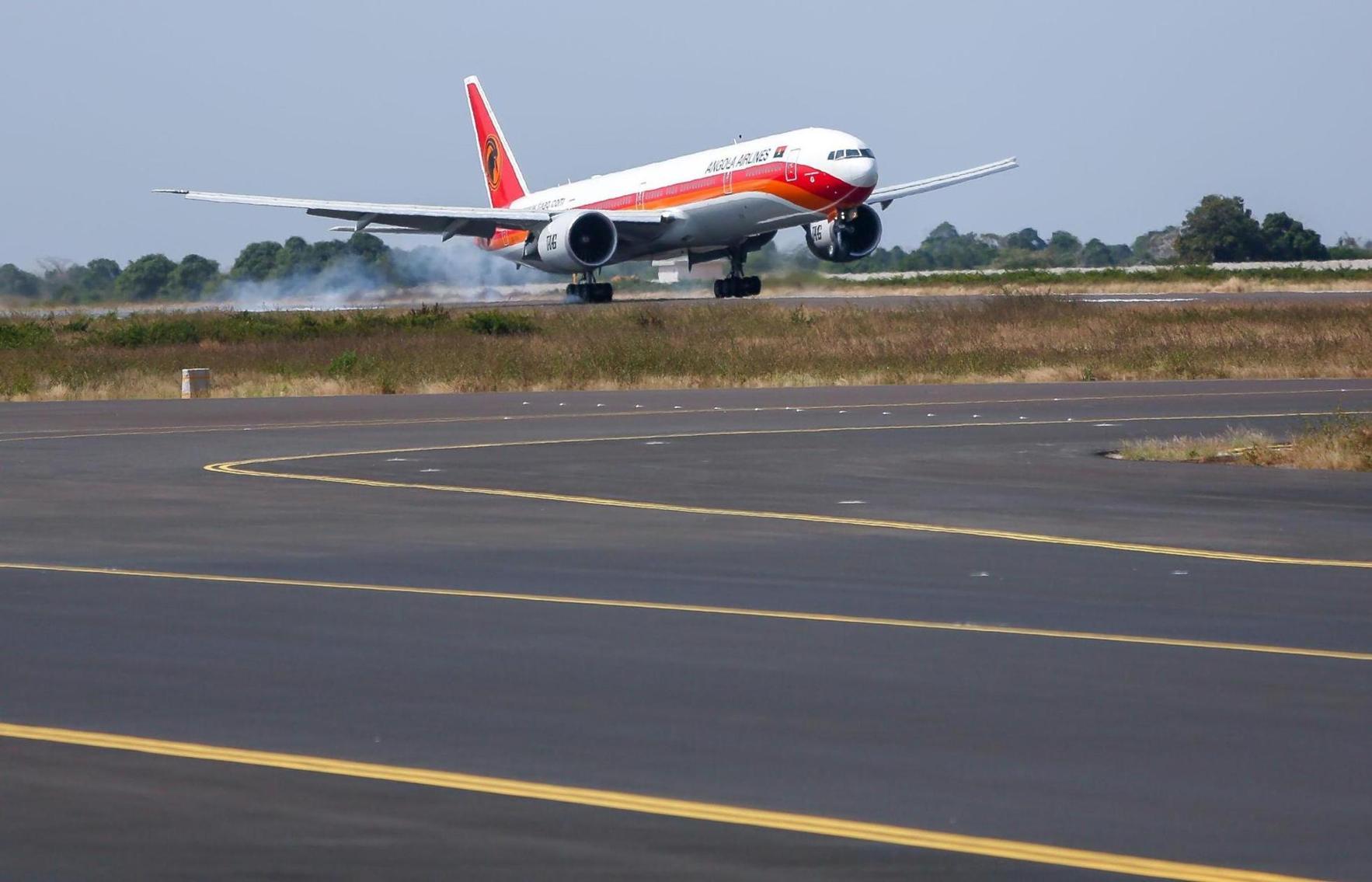
The highlight is the first shipment that took place on a 737-800 cargo aircraft, operated by TAAG. “The same aircraft went to the capital of Nigeria with 3,000 kg, having returned to Luanda with 10,000 kg.”
These two services, Luanda – Lagos and Lagos – Luanda, formalized the commercial cargo connection between Angola and Nigeria, as part of the company’s strategy of progressively increasing its participation in the regional African air cargo market.
It was, therefore, the first phase of the project’s implementation, reserved only for loading and unloading of cargo to various destinations, which runs until February 2024.
According to the airport’s operating schedule, the 2nd phase begins in February 2024, with domestic flight operations, with the last stage scheduled for June 2024, with the start of international passenger flight operations.
Reinforcement of the TAAG fleet
The year 2023 was also marked by the reinforcement of the TAAG-Linhas Aéreas Angola fleet, which ordered four new Boeing 787 Dreamliner aircraft, destined to cover the company’s continental and intercontinental routes, starting in the 3rd quarter of 2024.
On the occasion, the national flag company highlighted that the incorporation of these new aircraft is part of the business project and modernization of the TAAG fleet, which aims to improve service and provide comfort to passengers.
Of these aircraft, TAAG has already incorporated two of the Boeing 737-700 type, with capacity for 136 passengers, 12 in business class and 124 in economy class, in order to provide greater convenience of service to passengers and reinforce the availability of flights in a phase of year of high demand.
The planes will ensure connections to domestic destinations with greater traffic and regional routes.
Still in relation to orders, TAAG requested eight GEnx-1B engines and one B777, parts for the new fleet of Boeing 787 aircraft and for the B fleet.
On that occasion, it also signed a “TrueChoice” service agreement, which covers the existing fleet of five Boeing 777-300ER aircraft, with a GE90 engine.
In June, TAAG also purchased, under a “Dry Lease” regime, nine Airbus A 220-300 aircraft, whose long-term rental contract covers the supply of equipment, maintenance and staff training.
Also in the field of airport infrastructure, the Ministry of Transport launched a public tender for the construction of Cabinda International Airport, under the supervision of the Airport Management Society (SGA).
The airport, budgeted at 250 million dollars, is being built on an area of 850 hectares, with a runway 3,500 meters long and 45 meters wide, a passenger terminal with an area of 12 thousand square meters, control tower , fire station, police building, administrative building, among other service areas.
The work is being developed to serve 700 domestic and 500 international passengers at rush hour, for a total of 670 thousand 722 passengers per year.
This construction is generating 1,500 direct jobs, 95 percent of which are Angolan labor.
Regarding airport requalification works, the International 4 de Fevereiro (Luanda) and Maria Mambo Café (Cabinda) airports benefited from improvements, particularly in the improvement of runway pavement, lighting and signage.
In the chapter on international exchange, Angola hosted the International Conference of Southern African Airlines, called the 53rd edition of the General Assembly of AASA (Airlines Association of Southern Africa), which addressed the development of commercial aviation on the continent.
The annual event, held for the first time in Angola, brought together airlines, regulators, manufacturers, service providers, investors, diplomatic representations and government entities.
On the occasion of its 85th anniversary, TAAG presented its new website and its new headquarters, located in the One Metrópolis building, in Talatona, to optimize services and provide better working conditions and dignity for its staff.
In the first half of the year, the national flag company and the Brazilian GOL signed a codeshare agreement, with the aim of boosting passenger traffic between Latin America, Africa and Europe, through the São Paulo/Brazil hub (Airport of Guarulhos) and Luanda/Angola (4 de Fevereiro International Airport.
During this year, TAAG reinforced frequencies to several international destinations, with emphasis on Portugal. Weekly flights to the Republic of Congo (DRC) increased from 10 to 14, and went from two to four services per week.
The Luanda/São Paulo route went from having four daily services, totaling seven weekly flights.
The Luanda Railways (CFL), from January to November 2023, transported 727 thousand 761 passengers, on 16 operational locomotives, of which seven were diesel, having transported 415 thousand tons of various goods.
In terms of infrastructure and construction, the Bungo, Musseques, Baia stations and the new Dr. António Agostinho Neto International Airport are under construction.
As for passenger and merchandise transport, within the framework of the gradual withdrawal of fuel subsidies, and the consequent increase in the price of gasoline from 160 to 300 kwanzas, the Angolan Government created and distributed gasoline subsidy cards throughout the 18 provinces, to maintain the trip fare cost per passenger.
Sécil Marítima, in the last 12 months, transported 94 thousand 681 passengers, a cargo volume of two thousand 752 tons in hold, 85 containers and 315 vehicles on the five service vessels.
ANGOP
For More News And Analysis About Angola Follow Africa-Press