Africa-Press – Angola. The southern corridor, which crosses the provinces of Namibe, Huíla and Cuando Cubango, moved during the last six months of the current year, via the Port of Namibe, about 600 thousand tons of cargo.
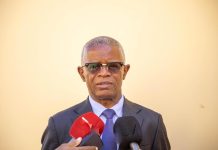
According to data revealed this Sunday by the Minister of Transport, Ricardo de Abreu, 100,000 tonnes were transported via the Moçâmedes Railway.
Ricardo Abreu was speaking at the opening ceremony of the Journey for the Revitalization of the Transport and Export Process of iron ore and ornamental stones in the southern region of Angola.
“These are smaller numbers, it is true, but we all know that the global economic crisis has not given us any respite, that international logistics chains have faced various challenges and difficulties, that our infrastructures and our economy are not immune to the effects of these global difficulties,” he said.
The Port of Namibe foresees the movement, this year, of approximately one million tons of cargo.
Data that, according to the official, require the effort of all the intervening parties, to increase the production pace and thus reach the established objectives.
“ It is an effort that must be even greater in the field of freight transport by rail, since in the first half of this year we fell short of our expectations, having reached only 50 percent of the level of execution of our annual target, which is that of transporting, by this route, approximately 200 thousand tons”, he added.
He also pointed out that the southern corridor is the one that most contributed to national exports in terms of volume.
He stressed that it is a domestic only corridor, with features that end up increasing the representativeness of the numbers of cargo already transported. For this year, he said, the intention is to launch a tender for the concession of its management by private entities, which will be responsible for its extension along the borders with Namibia and Zambia.
“ This is a corridor in which there is an increase in the development rates of the mineral sector, which is already putting pressure on the transport services and infrastructure that we have. The Jamba mine, which produces iron ore, and the Cuxi mine, which produces gunza iron, are good examples”, underlined the minister.
At the same time, he also stressed that this southern corridor is also witnessing the growth of the ornamental stone sector, further increasing the pressure on transport services and infrastructures and making coordinated intervention necessary and increasingly urgent so that progress and development take place and be fruitful for all.
On this journey, as detailed by the minister, the biggest challenge is to identify the needs according to the expected production levels so that the transport sector can adjust according to the real demand for the minerals and ornamental stones produced and to be transported.
To this end, he said, it is necessary for public and private financial partners to be able to understand the financing needs and involvement of public entities.
“We are gathered here to work on creating a coordinated, integrated and inclusive space for dialogue between all stakeholders. Because only in this way will we actually be able to guarantee the existence of adequate services, both in terms of port and rail, so that production is shipped in a timely, efficient and profitable way for the operators that produce and transport it”, he stressed.
In Namibe province, the minister visited the implementation areas of the Integrated Project for the Development of Moçâmedes Bay and Railway Infrastructures and CFM, the Saco-Mar Mining Terminal, the CFM workshop in Saco-Mar and the multipurpose terminal.
For More News And Analysis About Angola Follow Africa-Press