Africa-Press – Cape verde. The President of the Republic, José Maria Neves, today highlighted the historical relevance of the Lisbon Agreement, signed on December 19, 1974, in the decolonization process that led to Cape Verde’s independence. The head of state highlighted that the event is the recognition of the courage and determination of all those who, inside and outside the country, did their best to guarantee the freedom and sovereignty of the people.
“Today we celebrate a landmark date in our collective life, a determining moment in the process that culminated in our National Independence. This agreement was more than just a legal document; it was the consecration of our struggle, of our inalienable right to self-determination. It was recognition of the courage and determination of all those who, inside and outside the country, did their best to guarantee the freedom and sovereignty of our people”, he said.
On the occasion, José Maria Neves made a point of praising the protagonists of the agreement, both on the Cape Verdean and Portuguese sides.
“This is a day of tribute to Commander Pedro Pires, to the diplomats Amaro da Luz and José Luís Fernandes, who represented the African Party for the Independence of Guinea and Cape Verde (PAIGC), and to the representatives of Portugal, Melo Antunes, Mário Soares and Almeida Santos. It was thanks to his vision and capacity for dialogue that this historic milestone was possible.”
The president also highlighted the importance of the struggle for independence led by PAIGC and the crucial role of the agreement in the transition to a sovereign government.
“The Lisbon Agreement recognized the right of the Cape Verdean people to independence and laid the foundation for the creation of the Transitional Government, which paved the way for the proclamation of our sovereignty on July 5, 1975.”
The Head of State called for the preservation of historical memory as a pillar for the future and a call for national unity.
“The new generations must know and appropriate this heritage. Memory is the great asset for a future, without prejudice to the diversity of opinions and the confrontation of ideas that is characteristic of democracy. This is our greatest treasure. Be inspired by the ideals of the leaders who made independence possible. We have to imagine a future of prosperity, which will only be achieved with a great ‘djunta mon’ from all Cape Verdeans, inside and outside the country.”
The ceremony, which was attended by senior figures from the Cape Verdean State and society, reinforced the role of the Lisbon Agreement as a symbol of national unity and a milestone in the struggle for freedom and sovereignty.
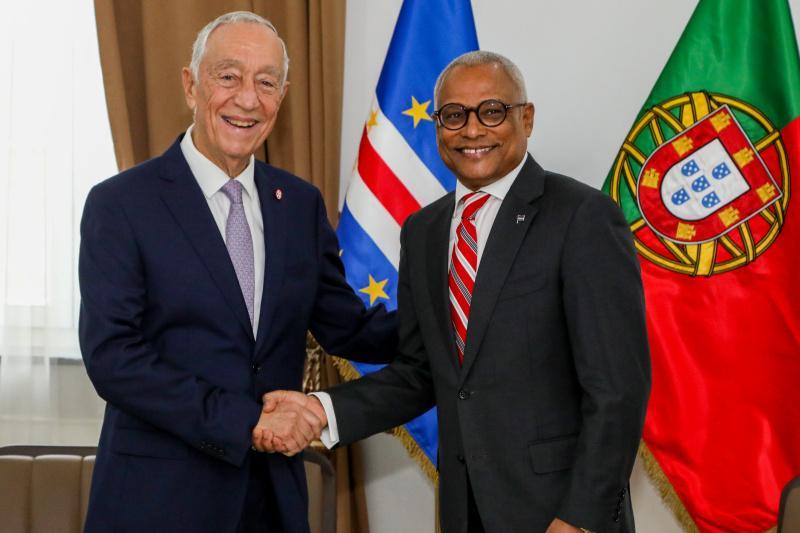
The President of Portugal, Marcelo Rebelo de Sousa, present at the invitation of his counterpart, also highlighted the importance of the Lisbon Agreement, describing it as “a decisive legal step on the path to Cape Verde’s independence.”
The President of the Republic of Portugal emphasized the transformation of relations between the two countries.
“Today we evoke an agreement that was not just a historic moment, but a turning point in relations between Portugal and Cape Verde. From a colonial relationship, we have become a partnership between sovereign states, linked by history, language and deep and genuine cooperation in areas such as health, education, economy and security.”
Marcelo Rebelo de Sousa praised Cape Verde’s trajectory after independence, “Cape Verde has been, for decades, a beacon of democracy and political stability in Africa. It is a major example of the transition to a stable multi-party and democratic constitutional framework.”
The Portuguese Head of State reaffirmed the commitment to cooperation between the two countries and concluded: “Long live Cape Verde! Long live the brotherly peoples and states of Cape Verde and Portugal, who today celebrate this milestone with an eye on the future, but with deep respect for the past that unites us.”
For More News And Analysis About Cape verde Follow Africa-Press