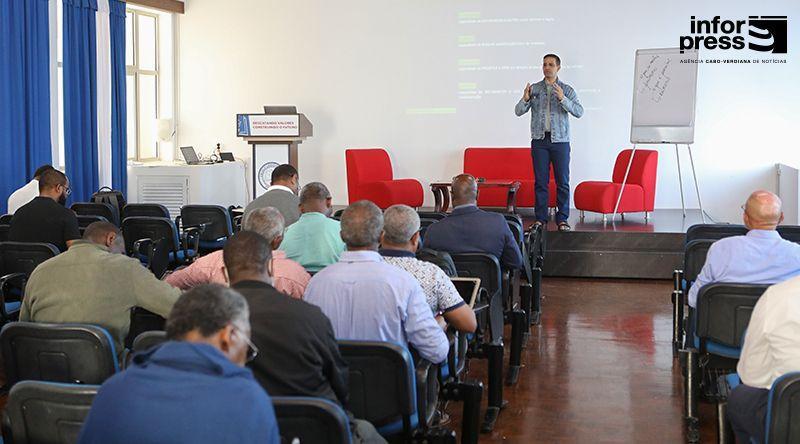
Africa-Press – Cape verde. Sixty-three clergy and deacons from the Diocese of Santiago are participating in a training course on Positive Psychology and Holistic Care in Praia, aimed at strengthening emotional balance and preventing burnout in the exercise of their ministry.
The initiative, which runs until Thursday the 12th, is promoted by the Catholic University School of Cape Verde (EU Católica) in partnership with the Catholic University of Pernambuco (Brazil).
The central objective is to promote the well-being of pastoral agents, providing them with resilience tools for a healthier service within their communities.
In an interview with Inforpress, the Vicar General of the Diocese of Santiago, Father António Martins, explained that this “clergy update” action follows the annual retreat and arises from the need to look at the human dimension of the priest.
Under the motto “Caring for those who care,” the training addresses crucial topics such as the prevention of burnout syndrome (professional exhaustion).
“Priests typically care for many people. Therefore, it is also necessary to care for those who care, those who have the Lord’s flock under their responsibility,” he said.
According to the vicar general, the most visible sign has been physical exhaustion, shared by many, but he acknowledges that there is still difficulty in clearly identifying other warning signs.
“We are tempted to frame exhaustion as something normal, typical of any work environment, and also of our pastoral service. We hope that, at the end of this training, we will have a greater capacity to identify other signs that we sometimes consider normal, but which may be indications of burnout,” he emphasized.
When questioned about the role of positive emotions as a protective factor against burnout and stress, Father Antônio Martins stated that ministry should be lived with joy.
“Our ministry is not a burden, but a gift that each priest gives himself. Embracing it with joy helps us to live it in a more balanced way,” he said.
Regarding the creation of support networks among clergy, he highlighted the importance of healthy practices and habits, such as mutual support, physical exercise, and “reflective pauses.”
“Sometimes it’s necessary to admit that we are tired, without feeling guilty. We can only take good care of others if we know how to take care of ourselves,” he emphasized.
In addition to prayer, he pointed to the practice of sports and moments of fellowship as important habits for maintaining emotional balance, believing that this training will bring new tools to strengthen the mental health of the participants and improve the exercise of ministry.
As for the message for clergy who feel at their limit, Father Antonio Martins stressed the importance of balance between pastoral work, prayer, and leisure, emphasizing that it is necessary to learn to say “no without feeling guilty.”
“We cannot perform our mission well if we are at our limit. Taking care of oneself is a condition for taking good care of others,” he concluded.
The training, which began today, is being given by Brazilian expert and professor at the Catholic University of Pernambuco (Brazil), Fabrício Cabral.
For More News And Analysis About Cape verde Follow Africa-Press