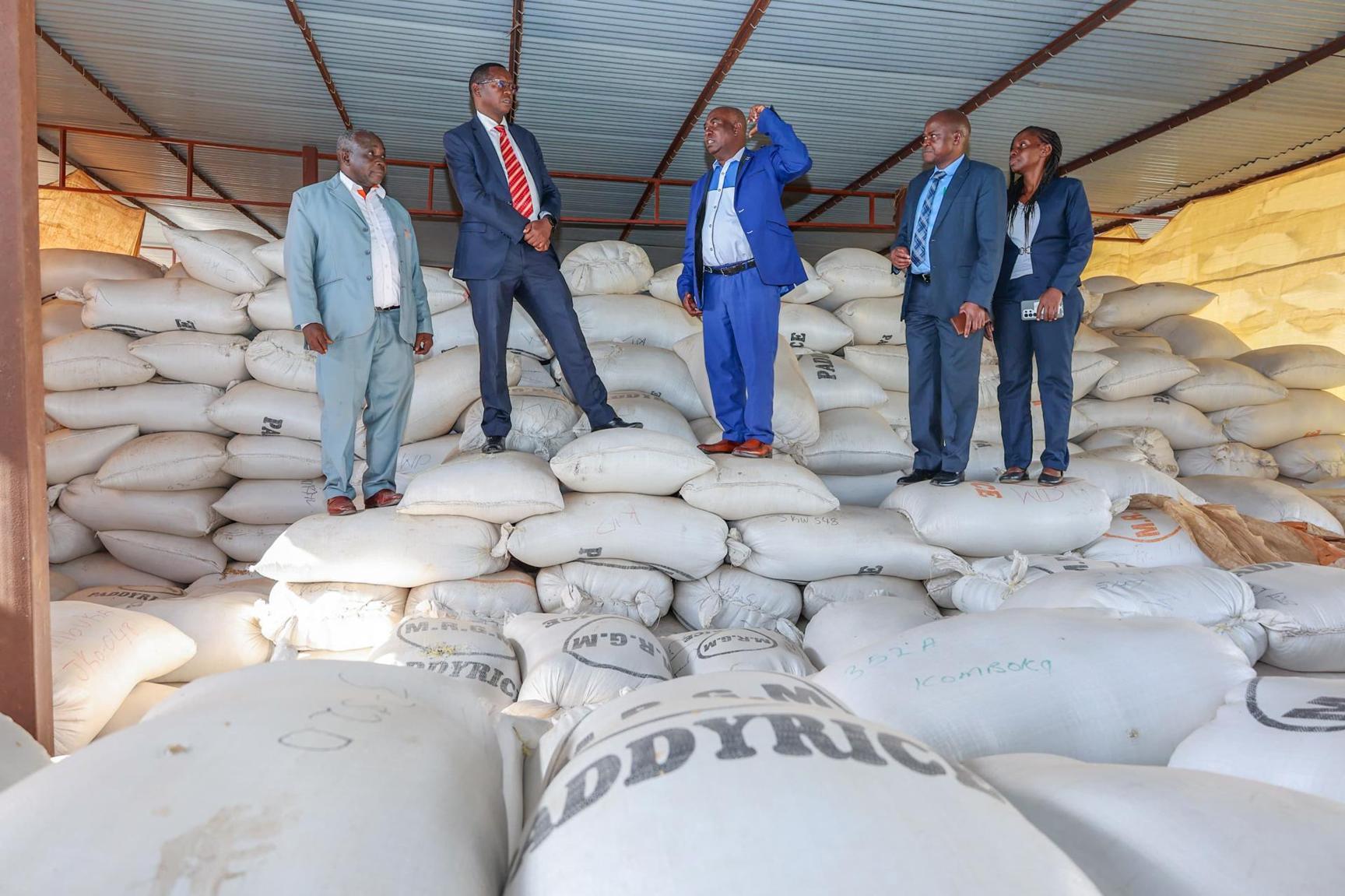
Africa-Press – Kenya. Chairman Rice Mwea Cooperative Society Muriuki Ndege, Agriculture and Food Authority (AFA) director general Bruno Linyiru, the cooperatives managing director Charles Muasya, AFA crop director Calistus Kundu and Kenya National Trading Corporation managing director Lucy Anangwe, during a rice mop up activity at the Mwea Rice Cooperative Society./Handout
Households are staring at high food prices as drought conditions hit key food-producing regions with domestic rice production being the most affected so far, amid a legal battle which is threatening to block emergency imports.
Rice has increasingly become a staple food commodity in Kenyan households, particularly in urban areas and Arid and Semi-Arid Land (ASAL) counties where climate stress has narrowed food choices.
With erratic rainfall disrupting planting cycles and reducing yields, rice prices are already showing signs of volatility, raising fears of a wider food inflation spiral that could spill over into maize and other staples.
According to data presented before the High Court, challenging importation of rice, Kenya’s rice deficit is structural, persistent and worsening.
National demand stands at between 1.3 and 1.5 million metric tonnes annually yet domestic production supplies less than 20 per cent of that requirement.
“If rice becomes unaffordable, households shift to maize, pushing up maize prices as well. Such knock-on effects could undermine national efforts to stabilise food prices and protect vulnerable populations,” the government said in its submissions to the court, presented by State Counsel Samuel Kaumba and Erick Theuri representing government.
According to data by the Ministry of Agriculture, the pressure is expected to intensify in the first half of 2026 (January to June).
Kenya will require about 750,000 metric tonnes of rice, but domestic production for the same period is projected at just 110,000 metric tonnes of paddy rice, a shortfall that cannot be bridged through local stocks alone.
The Ministry of Agriculture and Livestock Development’s Contingency Emergency Response Action Plan 2025 paints an even starker picture, projecting a rice deficit of 381,225 metric tonnes by the end of January 2026.
These supply gaps are unfolding against a backdrop of worsening food insecurity. By November 2025, an estimated 1.8 million people in ASAL counties were already experiencing high levels of acute food insecurity.
Without timely intervention, that number is projected to rise sharply to 3.5 million people, in what the state argues will be the human cost of delayed policy action.
Climate forecasts presented to the Court show erratic and below-average rainfall across key food-producing regions, disrupting planting calendars and sharply reducing yields.
For irrigated rice schemes such as Mwea, Ahero and Bunyala, reduced water availability has increased production costs and constrained output. In rain-fed areas, failed or delayed rains have wiped out entire planting seasons.
During detailed submissions before the High Court sitting in Kerugoya, State Counsel Samuel Kaumba, Erick Theuri and other government lawyers warned that rice prices could rise sharply if the court blocks imports needed to plug the widening national deficit.
The case, pits the government against substituted petitioners James Kamau Murango and David Munyi Mathenge, who are challenging Gazette Notice No. 10353 of July 28, 2025, which authorised the importation of rice on a duty-free basis.
The State told the Court that the lapse of the Gazette Notice had already triggered price volatility in non-basmati long-grain rice, with retail prices fluctuating sharply in the second half of 2025, a warning sign of what could follow if imports are blocked entirely.
Government lawyers argued that rising rice prices disproportionately affect low-income households, particularly in informal settlements and drought-affected counties, where food consumes the largest share of household income.
The Ministry firmly rejected claims that duty-free imports were designed to benefit a few individuals, maintaining that the policy was anchored in the Constitution’s obligations under Articles 21 and 43, which guarantee the right to food.
Blocking imports, the government has warned, would expose millions of Kenyans to higher food prices, reduced access to staple foods and heightened hunger, particularly in ASAL counties already grappling with drought.
Addressing claims that locally produced rice remains unsold, the Ministry explained that the mop-up of local rice has been ongoing, lawful and conducted in good faith through the Kenya National Trading Corporation (KNTC).
Since 2020, KNTC has purchased rice from cooperatives in Mwea, Ahero, Bunyala, Kuja, Kano and Bura, among other schemes, for redistribution to public institutions such as schools, hospitals and prisons.
However, the government was emphatic that even full absorption of available local stocks cannot bridge the national deficit nor stabilise prices countrywide.
“Localised surplus cannot be mistaken for national food security,” the State submitted, stressing that food security must be assessed at a national scale, not based on conditions in a single production zone.