
LAWI SULTAN
What You Need to Know
The article examines the impact of the Rosenhan Effect on Kenyan politics, highlighting how political labelling distorts public perception and undermines rational discourse. It argues that the 2010 constitution offers a framework to counteract these harmful labels, empowering citizens to reclaim their sovereignty and dignity in political discussions.
Africa-Press – Kenya. In 1973, psychologist David Rosenhan published a revolutionary study, ‘On Being Sane in Insane Places’. Between 1969 and 1972, Rosenhan conducted a radical experiment, enlisting eight sane individuals—including himself—to gain admission to psychiatric hospitals by feigning a single, vague auditory hallucination.
Upon entry, they immediately ceased all pretence and behaved normally, yet the system proved incapable of recognising their sanity; their ordinary actions were pathologised by staff, they were held for an average of 19 days and all were discharged with damning, lingering diagnoses like “schizophrenia in remission”.
In a masterful second act, when a challenged hospital boasted it could not be fooled, its staff identified 41 new patients as likely impostors over three months—Rosenhan had sent none, thereby proving his chilling thesis: that the power of the institutional label and context is so absolute it can completely override objective reality, a revelation that ignited a global debate on perception, authority and the very nature of diagnosis.
This is the Rosenhan effect: where the stickiest of labels, applied by an authoritative system, redefines a person and makes objective truth a casualty.
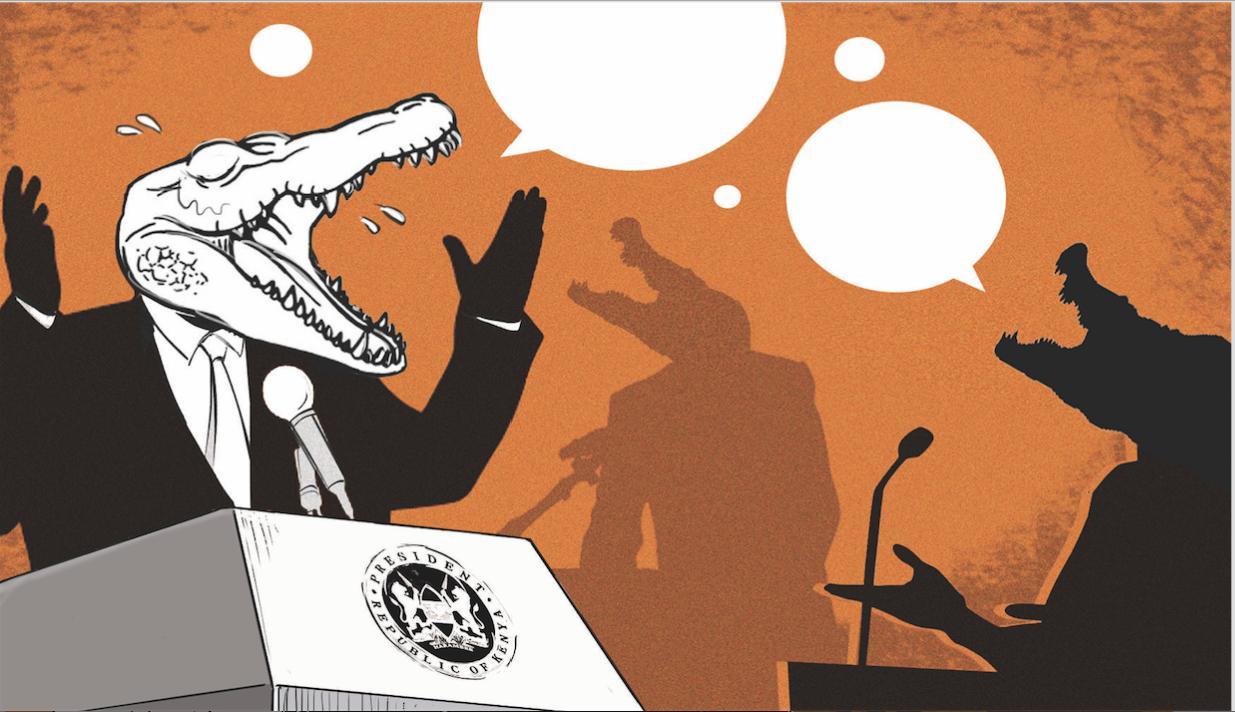
Walk through the halls of Kenyan politics and you will hear the echoes of this experiment. Our political discourse is a masterclass in pathological labelling. An opponent is not merely critical; they are a project, an enemy of development or a foreign agent. A community questioning a land acquisition is not exercising a right; it’s exhibiting backwardness.
Once applied, these labels become the primary lens. Every subsequent speech is incitement, every policy critique sabotage, every alliance a tribal conspiracy. The political institution, like Rosenhan’s hospital, validates the diagnosis and a large section of the media and populace begins to interpret all actions through this fabricated frame. The citizen, like the pseudopatient, struggles to be seen as sane within an insane system.
The cost is our collective reality. Debate devolves into diagnostic warfare, not over the merits of a policy, but over the alleged sickness of its proponent. We stop asking, “Is this financing model sound?” and instead argue, “Is he a patriotic visionary or a wantam traitor?” This is the Rosenhan trap: a cycle where labelling prevents rational assessment, entrenches divisions and makes the electorate passive consumers of manufactured narratives, rather than sovereign arbiters of their fate.
Yet, nestled in our national foundation lies a powerful prescription for this malaise. The 2010 constitution is, in essence, a profound anti-Rosenhan document. It is engineered to dismantle the architecture of arbitrary labelling and restore the dignity of the individual and the sovereignty of the public gaze.
Consider two pivotal clauses. Article 1(2) declares that sovereign power belongs to the people, exercised directly or through representatives. This is a direct reversal of the Rosenhan dynamic. It states unequivocally that the ultimate diagnostic authority does not rest with the political institution. It rests with us. We are not passive patients in the state’s hospital; we are its proprietors and supervisors. This article is the legal basis for rejecting political paternalism—the idea that a leader alone defines what is good or sane for the body politic.
Even more potent is Article 4(1): “Kenya is a sovereign republic”, a declaration that sovereignty resides not in a ruling class or institution, but in the collective body of the people. This directly counteracts the top-down, institutional power dynamic that the experiment exposed.
Together, these articles form a restorative framework: the first places ultimate authority in the people’s hands, flipping the diagnostic gaze, and the second protects the individual’s humanity from being erased by the sticky, distorting labels of political warfare. The constitution, thus, provides the blueprint for a polity where sovereign power is not the arbitrary diagnosis of a powerful institution.
But a prescription unfilled cannot cure. The bitter truth is that our political culture routinely violates this constitutional ethos. The “hospital” often resists its own cure. The loudest voices still trade in dehumanising tags, and a landscape of economic anxiety and fragmented media makes the electorate vulnerable to these simplistic diagnoses.
Therefore, our task is active restitution. It begins with a personal refusal to use or accept the political labels that violate human dignity. It demands that we, the sovereigns, use our power under Article 1(2) not just at the ballot, but daily—by challenging inflammatory rhetoric, by demanding issue-based scrutiny from our representatives, and by supporting institutions like the judiciary that are meant to impartially uphold Article 4(1).
Rosenhan’s lesson was that in a powerful system, the sane can be made to look insane by being told “you are naïve, you don’t know how things work”. Kenya’s constitution provides the blueprint to ensure our politics is a system where, finally, sanity—rooted in dignity, fact and sovereign will—can prevail.
Plot twist: Some of the actual patients in Rosenhan’s study detected the fake patients and would make comments at them, such as: “You are not crazy, you are investigating the hospital”.
In 1973, psychologist David Rosenhan conducted a groundbreaking study that revealed how psychiatric labels can distort reality and perceptions. His experiment involved sending sane individuals into psychiatric hospitals, where they were misdiagnosed and treated as mentally ill despite behaving normally. This study sparked a global debate about the nature of mental health diagnoses and the power of institutional labels.
The implications of the Rosenhan Effect extend beyond mental health, influencing various societal structures, including politics. In Kenya, the political landscape reflects similar dynamics, where opponents are often labelled in ways that hinder constructive dialogue. The 201
Source: The Star