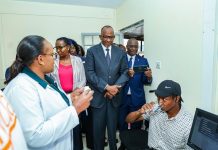

Africa-Press – Kenya. All primary healthcare services will now be clearly marked under a new Green Label Charter to ensure Kenyans receive fully government-funded services without hidden charges, Health CS Aden Duale has said.
The charter will be displayed in Level 2, Level 3 and selected Level 4 public health facilities.
“For primary healthcare, in order to completely stop co-paying — because it is fully paid for by the government — we are using capitation. What we are doing now is putting a green label charter at every Level 2, Level 3 and some selected Level 4 facilities,” Duale said.
“On top of the charter is written ‘walk in, walk out’. And you must give the items that are free — laboratory, diagnostics, seeing the doctor, vaccination, immunisation, HIV services — all these, up to medicine. The patient must be given free of charge.”
Duale said patients will now receive an SMS after visiting a facility to confirm whether they received all services due to them.
“For example: were you given outpatient consultation? Did you get diagnosis and treatment of common illnesses? Did you get basic laboratory tests? Did you get essential medicine?” he said.
“If there was a referral, were you told your case is more complicated and that you need to be referred?”
He said the new system empowers patients to question gaps in service.
“Before, the Kenyan did not know. Now he will know he is entitled to essential medicine. So he can go back to the facility and ask, ‘How come? Where is my medicine?’” he said.
Duale also announced strict enforcement measures through the Digital Health Agency (DHA), which now tracks patient treatment and medicine issuance in real time.
“If you go to your Afya Yangu, you have all the information of the patient — even the balance of his reimbursements,” he explained.
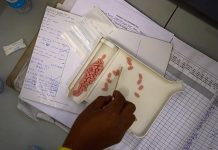
“We have seen a pattern where patients go through the hospital, go to the lab, see the doctor, everything is done, but they don’t get drugs.”
Duale cited data from two counties.
“We saw that in Kakamega, where 52,000 patients went through the county referral hospital and only 9,000 got medicine. We came to Bomet last week and close to 34,000 patients went through the hospitals, and only 4,600 got medicine,” he said.
He said the ministry has also identified collusion between health workers and private chemists operating near public hospitals.
“Either the drugs are stolen or there is collusion between hospital staff and the owners of those pharmacies,” the CS said.
Duale said going forward, hospitals that fail to issue prescribed medicines will face financial penalties.
“If you go through the system and you don’t get medicine, SHA will not pay for the medicine part of it,” he said.
“From the system, we can tell that the patient was not given medicine.”
Duale said the move aims to end the pharmacy diversion racket and ensure transparency, accountability and patient protection in public healthcare.