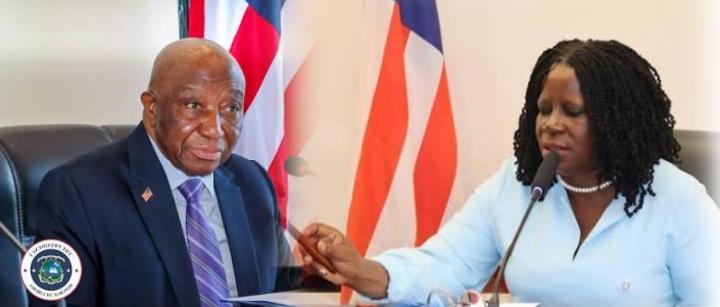
Africa-Press – Liberia. The Liberian Senate has again re-passed sweeping port reform legislation, pressing ahead in defiance of President Joseph Nyuma Boakai’s veto and intensifying a growing constitutional and political confrontation over the control, structure, and future of Liberia’s maritime governance system.
The Senate’s action signals a firm legislative resolve to dismantle the National Port Authority and replace it with a new regulatory and decentralized port management regime, despite sustained objections from the President and strong legal warnings from the Ministry of Justice.
The re-passed legislation consists of two interrelated measures, the Liberia Sea and Inland Ports Regulatory Authority Act of 2024 and the Liberia Sea and Inland Ports Decentralization and Modernization Act of 2024.
Taken together, the Acts repeal the National Port Authority Act, dissolve the National Port Authority, establish four autonomous seaports in Monrovia, Buchanan, Greenville, and Harper, and create a new Liberia Sea and Inland Ports Regulatory Authority with expansive oversight responsibilities over ports and maritime activities across the country.
The bills were introduced in the Senate by Grand Bassa County Senator and President Pro-Tempore Nyonblee Karnga-Lawrence. Their review and consideration were handled by a Joint Committee of the Senate, led by Montserrado County Senator H. Saah Joseph, Chair of the Transport Committee, and Sinoe County Senator Augustine Chea, Chair of the Judiciary Committee.
Before the re-passage vote, the Joint Committee informed the plenary that the President’s objections were largely limited to issues of nomenclature and formatting, including the table of contents, an assessment that critics say significantly minimized the depth and substance of the concerns raised in the veto message.
President Boakai returned the bills to the Legislature in accordance with Article 35 of the Constitution, stating that he acted “by virtue of the authority in me vested” and urging lawmakers to reconsider the measures in the broader interest of national stability and effective governance.
In his veto message, the President emphasized that the two Acts are legally and operationally inseparable, warning that autonomous ports cannot function properly without a clear, coherent, and constitutionally sound regulatory framework. He cautioned that passing one law without addressing defects in the other would create fragmentation, uncertainty, and institutional instability within the maritime sector.
Despite these warnings, the Senate proceeded to re-pass the legislation without materially addressing the defects identified by the President. This move has fueled accusations that lawmakers are weakening the constitutional role of the Executive by re-enacting substantially similar laws while disregarding the substance of a presidential veto.
Central to the dispute is a comprehensive legal opinion issued on July 14, 2025, by Justice Minister and Attorney General Oswald Tweh. In that opinion, the Attorney General acknowledged the Legislature’s constitutional authority to enact and repeal laws but warned that the proposed restructuring of Liberia’s maritime sector represents one of the most far-reaching institutional changes since independence and therefore requires careful constitutional scrutiny, practical assessment, and close coordination with the Executive.
The Attorney General warned that the Liberia Sea and Inland Ports Regulatory Authority Act creates a regulatory framework that departs sharply from both established domestic governance trends and international best practices.
The Act grants the proposed Authority broad powers to approve tariffs and fees, regulate port operations, oversee vessel and seafarer safety and security, implement international maritime conventions, and at the same time develop and operate port facilities.
According to the opinion, the convergence of regulatory, oversight, and operational functions within a single institution undermines regulatory independence and creates inherent conflicts of interest that could compromise effective maritime governance.
Equally troubling, the Attorney General stated, was the Legislature’s decision to exclude the Executive from the legislative process. While acknowledging that the Constitution does not require executive consultation prior to the passage of legislation, he warned that unilateral legislative action on reforms of such magnitude foregoes the benefit of executive expertise and institutional knowledge.
He noted that the President and executive agencies possess detailed familiarity with port operations, contractual obligations, and international maritime commitments, insight that could have strengthened the laws and reduced implementation risks.
The opinion further cautioned that when the Legislature acts alone to dissolve a major government agency and create multiple new entities, it places the Executive in a peculiar position of being constitutionally required to implement a system it had no role in designing.
This situation, the Attorney General warned, risks inefficiencies, administrative confusion, and suboptimal governance outcomes. He added that such exclusion could set a precedent for unilateral legislative action that gradually erodes cooperative governance and alters the balance of interbranch relations.
President Boakai echoed these concerns in his veto message, stating that the Attorney General’s warnings were not heeded. A major pillar of the President’s objection centers on the overlap between the proposed ports regulator and the Liberia Maritime Authority, an executive agency traditionally responsible for maritime safety, vessel inspection, seafarer certification, port security, and enforcement of international maritime conventions.
According to the President, the broad powers assigned to the new Regulatory Authority would significantly erode the Maritime Authority’s statutory mandate, rendering it partially redundant and leaving it with limited functions such as ship registration.
The President warned that transferring these responsibilities wholesale could lead to regulatory confusion, weaken Liberia’s compliance with international maritime obligations, and disrupt governance frameworks that have guided the sector for decades.
The Decentralization and Modernization Act further deepens the controversy by repealing the National Port Authority and replacing it with four autonomous seaports vested with extensive financial and administrative independence.
Under the proposed arrangement, each port would independently manage, operate, and develop infrastructure within its territorial limits, retain revenues from services rendered, and exercise broad control while coordinating with other government agencies.
President Boakai objected that the Act fails to provide adequate transition mechanisms for dismantling an authority with substantial assets, liabilities, long-term contracts, and a large workforce.
He warned that abruptly dissolving the National Port Authority and leaving transition decisions to a limited working group could result in legal disputes, operational disruptions, and financial uncertainty. He also cautioned that the proposed six-month transition period is insufficient and could violate Article 25 of the Constitution, which protects contractual obligations.
The President further pointed to internal inconsistencies in the legislation, including references to inland ports in the title without substantive provisions addressing them, a defect he warned could necessitate repeated amendments and generate future confusion.
The Senate’s decision to re-pass the bills has reframed the dispute as a direct constitutional test of Article 35, which grants the President authority to approve or disapprove legislation before it becomes law. Critics argue that while the Legislature may override a veto through constitutional procedures, re-enacting materially similar legislation without curing identified defects undermines the spirit of checks and balances.
Political pressure has also mounted, with Unity Party USA and Canada accusing lawmakers of treating the veto as a mere editorial suggestion rather than a constitutional warning.
The group described the Senate’s action as legislative indirection, arguing that the restructuring effectively removes executive oversight and displaces presidential appointees without due process or executive concurrence.
Further fueling the controversy are allegations that key executive and economic stakeholders were sidelined even after the veto. Senior officials at the Ministry of Finance and Development Planning, the Ministry of Commerce and Industry, the Liberia Revenue Authority, and the National Port Authority were reportedly not invited to review or comment on revised drafts.
Critics argue that ports are national gateways central to customs administration, revenue collection, immigration control, and national security, and that fragmenting their governance without broad consultation risks weakening coordination and accountability.
As the bills advance toward final constitutional procedures, the standoff underscores a deepening struggle between the Legislature and the Executive over authority, consultation, and governance philosophy.
The outcome is expected to have far-reaching implications not only for Liberia’s maritime sector but also for the future balance of power between the branches of government.
For More News And Analysis About Liberia Follow Africa-Press