Africa-Press – Liberia. The United Nations Security Council on Monday held an emergency session to discuss the escalating political situation in Venezuela following the capture and detention of President Nicolás Maduro and his wife, developments that have drawn widespread international concern.
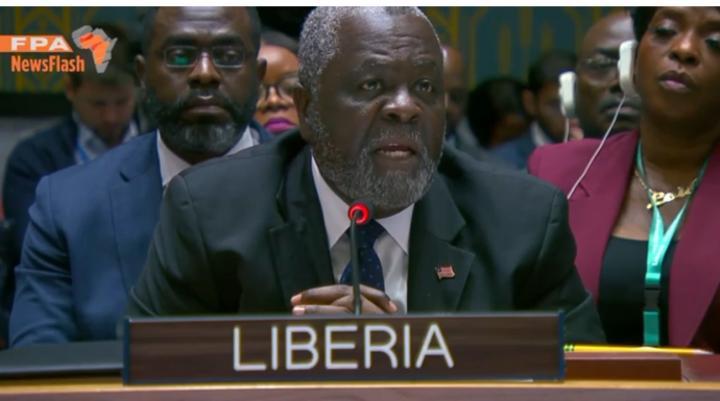
Liberia’s Permanent Representative to the United Nations, Ambassador Lewis Brown, addressed the Council on behalf of the A3 members—Democratic Republic of Congo, Somalia, and Liberia—warning that the unfolding events pose serious risks to Venezuela’s internal stability and to regional and international peace and security.
The meeting, convened under Somalia’s presidency of the Council, brought together UN member states, regional organizations, and civil society representatives to assess the rapidly evolving situation. Ambassador Brown welcomed briefings from UN officials, including Under-Secretary-General for Political and Peacebuilding Affairs Rosemary DiCarlo, and commended the Council for responding promptly to the crisis.
Citing a recent communiqué from the African Union, the A3 expressed concern over developments surrounding the detention of Venezuela’s president and disruptions to state institutions. Ambassador Brown underscored the importance of upholding international law, particularly the principles of sovereignty, territorial integrity, and political independence as enshrined in the UN Charter.
“The complex situation in Venezuela presents serious challenges not only to the country’s internal stability but also to peace and security in the region,” Brown told the Council, emphasizing that respect for constitutional order and institutional processes is critical to preventing further escalation.
The A3 called on all parties to exercise restraint and urged a comprehensive, inclusive, and nationally owned approach to resolving the crisis. Ambassador Brown stressed that a sustainable solution can only emerge through dialogue among Venezuelans themselves, supported by the international community and grounded in respect for the rights and aspirations of the Venezuelan people.
Reaffirming solidarity with the Venezuelan population, the A3 echoed the African Union’s commitment to peace, stability, and mutual respect among nations. Brown concluded by stating that the group stands ready to work with the Security Council and regional partners to support efforts toward a peaceful, inclusive, and lasting resolution.
The situation in Venezuela marks one of the first major international crises debated since Liberia and four other countries assumed their roles as non-permanent members of the Security Council.
Global Reactions Intensify
Meanwhile, reactions to the U.S. military action and arrest of President Maduro and his wife, Cilia Flores, have continued to reverberate globally.
United Nations Secretary-General António Guterres earlier warned against actions that undermine international norms, stressing the need to respect national sovereignty, political independence, and territorial integrity. He cautioned that such developments risk setting a dangerous precedent for the international system.
In West Africa, the Economic Community of West African States issued a statement expressing concern over recent developments in Venezuela. The regional bloc urged adherence to international law while acknowledging the global fight against transnational crime.
“While recognizing the right of states to combat international crimes, including terrorism and drug trafficking, ECOWAS reminds the international community of its obligation to respect the sovereignty and territorial integrity of states,” the statement said, citing Article 2(4) of the UN Charter.
ECOWAS aligned itself with the African Union’s position issued on January 3, 2026, which called for restraint and inclusive dialogue among Venezuelans.
Debate Within the United States
The reported operation has also sparked debate within the United States, where several lawmakers questioned its legality and broader implications.
Representative Thomas Massie of Kentucky called for congressional authorization before any military engagement, warning against unilateral action. Senators Rand Paul and others echoed concerns about executive overreach, citing constitutional limits on the use of military force.
Some lawmakers supportive of U.S. foreign policy objectives nonetheless urged caution, emphasizing the need to preserve constitutional processes and avoid prolonged conflict.
Latin America and Global Powers Respond
Across Latin America, reactions have been mixed. Brazil’s President Luiz Inácio Lula da Silva condemned the reported action, describing it as a violation of Venezuela’s sovereignty and international law. Mexico, Chile, Cuba, and Uruguay also rejected unilateral military intervention, calling instead for dialogue and negotiation.
By contrast, leaders in some countries welcomed the development, arguing it reflected the will of the Venezuelan people as expressed in previous elections.
Major global powers also weighed in. Russia described the incident as a serious violation of international law, while China expressed concern over the use of force. European Union officials urged restraint, emphasizing that all actions must remain consistent with the UN Charter and international law.
Calls for Venezuelan Self-Determination
As diplomatic efforts intensify, ECOWAS reiterated its support for the Venezuelan people’s right to determine their own future without external imposition.
The growing international response highlights concerns that the capture of a sitting head of state by foreign forces could set a precedent with far-reaching implications for global peace and security.
For More News And Analysis About Liberia Follow Africa-Press