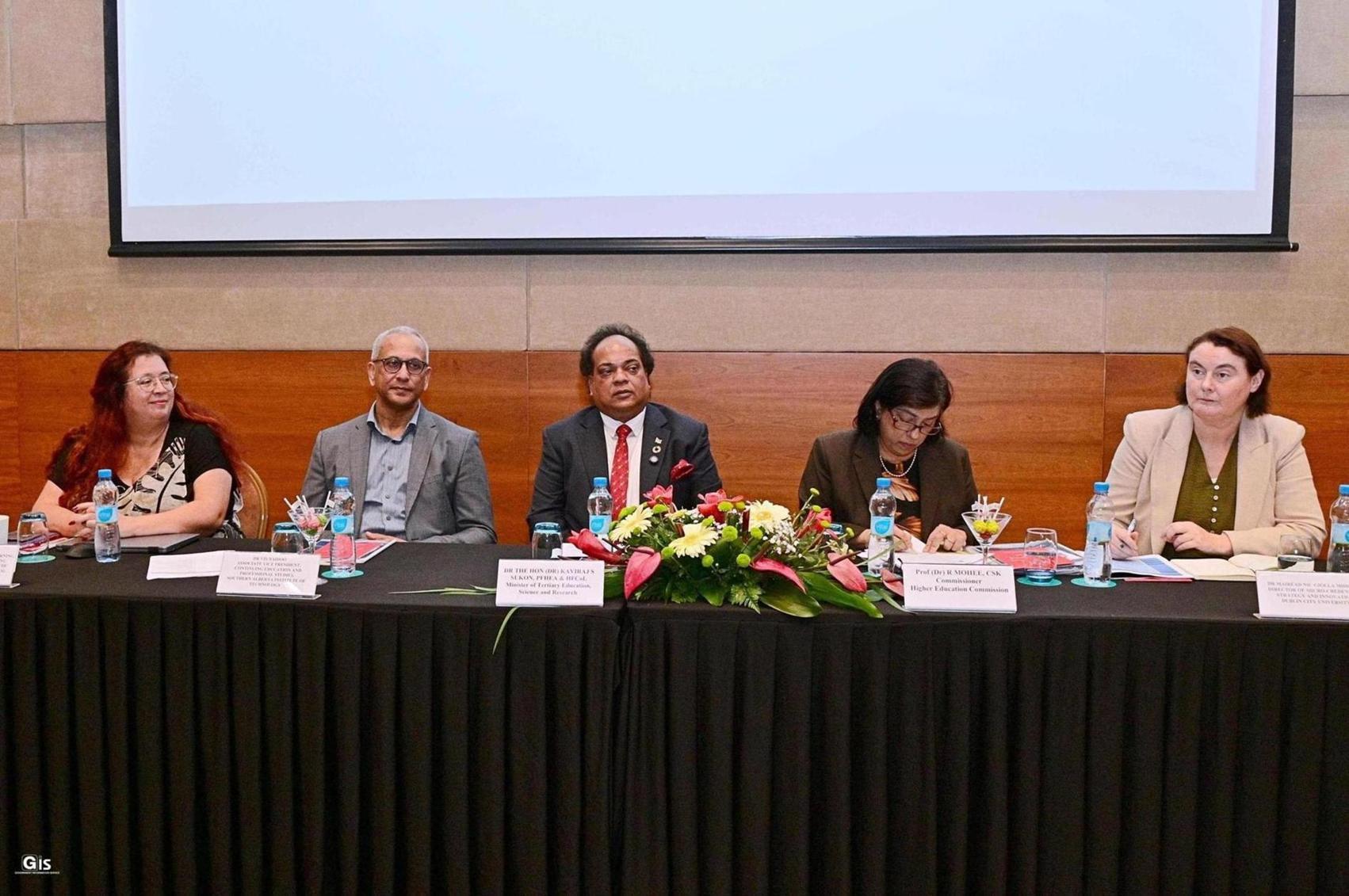
Africa-Press – Mauritius. A three-day workshop bringing together academia, industry leaders and regulators to collaboratively design short learning programmes known as micro-credentials in response to labour market demand, kicked-off this morning at the Ocean’s Creek Beach Hotel in Balaclava.
The opening ceremony was attended by the Minister of Tertiary Education, Science and Research, Dr Kaviraj Sharma Sukon, the Commissioner of the Higher Education Commission (HEC), Professor Roomeela Mohee, as well as representatives from the public and private sectors.
The workshop which will last till 30 January 2026 is being facilitated by three resource persons from Canada, Ireland and Australia who will share practical sessions on quality assurance and assessment to co-design micro-credentials.
Addressing participants, Minister Sukon reaffirmed Government’s recognition of micro-credentials as an accepted mode of learning that certify specific skills and competencies to address mismatch in the labour market. Micro-credentials complement traditional degrees, allowing learners to gain industry-relevant expertise in short timeframes while enabling employers to identify candidates with job-ready skills, he said.
According to the Minister, micro-credentials will further strengthen linkages between graduates and employers, ensuring that graduates leave higher education institutions with both academic qualifications and recognised professional credentials that are essential for today’s job market.
Referring to recent initiatives, Dr Sukon mentioned that the Higher Education Act has been amended to recognise micro-credentials in Higher Education. Consequently universities will revise their syllabus in 2026 for the implementation of a new curriculum as from January 2027. He also spoke of amendments brought to legislation last year allowing all universities to use the National Credit Value and Transfer System for a uniform credit framework.
For her part, HEC Commissioner Mohee dwelt on the importance of this collaborative approach regrouping academia and industry leaders to design and deliver higher education micro-credentials, contributing significantly to bolster the scalability and sustainability of these programmes.
Professor Mohee reaffirmed the HEC’s role commitment to skills-driven education, employability and lifelong learning. She recalled thar micro-credentials are gaining global recognition as a flexible means to upskill, reskill, and support lifelong learning in rapidly evolving sectors. “This workshop is about ensuring that what is offered is trusted, well-designed and clearly linked to the skills our economy needs”, she added.
Through this workshop, the HEC seeks to ensure that such programmes in Mauritius are relevant, credible, and jointly shaped by academia and industry. A key outcome will be six pilot micro-credentials in priority sectors, namely Tourism, Information Technology, Finance, Artificial Intelligence, Human Resource Management, and Nursing and Health Care.