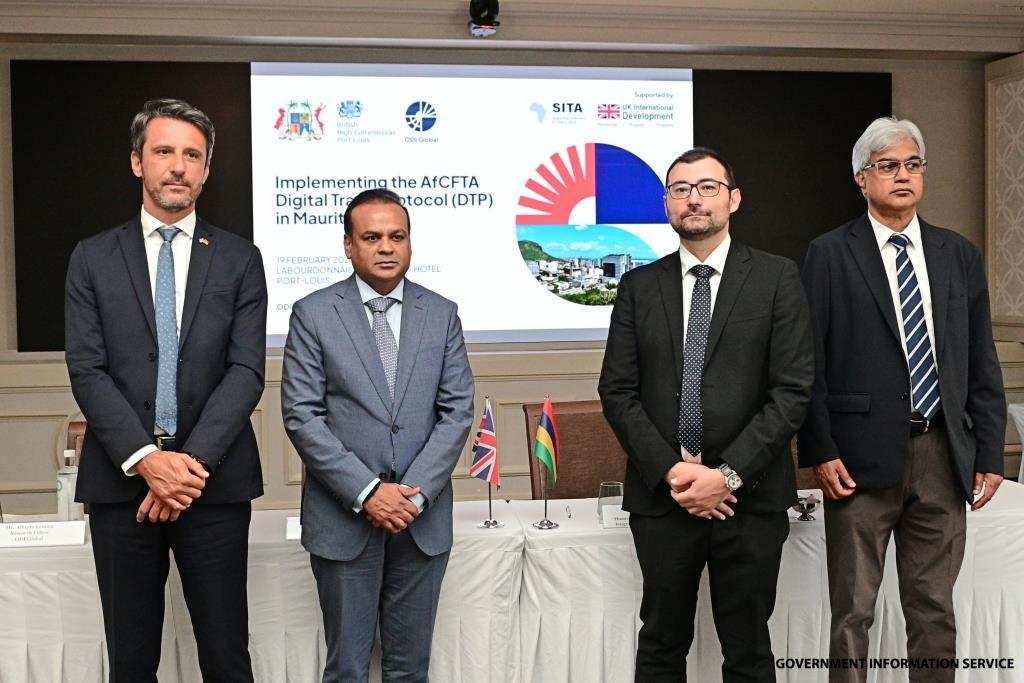
Africa-Press – Mauritius. A validation workshop on ‘Implementing the African Continental Free Trade Area (AfCFTA) Digital Trade Protocol in Mauritius’ was held, today, at the Labourdonnais Waterfront Hotel in Port Louis. Organised by the Ministry of Foreign Affairs, Regional Integration and International Trade in collaboration with the Overseas Development Institute (ODI) and the British High Commission in Mauritius, the workshop aims at advancing national preparations for the effective implementation of the AfCFTA Digital Trade Protocol.
The workshop forms part of technical assistance being provided to Mauritius since August 2025 by the Foreign, Commonwealth and Development Office under the Supporting Investment and Trade in Africa (SITA) programme. This support includes a comprehensive assessment of the country’s legislative framework, digital infrastructure and institutional capacity, which is intended to inform a practical and coherent national implementation strategy for the Protocol.
The opening ceremony was attended by the Minister of Foreign Affairs, Regional Integration and International Trade, Mr Dhananjay Ramful; the Chargé d’Affaires of the British High Commission in Mauritius, Mr Goran Mandic; and the Research Fellow at the ODI Global, Mr Alberto Lemma, among others.
In his address, Minister Ramful stated that the AfCFTA has entered a decisive implementation phase, with recent African Union’s decisions urging Member States to advance the Phase II protocols, including digital trade. He recalled that the Protocol on Digital Trade is central to Africa’s integration agenda, as it enables interoperable digital payments, harmonised e-commerce rules, and robust data protection and cybersecurity frameworks necessary for facilitating cross-border digital trade.
Highlighting Mauritius’s ambition to establish itself as a high-income digital hub, the Minister noted that the Digital Trade Protocol aligns closely with national efforts to modernise the digital economy and expand continental market access for Mauritian enterprises, including small and medium-sized enterprises and technology startups. He also welcomed the United Kingdom’s support under the SITA programme, observing that the ongoing assessment provides a solid evidence base to address regulatory and infrastructure gaps and to position Mauritius as a trusted gateway for digital trade and investment in Africa.
For his part, the Chargé d’Affaires spoke about the strong economic partnership between Mauritius and the United Kingdom and the growing importance of digital trade in shaping modern economies. He underlined opportunities in cross-border digital services, fintech, digital identity, electronic signatures, and data-driven technologies to enhance investment, streamline transactions, strengthen regulatory cooperation, and build resilient supply chains.
Referring to the ODI Global assessment, Mr Mandic noted that Mauritius has a solid digital foundation and the potential to become a regional digital leader, while also identifying areas needing further progress such as cross-border data flows, trust services, and online dispute resolution. Mr Mandic stressed that the workshop is a crucial platform for stakeholders to provide input, ensuring locally driven