Africa-Press – South-Sudan. Women entrepreneurs in South Sudan face a crippling combination of cultural barriers, structural bias, and weak law enforcement that prevent them from scaling their businesses and accessing vital bank financing.
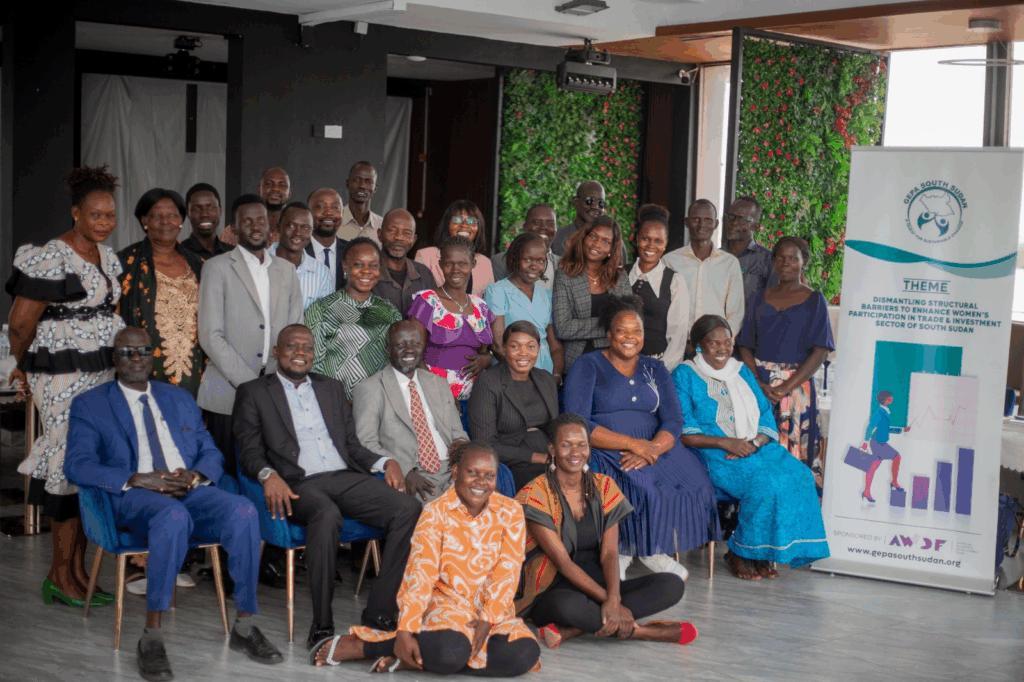
These challenges were the central focus of a one-day event in Juba, on Wednesday, December 3, themed “Dismantling Structural Barriers to Enhance Women’s Participation in Trade and Investment”.
The event that brought together policymakers, legal professionals, human rights defenders, and civil society representatives was organised and supported by Global Empowerment for Poverty Alleviation (GEPA).
Liz Nelson, General Manager, Dream Farms Agribusiness, urged women entrepreneurs to be creative, advising them to consider using their gold (jewellery) as initial capital to grow their ventures.
She described financial formality as the primary obstacle for businesswomen, pointing out that the failure of many women to properly register and document their business activities with relevant authorities makes it nearly impossible for them to secure loans from banks.
The General Manager of Dream Farms Agribusiness explained the dilemma: “Access to capital is the biggest issue. When [women] approach financial institutions, they struggle because banks require documentation and collateral.”
She stated that the high cost of formalization is a critical hurdle, saying that since most women start small businesses from home without formal documentation, they are automatically disqualified from financing.
Liz stated that registering a business name alone costs at least $700, forcing many women to choose between paying the registration fee and using that money as starting capital.
The General Manager suggested that women who cannot afford company registration should instead register cooperatives with their peers, which is cheaper and can still provide access to certain financial opportunities.
Advocate Dier Benen Chol, who spoke during the event, stated that the challenges extend beyond finance into deep-rooted societal expectations. She noted that structural barriers include societal norms that view women as weaker, limiting them to small-scale businesses with minimal capital.
The advocate also noted the struggle of balancing family responsibilities with business demands: “Culturally, women are still expected to remain at home and avoid interacting with men. Society places women in a restrictive ‘box’ and labels them as weak or easily harassed.”
She stated that this mindset undermines women’s ability to expand and be taken seriously, limiting them to small-scale activities with minimal financial growth.
Betty Pony Christopher, Deputy Chairperson for Gender and Social Welfare in the Central Equatoria State Transitional Legislative Assembly, affirmed that multiple barriers prevent women’s active participation in business.
She listed key challenges that include longstanding traditions that dictate women must stay home, discouraging entry into trade, and adding that women were historically denied education and confined to household roles.
The lawmaker stated that even educated women face resistance from men who insist they should not engage in economic activities, a mindset rooted in cultural attitudes.
Deputy Chairperson Betty stressed that while South Sudan possesses good policies, the major problem is implementation. She called for the passage and enforcement of strong legislation, such as the gender bill and the women’s empowerment bill.
Hon. Betty also called for urgent government support, including refunding capital, for women who lost their livelihoods in the recent Customs Market fire.
Medina Charity, Owner of Medina’s Kitchen, highlighted the daily pressures faced by female entrepreneurs. She stated that the struggle to balance small business demands with personal and family life often leads to mental stress.
She says many low-income women lack knowledge about financial products and services, preventing them from accessing available opportunities.
According to Charity, women-owned businesses are affected by the “pink tax”—higher prices for female-use products—and suffer from unfair treatment by city councils, including demands for high fees for even the smallest businesses.
She added that women avoid working at night due to insecurity, which limits their participation when goods arrive late.
Ms Charity noted that over half of women cross-border traders face violence and harassment from border officials and police, and women frequently face harassment in markets and during product transportation.
Ayot Jennifer, Social Inclusion Manager at GEPA South Sudan, reiterated that unfavourable trade and investment policies compound the issues.
She stated that existing government programs meant to support small-scale enterprises are often marred by issues of bureaucracy, implementation flaws, and corruption.
Jennifer emphasized that the economic structure and excessive over-taxation by the city and licensing councils limit growth.
According to Jennifer, profits intended for reinvestment are often consumed by sudden, excessive, or double taxation, pushing many women out of the sector.
Ms. Jennifer concluded that meaningful change must start at the grassroots level, empowering indigenous and vulnerable women to participate practically and fully in the economy.
For his part, Advocate Chol emphasized that inclusion in collective organizations is paramount, urging women to participate in unions, chambers of commerce, and associations.
She stated that being part of these bodies allows women to voice their experiences, advocate for reforms, and push for the implementation or revision of ineffective laws.
For More News And Analysis About South-Sudan Follow Africa-Press