

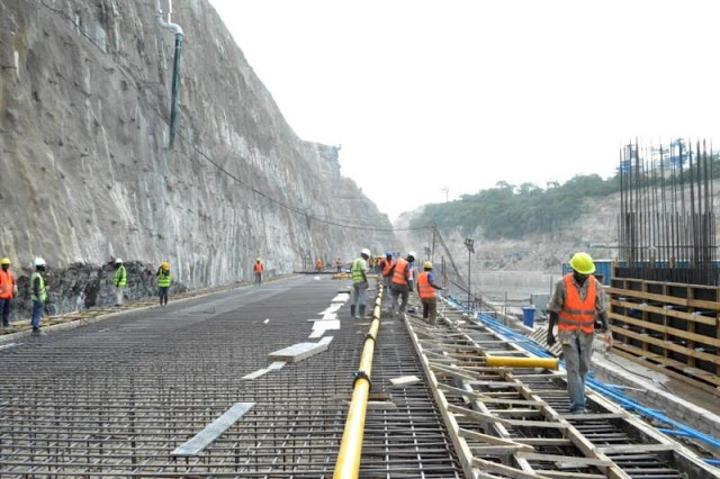
Africa-Press – Tanzania. THE government has allocated 1.4tri/- for the ongoing construction of 2,115-MW Julius Nyerere Hydropower Project (JNHPP) which reached 52 per cent of implementation stage by May, this year.
Minister for energy, Dr Medard Kalemani told the Parliament yesterday that the government is committed to completing the project on time. Dr Kalemani tabled 2.386tri/- Ministry’s budget for the coming 2021/22 fiscal year.
He said in the coming financial year, the project implementation will focus on the construction of the main dam, spillways, tunnels, power house and switch yard, adding: “The government is committed to releasing the required fund on time to avoid any delays.”
According to Dr Kalemani, upon the completion of the project, the country will hugely boost the power pool for socio-economic development. He told the Parliament that the project will cost a total of 6.55tri/- to its completion, and that so far the government has already released 2.49tri/-.
Dr Kalemani stated that the construction activities were ongoing; pointing out that 27 turbines will be installed in the power house. Currently, the work involves strengthening concrete walls for tunnels to allow water pass for generation of the turbines.
The minister further said the required equipment have already been shipped into the country. “The equipment is already at Dar es Salaam Port and the base, where the turbines will be installed have already been constructed,” he noted.
Elaborating, the minister said the exercise of filling 32.3 billion litres of water into the dam is expected to begin as from November 15, this year to April 23, next year followed by trials in May before going for full operations.
Moreover, he noted that the completion of the project will provide various economic opportunities to be tapped as in fishing, tourism and farming sectors.
The project is carried out by two Egyptian contractors- Elsewedy Electric and Arab Construction- who on different occasions vowed to implement the project on time by continuing to work hard to achieve the goals.
The JNHP will be the largest electricity scheme installed in East Africa and among the largest in Africa in comparison to Egypt’s Aswan High Dam (2100 megawatts), Mozambique’s Cahora Bassa Dam (2075 megawatts) and Angola’s Lauca Dam (2069 megawatts).
The project is expected to transform the country through the generation and supply of reliable electricity for both domestic and industrial use, besides making the country to improve in its manufacturing sector competitive.
On the availability and distribution of petroleum products, Dr Kalemani stated that the supply has been stable and that as of April this year, imported litres stood at 3.14 billion in comparison to 3.11billion litres of the same period in 2019/20.
He said the government is applying control measures through modern flow meter technology in which one can get the actual litres when ships are offloading the products, and thus ease revenue collection and other charges.
Dr Kalemani said the state of an art flow meters have been fixed at the ports in Dar es Salaam, Tanga and Mtwara, adding that his office has already instructed the Energy and Water Utilities Regulatory Authority (EWURA) to direct petroleum importing companies to install the gadgets in their reserve tanks.
He told the Parliament that there is increased use of Liquefied Petroleum Gas – LPG in households that is a blessing for environment conservation, as it reduces the chances of using charcoal and fire woods as source of cooking energy.
Dr Kalemani said the government is working out on the best modality and practice including scrapping some of the levies and taxes charged by public institutions, when one wants to construct a gas station so that more investors could be attracted to allocate services closer to the communities.