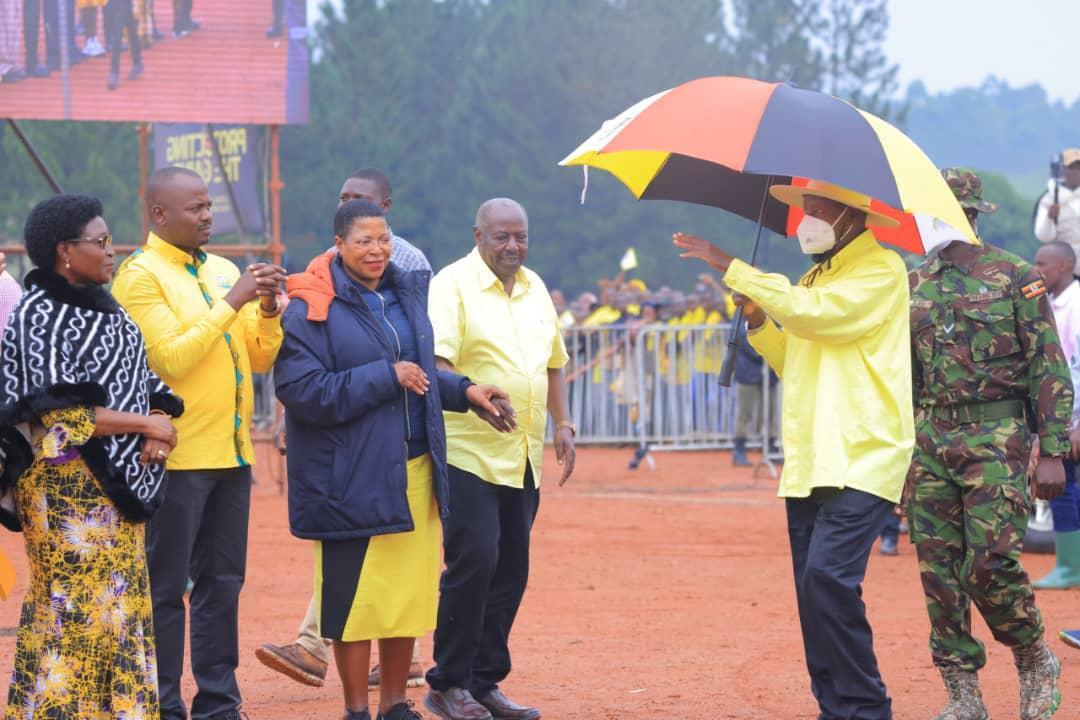
Africa-Press – Uganda. President Museveni on Tuesday once again returned to Kyankwanzi, one of the battlegrounds of the bush war, as he canvassed for support ahead of the 2026 elections.
Speaking at the soggy Butemba College School playgrounds in Kyankwanzi District, Museveni applauded NRM supporters who braved heavy morning rains to attend the rally.
“I thank you, the people of Kyankwanzi, for showing the world that you are grandchildren of fighters. You have shown that when we, the fighters, decide to do a thing, we do it with our whole heart. It was raining heavily, but you came in big numbers. Thank you,” Museveni said.
He said when the NRM came to power, its first major contribution was peace, which he described as the springboard for everything Kyankwanzi has achieved.
“As people of Luweero know what peace means, we saw the 1966 crisis when Obote fought with Muteesa. In 1971, there was fighting between Amin and Obote, and other wars in 1979 and from 1981 to 1986. Now it is 40 years, and this area is peaceful,” he said.
“A child who was born when we had just captured power grew up, gave birth to children, and those children have also given birth to other children, and the entire lineage has never seen war.”
Museveni added that whereas a number of neighbouring countries have been at war for many years, Uganda has remained an island of peace, which he credited to the NRM ideology of politics of interests rather than identity.
He said this approach led to the creation of a mass political party and strong government institutions such as the army, police and prisons.
He noted that unlike past governments, the NRM does not believe in sectarian politics based on tribe or religion and has also addressed the marginalisation of women.
“In 1962, in Parliament, there were 90 MPs with only two women: Florence Lubega from Mityana and an Indian called Vizram. Right now, many women are in Parliament. This is all the work of the NRM,” he said.
Museveni told the gathering that one can easily audit what the NRM has done for Kyankwanzi in the last 40 years since it came to power.
“When the NRM came to government, tarmac ended at Busunju, and the Busunju–Kampala road was deteriorated, but we have done it twice. We extended tarmac from Busunju to Kiboga, Kafu and Hoima up to Lake Albert. Buliisa and Kaisotonya are all tarmac. On the other side, tarmac ended in Mityana, but we have taken it to Fort Portal, then Bundibugyo up to Lamia,” he said.
He also mentioned the Kampala–Mubende–Kyankwanzi road, which is currently being repaired.
“No other government had done it until the NRM came to power,” he said.
The President expressed happiness that out of the 21 sub-counties in Kyankwanzi, only three do not have electricity.
He explained that the government’s plan was to first extend power to district headquarters and then to sub-county headquarters, from where it can easily be extended to villages.
“Whereas it might not have reached all villages, as fighters, we don’t handle all things at ago,” he said.
Museveni said that out of the 486 villages in the district, 420 now have access to safe water, representing 84 per cent coverage. He noted that the remaining villages would receive clean water in the next term.
He advised locals to make use of nearby swamps for irrigation while protecting them.
“Make use of nearby swamps to get water for irrigation. In order to get water for irrigation, you must protect swamps. We are to introduce irrigation systems here using water from swamps. We shall pump water to the hills and, using gravity flow, it will help you irrigate,” he said.
On health, Museveni pledged to upgrade several health centres and construct new ones in Kyankwanzi as part of efforts to improve healthcare.
Despite these strides, Museveni emphasised that wealth creation remains key.
“Development benefits everyone, but poverty or wealth benefits you as an individual. Create wealth for yourselves,” he said.
He cited George Matongo, a farmer from Ngoma, saying that although he is not educated and lives far from major infrastructure, he has been able to create wealth.
“Matongo sells 900 litres of milk per day and earns Shs21 million per month and Shs250 million per year. He has built a house and educated his children, yet he is over 70 miles away from the nearest tarmac. Development in his area is not as good as here, where you have electricity, water and tarmac, but he is wealthy. You too can emulate him,” Museveni said.
He said the government has for a long time been sending funds, including Bonna Bagaggawale, Entandikwa, Operation Wealth Creation and now the Parish Development Model, to help the population create wealth.
“Other countries construct schools, roads and health facilities and end there, but the NRM helps you to get out of poverty. No other government helps you to get out of poverty. In Kisozi, I had to beg my neighbours to work hard, and they are now wealthy. Apart from funds, we have been advising people on what to do to get out of poverty,” he said.
Museveni noted that individual wealth has a ripple effect on national development.
“If one person becomes wealthy and another does the same, the entire country benefits. For example, Uganda now produces 10 million bags of coffee, compared to three million bags in 1986. When individual wealth comes together, the country benefits,” he said.
He urged Ugandans to take advantage of programmes such as the Parish Development Model and Emyooga to improve their livelihoods.
“NRM has done wonders for Uganda, moving it from where it was to where it is now. Support the NRM to continue on this trajectory,” Museveni urged.
For More News And Analysis About Uganda Follow Africa-Press