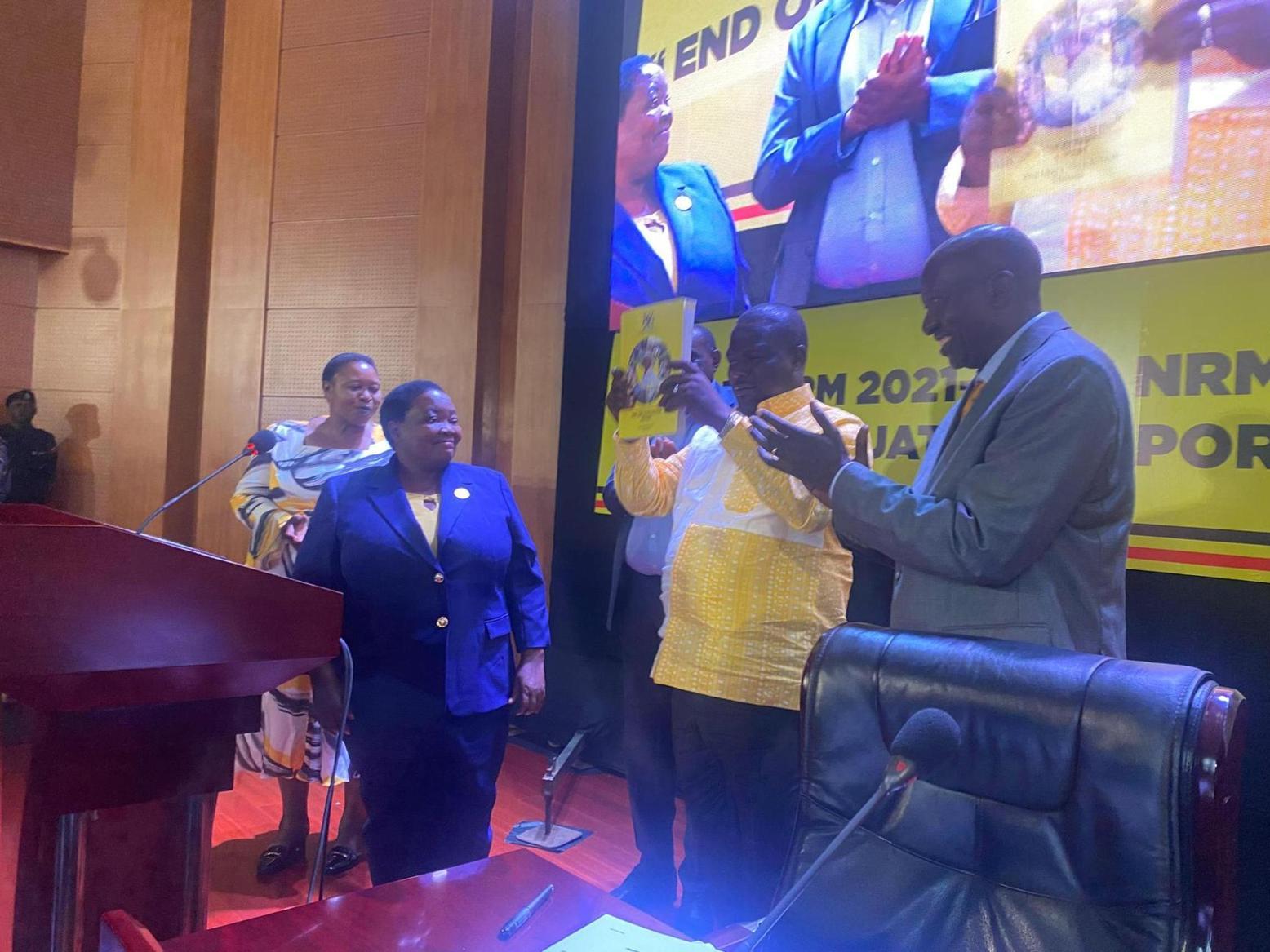
Africa-Press – Uganda. The Secretary General of the National Resistance Movement (NRM), Richard Todwong, has defended the government’s record, citing an 89% implementation rate of the party’s 2021–2026 manifesto and describing it as a historic milestone in accountability.
Todwong made the remarks after receiving the manifesto implementation report from Prime Minister Robinah Nabbanja, noting that it marked the first time such a comprehensive report had been formally handed over to the party secretariat.
“This is the first time in the record of NRM that we are receiving a report on how our manifesto has been implemented,” Todwong said, emphasizing the importance of manifestos in Uganda’s multiparty political system.
He argued that political competition in Uganda is fundamentally driven by ideas contained in party manifestos, which are derived from long-term national frameworks such as Vision 2040 and the National Development Plan.
“When Ugandans vote, they are voting for ideas contained in manifestos. The winning party then hands over that manifesto to government for implementation,” he said.
Todwong linked the ruling party’s continued electoral success to what he described as effective service delivery, saying voter confidence reflects satisfaction with government performance.
Despite the high score, he acknowledged that 11% of the manifesto commitments remain unfulfilled, a gap that has attracted criticism from sections of the public.
“Governance is a continuous effort. We improve where we have done wrong,” he said.
He identified corruption as a persistent challenge affecting public perception of both the party and government, calling for collective responsibility among public officials and private sector actors.
“You can have good policies, but people will still say NRM is corrupt,” he noted.
Looking ahead, Todwong outlined an ambitious economic vision, projecting that Uganda could grow into a $500 billion economy within the next decade if key sectors are effectively leveraged.
He said the next manifesto cycle would prioritise “trigger sectors” to accelerate growth, building on projections that place the economy at about $68 billion by mid-2026.
Among the priority areas highlighted are wealth creation, land reforms, resolution of land ownership disputes, value addition, agricultural productivity, and investment in science and technology.
Todwong stressed that technological advancement is central to economic transformation, describing it as the engine that drives societies through different stages of development.
He added that government will intensify efforts to reduce the cost of doing business through major infrastructure investments, including fuel pipelines, expansion of the Standard Gauge Railway, and increased electricity generation to lower tariffs.
Urban challenges, particularly traffic congestion in Kampala, were also acknowledged, with Todwong pledging further investment in metropolitan transport systems to improve mobility.
On revenue mobilisation, he said the government aims to raise the tax-to-GDP ratio to about 20%, noting that current levels remain below target despite economic growth.
Expanding access to regional and international markets will also remain a key pillar of the NRM’s strategy, alongside industrialisation efforts such as the establishment of industrial parks across all subregions to boost job creation, especially for young people.
Todwong reiterated the party’s commitment to inclusive development, saying interventions will focus on reaching underserved populations lacking access to essential services.
“As a mass party, we want everybody to move together. No Ugandan should be left behind,” he said.
The remarks come ahead of the swearing-in of President Yoweri Museveni on May 12, marking the close of the current political term.
For More News And Analysis About Uganda Follow Africa-Press