Kholoud Al-Fallah
What You Need to Know
Eritrean literature, particularly in Arabic, emerges as a vital expression of identity and resistance amid the country’s tumultuous history. Writers like Mohammed Saeed Nawood and Hashim Mahmoud highlight the challenges faced by authors in exile, preserving cultural memory and addressing themes of displacement, war, and the quest for freedom.
Africa. Eritrea lies in the eastern part of Africa, bordered by two Arab countries, Sudan and Djibouti. Its coastline stretches for more than 1,100 kilometers along the Red Sea, facing Yemen and Saudi Arabia. Despite its rich cultural heritage, the harsh circumstances the country has endured have contributed to the marginalization of Eritrean literature.
While preparing this report, research took considerable time to identify prominent names in the Eritrean literary scene, whether inside or outside the country, reflecting the isolation Eritrea experiences. Moreover, Eritrean literature remains distant from the Arab reader’s attention, who knows very few of its authors.
Linguistic Diversity
In this context, writer Mohammed Saeed Nawood (1926–2010) is considered the cornerstone of Eritrean Arabic-language fiction. He produced the first Arabic novel, Winter Journey… Saleh, published in 1978 by Dar Al-Kateb Al-Arabi in Beirut. This novel marked a turning point in the history of Eritrean fiction.
Eritrean literature is characterized by linguistic diversity, shaped by a long history of colonialism and liberation movements. Writing developed in a multilingual environment that included Tigrinya and Arabic. Yet writing remained a weapon of resistance and a means of preserving identity, especially as intellectuals were forced into distant exiles.
After independence in 1993, the literary scene inside the country practiced self-censorship out of fear of harm. In contrast, Eritrean writing flourished in the diaspora, where many authors published their works, giving Eritrean literature a wider window to reach Arab readers.
War, Displacement, and Freedom
Eritrean novelist Hashim Mahmoud believes that diaspora literature has played, and continues to play, a pivotal role in preserving Eritrean national and cultural identity, particularly amid the geographic dispersal caused by colonialism, displacement, and wars. It safeguarded collective memory, strengthened cultural belonging, connected the exile generation with the homeland generation, and in its most creative texts became a platform for resistance through words and struggle through literature. It helped bring the Eritrean voice to the world, highlighting the people’s suffering and their fight against injustice and colonialism.
He adds: diaspora literature is the literature of communities living outside their homeland. Its authors are writers who have practiced and continue to practice writing outside their countries and mother tongues, in conditions of instability, with a tragic sensibility, feelings of persecution, fear, and uprooting. They write about a homeland preserved in memory that finds refuge on paper, about imagined homelands, with a violent sense of rejection and inability to adapt or integrate into host societies, and with a painful longing to return.
On another side, Eritrean short story writer and journalist Jamal Hamd wonders: “I do not know to what extent the term diaspora literature applies to Eritrean literature written in Arabic in its current state.” He continues: “Nevertheless, I insist that exile or asylum was not a choice for Eritrean writers in general, and certainly not for me in particular.”
Hamd points out: “This forced condition imposed on Eritrean literature, especially narrative, questions about the relationship with place, uprootedness, and forced estrangement, as well as the contexts of new life imposed upon it. Therefore, literature must confront these questions. We can say it also works to address issues of identity and its complexities, revive the collective national memory of our people, and repair what has been and continues to be damaged by uprooting policies and the so-called national melting pot that seeks to create a new people with a new memory suited to domestication and authoritarianism. Literature also raises the question of the homeland itself and the threats it faces, alongside the burdens of daily life that weigh on those engaged in arts and letters in a new world they had not planned for.”
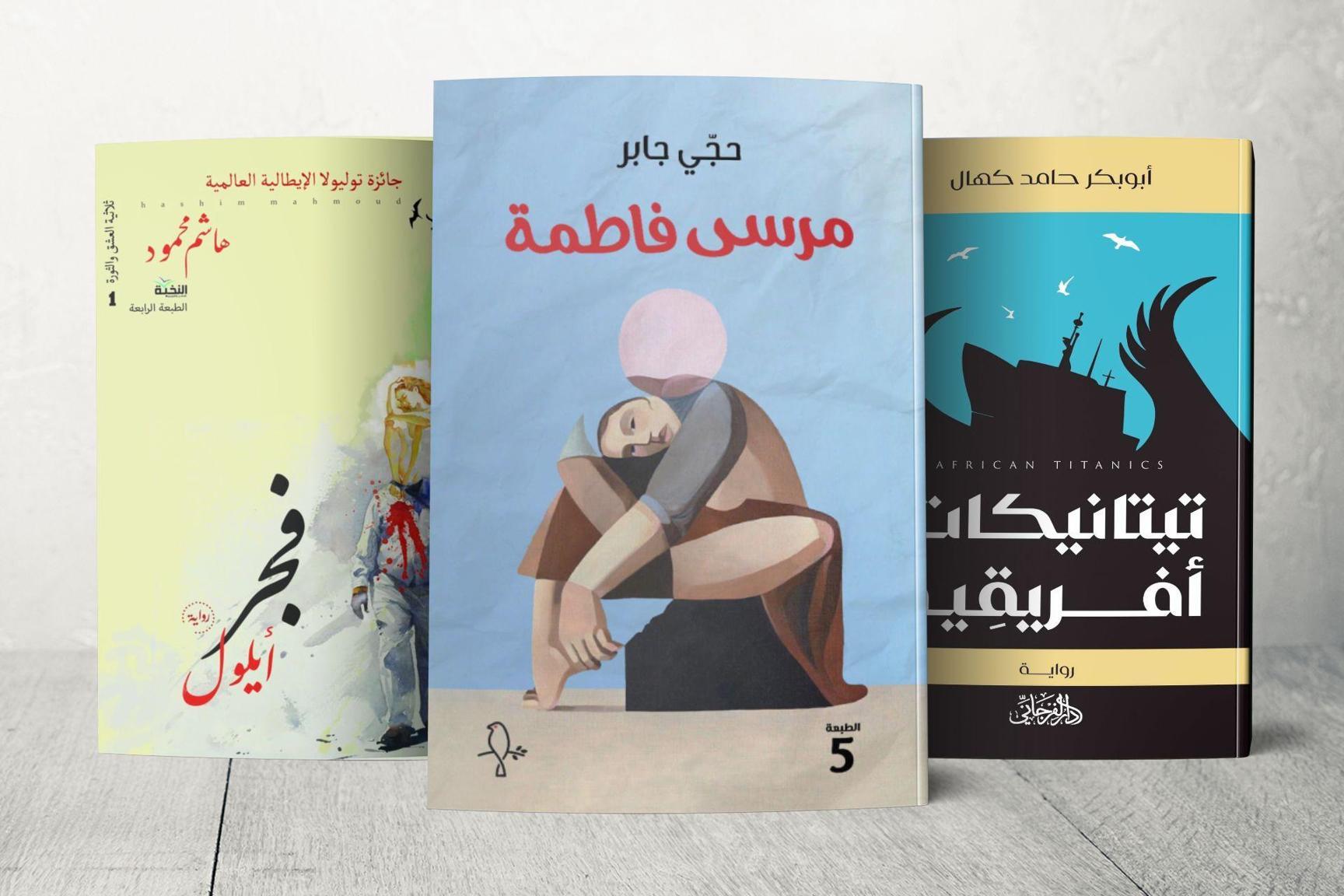
In this regard, Eritrean writer Fatima Musa noted that Eritrean novelists have documented the suffering of wars, displacement, and exile. Among them are Abu Bakr Kahal with African Titanics, Hashim Mahmoud with September Dawn, Haji Jaber with Fatima’s Harbor, Abdelkader Muslim with Azmarino, and Mahmoud Shami with The Ninth of March. Their works conveyed the voices of those who lost their homeland, immortalized the struggle, and reflected the search for freedom.
Linguistic and Cultural Diversity
On what distinguishes Eritrean literature from that of other African and Arab countries, poet Muna Mohammed Saleh explains that this literature possesses a unique character born of its position between two worlds, and of its formation within a harsh historical experience of colonialism, war, repression, and exile. In Eritrea, writing became an act of survival and resistance more than a mere creative practice. Texts carry a distinctive tone that stands at the crossroads of Arabic and African traditions without dissolving into either, making them different from their surroundings—not out of superiority, but because of the distinct experience, formative circumstances, and environment that shaped them.
She adds: “This uniqueness draws strength from the fact that Arabic is not a foreign language, but an integral part of the country’s consciousness since the first migration, tied to religion, history, and oral memory. Thus, the texts appear alive, charged with questions and tension, often outside cultural institutions. The writer relies on his or her individual voice to preserve a collective memory that resisted exclusion with all its might, blending linguistic and cultural diversity between popular heritage and individual identity. The political experience—strict censorship, long wars, and widespread diaspora—gave the texts their density and emotional intensity. Writing became an extension of the wound, and language was infused with questions of freedom, existence, identity, and the movement of the self in confronting exile and loss.”
Writer Fatima Musa points out that literature and culture are mirrors of Eritrean identity, reflecting its ethnic and geographic diversity—from its countryside and cities to its mountain plateaus, plains, islands, and long Red Sea coastline. Since ancient times, Eritreans expressed their emotions through poems and epic songs accompanied by the rababa and drum rhythms, narrating stories of heroism, dignity, and longing for the homeland. These traditions are among the most important sources of Eritrean culture that nourished national identity. For thirty years, Eritreans faced Ethiopian occupation—stemming from British colonial policies after World War II—with patience and determination until independence was achieved on May 24, 1991, and formally declared in 1993, strengthening national unity.
According to Musa, Eritrean literature played a central role in supporting the revolution and reinforcing identity. Poets such as Mohammed Osman Kajray, Ahmed Saad, and Mohammed Madani wrote about resistance, while from exile the late poet Sharifa Al-Alawi voiced poems of estrangement and longing for the homeland. Artists like Al-Amin Abdul Latif, Yemane Baria, Abdul Rahim Osman, and Idris Mohammed Ali also contributed to spreading Eritrean culture and strengthening its identity through songs and poetry in the country’s multiple languages, making them essential sources of Eritrean cultural heritage.
She concludes: “Despite isolation and media neglect, Eritrean writers continue to produce intellectual and literary works that are translated into world languages and win awards, striving to break cultural isolation and connect with peoples of the region and the world. Eritrea is not merely a homeland, but a vibrant mosaic, as the late poet Sharifa Al-Alawi described: ‘Eritrea, the emerald of identities.’ This diversity is embodied in its rich heritage and historical role as a civilizational and commercial hub since ancient times.”
Mohammed Saeed Nawood
Hashim Mahmoud points out that pioneering writers in every language are the torchbearers who illuminate the path for those who come after them, laying the foundations of art in their countries. Early Eritrean writers, such as Mohammed Saeed Nawood, played a pivotal role in establishing Eritrean literature in Arabic by expressing national identity and Eritrea’s political and social issues through various literary forms such as poetry and short stories. They helped root Eritrean literature by engaging with modern Arabic literature of their time and adapting it to reflect Eritrea’s reality and history, through works that addressed national struggle, unity, and the strengthening of social awareness.
For his part, Jamal Hamd considers Nawood’s novel Winter Journey… Saleh to be the first Eritrean novel written in Arabic. Despite its stylistic and technical shortcomings, leaning toward report-like direct narration, it deserves to be recorded as such. Published in the late 1970s, when Arabic fiction was flourishing, it remains Nawood’s only novel.
Hamd continues: “Fiction in Eritrea was delayed for decades for various reasons, but all the narrative output that emerged after liberation can be said to have arrived fully formed. Today we have names in fiction such as Abu Bakr Kahal, Haji Jaber, the imprisoned Idris Saeed Ab’ari, Abdelkader Hakim, Khalid Mohammed Taha, Jamal Hamd, Muna Mohammed Saleh, Fathi Osman, Hashim Mahmoud, and others.”
Poet Muna Mohammed Saleh describes Nawood’s Winter Journey… Saleh as the first Arabic novel in Eritrean literature, blending national memory with imagination and shaping Eritrean consciousness as the people forged their history in both the literary and cultural spheres.
She continues: “Then came prominent voices such as novelist Abu Bakr Kahal, who wrote about the painful experiences of diaspora and migration, and the human risks that accompanied Eritrean geography wherever it went. Haji Jaber explored questions of identity and cultural fragmentation. Short story writer Jamal Hamd offered a profound voice for the torn self moving between two places and two languages. Mahjoub Hamid presented, in his narrative reflections, Eritrean heritage and the pains of places between home and exile.
In poetry, Ahmed Saad, Mohammed Osman Kajray, Ahmed Omar Sheikh Abdulrahman Skab, and Mohammed Mahmoud Sheikh established what is known as poetry of crossing, which combines Arabic rhythm with East African cultural belonging. It expresses homeland, identity, and diaspora through a blend of popular heritage, political awareness, and individual emotion, giving the texts depth and richness.”
She adds: “The uniqueness of Eritrean literature is not a judgment on other literatures, but a natural reflection of the Eritrean experience itself—an experience that turned the fragility of the journey into narrative and poetic strength, memory into a form of survival, and the resilience of the spirit into a literary voice that stands alongside others yet resembles only itself.”
Source : Al Jazeera Net