Africa-Press. The Somali government has rejected any operation involving the deportation or displacement of the Palestinian people to its territory or to its northern region, stressing that bringing Palestinians to the separatist Somaliland region is unacceptable and will not take place.
It also rejected the construction of any Israeli military base on Somali territory, stating that any course of action contrary to this position would not be welcomed.
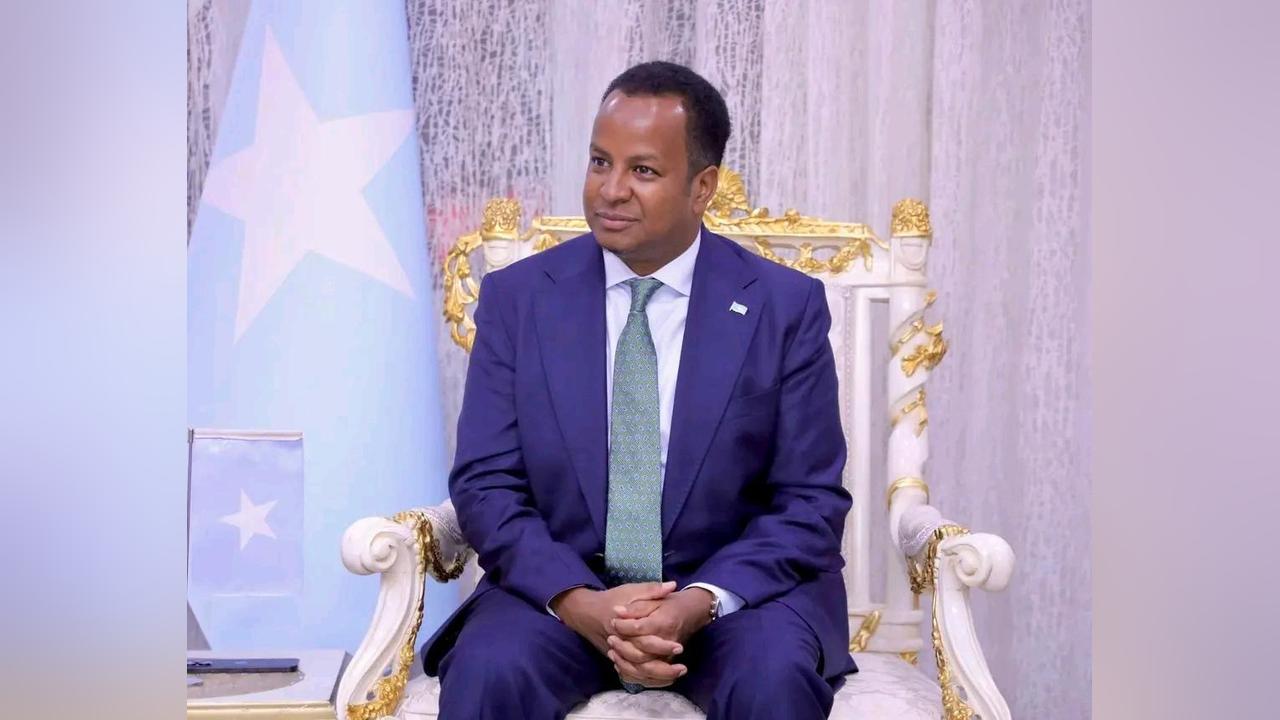
Somalia’s Minister of Foreign Affairs and International Cooperation, Abdisalam Abdi Ali, revealed in an interview with Al Jazeera his country’s firm stance against the potential forced displacement of Palestinians and Israeli plans in the region.
The minister stressed that Somalia’s goal is to preserve a stable and unified country moving in the right direction, and that the displacement of Palestinians, forcing them to relocate to Somalia, or the establishment of a military base would not be accepted.
Ali said the Somali government has clearly and firmly informed the world that this will not happen. He added that he fully agrees with Somali President Hassan Sheikh Mohamud and will not allow Palestinian displaced persons to be brought to northern Somalia.
The minister expressed hope that the information circulating about resettlement and an Israeli military base is inaccurate, but noted that this is the information currently reaching the Somali government.
In a related development, the Somali federal government officially rejected Israeli recognition of the separatist Somaliland region, considering it an integral and indivisible part of Somali territory.
The foreign minister said this declaration constitutes a violation of the United Nations Charter, a clear breach of the African Union Constitutive Act, and a blatant violation of international law. He believes Israel is seeking to control the southern gateway to the Red Sea and the Bab el-Mandeb Strait.
The official position
Ali affirmed that Somalia is a sovereign state with borders recognized by the United Nations, the African Union, the Arab League, and many international institutions and organizations, and that its unity cannot be altered by external factors.
He stressed that recognition does not occur through media announcements or political statements, but must comply with international charters and norms.
The Somali foreign minister noted that 30 days after the Israeli announcement, no other country, international body, or organization has recognized the separatist Somaliland region as an independent state.
Ali explained that this demonstrates the illegality of the Israeli move and its contradiction with international charters, adding that multiple countries have expressed support for Somalia. He emphasized that the declaration made by Israeli Prime Minister Benjamin Netanyahu — who is wanted by the International Criminal Court — will not change Somalia’s borders.
Regarding the strategic importance of the Red Sea, the minister warned that any violation of the stability and security of this region would disrupt international trade and logistics routes and could bring “terrorists” into this maritime corridor, affecting regional stability and that of Somalia, which has battled terrorism and insecurity for three decades.
Regional alliances
At the regional level, Saudi Arabia and Egypt were among the first countries to support Somalia’s sovereignty and territorial unity, according to the Somali foreign minister.
Ali explained that these relationships are long-standing and have spanned many years, with these countries working closely with Somalia on various issues, including stability, sovereignty, and territorial integrity. He noted that this strategic friendship did not begin 30 days ago following Israel’s recognition of the northern region.
He added that Saudi Arabia and Egypt are part of the Red Sea system and view the Israeli move as related to regional security, particularly the Red Sea corridor and the Bab el-Mandeb Strait, stressing that the issue does not affect Somalia alone but threatens the stability of the entire region.
The minister welcomed any defensive cooperation with Arab countries that respect Somalia’s sovereignty and territorial integrity and recognize its federal government, noting that Somalia has many strategic partnerships with such states.
Regarding relations with Ethiopia, the Somali foreign minister described them as relations between two neighboring and friendly states, despite occasional tensions and difficulties.
He said Ethiopia has forces stationed in Somalia, that visits are exchanged between Addis Ababa and Mogadishu, and that relations are generally stable, with a long shared border and mutual trade.
Ali stressed that any commercial cooperation between Ethiopia and Somalia is welcome, but only through the Somali federal government.
He emphasized that there is only one gateway for Somalia — the federal government — and that all agreements or commercial activities must go through this channel. Any country wishing to make use of Somali ports is welcome, provided this is done in accordance with international law and state-to-state relations.
Strategic importance
The separatist Somaliland region holds significance that goes beyond its geographic area of approximately 177,000 square kilometers.
The Bab el-Mandeb Strait, which falls within the strategic sphere of influence of the region’s coastline, is one of the world’s most important trade corridors. About 21,000 commercial vessels pass through it annually, accounting for 10% of global maritime traffic, 30% of global container shipping, and nearly 12% of seaborne oil trade.
According to data from the U.S. Energy Information Administration, the strait ranks third globally in terms of energy trade volumes after the Straits of Malacca and Hormuz.
Flows amounted to around 6.2 million barrels per day in 2018 and rose to approximately 8 million barrels per day in 2023, reaching a peak before the escalation of security tensions in the Red Sea.
Maritime routes that include the Red Sea, the Bab el-Mandeb Strait, and the Suez Canal carry up to a quarter of global trade and more than one billion tons of goods annually.
In this context, May Darwich, Professor of Middle East International Relations at the University of Birmingham, explained that Israel has developed strategies viewing non-Arab minorities in Arab territories as allies, and established the Dayan Center for Middle Eastern and African Studies in Tel Aviv, which examines minorities such as Africans in Sudan, Kurds in regional countries, and Amazigh communities.
She added that Eritrea has emerged since the 1990s as a strategic foothold for Israel, with reports of undisclosed security and intelligence cooperation, including surveillance sites, listening stations, and monitoring facilities at the port of Massawa.