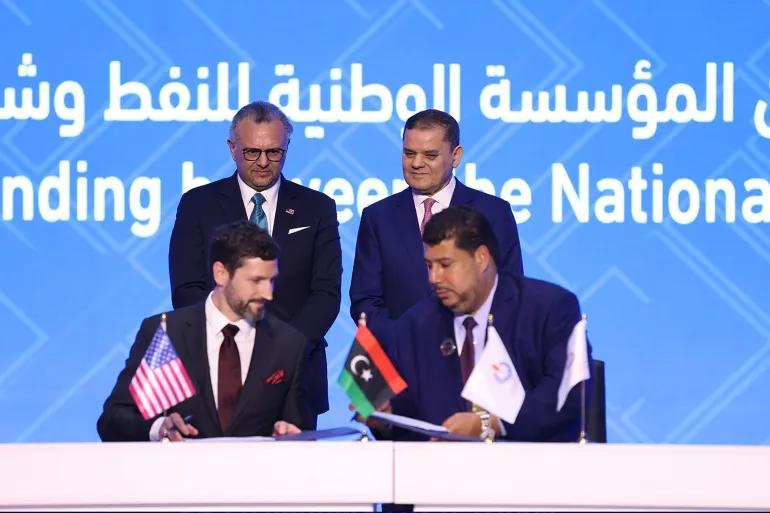
Africa-Press. Waha Oil Company signed a major agreement a few days ago with TotalEnergies and ConocoPhillips, with investments up to $20bn, during the Libya Energy and Economy Summit in Tripoli. Libyan officials and economists expect the deal to have significant repercussions for the country’s oil sector.
Funded outside the state budget, the agreement aims to raise oil output by 850,000 barrels per day above the current 2.2 million bpd, with projected total revenues of about $376bn over 25 years, according to Government of National Unity head Abdul Hamid Dbeibeh.
The event highlighted global interest in Libya’s oil market: 19 French companies, 17 US companies, and 16 UK companies took part, while Italian participation was limited to six companies and Turkish participation to four.
Immediate gains
On off-budget financing, GNU Minister of State for Communication Walid Al-Lafi told Al Jazeera Net that the Libyan government would bear no costs, with the foreign investor covering all expenses under production-sharing agreements (EPSA).
He added that the key Libyan gains include a direct boost to the oil sector and local infrastructure, bringing Libya back onto the international investment map, improving production efficiency, and stabilising output rates over the medium term—linked to the political and security stability the government is seeking to entrench.
Long-term implications
Economics professor Abdullah Al-Kilani of the University of Benghazi said the agreements could position Libya among the world’s major oil producers and give it greater weight within OPEC+, strengthening its ability to influence prices.
He added that expected revenues of roughly $370bn over 25 years would provide long-term stability in cash flows, enabling the state to rebuild reserves eroded by crises and cover development spending. He also said resuming licensing rounds after a 17-year pause sends a reassuring signal to global markets about Libya’s openness to investment.
Economics professor Ayyoub Al-Farsi, also at the University of Benghazi, said the massive agreements would restore Libya to its “natural” position in the global energy market, benefiting the economy and potentially helping defend the local currency’s exchange rate and support citizens’ and investors’ purchasing power.

Losses from past shutdowns
On the impact of repeated shutdowns on output, Al-Lafi said the 2013–2016 period cost the state about $170bn in direct losses, alongside indirect damage to infrastructure, the local economy, and the public treasury.
Oil expert Mohammed Al-Shahati said reaching the target output level would likely boost oil revenues and GDP, which could improve average per-capita income if oil prices remain stable.
Former oil minister Mohammed Aoun questioned Libya’s share of the expected revenues, noting foreign companies could receive more than 40% under current agreements.
Deal background and production challenges
Al-Shahati explained that the plan to raise production to two million bpd dates back to 2009 but was delayed by political tensions and the withdrawal of US companies, before being revived after Total acquired earlier partners’ stakes. He added that Waha’s original agreement was signed in 1965 and amended in 1974 when the National Oil Corporation entered as a partner with a 59% share of production. With the current agreement expiring in 2031, partners’ investment hesitation increased.
On the practical feasibility of adding 850,000 bpd, Aoun told Al Jazeera Net that Libyan production alone cannot reach that level: output could rise by about 300,000 bpd in addition to Waha’s current production, meaning the maximum achievable would be 600,000 bpd.
Conditions for success
Al-Kilani said Libya has the reserves and extraction potential, but meeting the goal requires:
– political and security stability and insulating the sector from political rivalries;
– directing investments to modernise damaged infrastructure;
– adherence to transparency and good governance to ensure a stable legal environment;
– training Libyan technical staff on modern technologies.
Political analyst Mohammed Mutairid said the US presence in Libya’s oil file aims to ensure oil flows to global markets and use it as leverage to recalibrate United States’s role and balance other international powers in Libya.