Tamara Pro, researcher on Asian affairs
What You Need to Know
After years of cautious observation following the 2011 events, China is re-engaging with Libya economically. The reopening of the Chinese embassy and the appointment of a new ambassador signal a renewed partnership aimed at supporting Libya’s reconstruction and enhancing China’s presence in Africa amid shifting global dynamics.
Africa-Press. After years of anticipation and caution following the events of 2011, China has returned to Libya through economic channels. The relationship between the two countries is entering a new phase of repositioning and gradual rapprochement after years of absence due to the security and political developments in Libya since 2011 and the fall of the Gaddafi regime. This return occurs amid rapid international transformations, as Beijing seeks to enhance its presence in Africa, while Libya looks for international partners to support its reconstruction efforts and stimulate its economy.
In November of last year, China reopened its embassy in Libya after having closed it permanently in 2014, relocating its diplomatic mission to Tunisia and evacuating thousands of Chinese citizens following the outbreak of civil war. Recently, Beijing appointed Ma Xiuliang as its new ambassador to Tripoli.
The reopening of the Chinese embassy and the appointment of a new ambassador followed extensive study and careful monitoring of the security situation in Libya, alongside communications and meetings between Chinese officials and Libyan authorities to assess whether the conditions were suitable for the return of Chinese investments. It appears that Tripoli has granted Beijing assurances regarding its investments in the country.
China’s renewed engagement with Libya began before the reopening of its embassy, as there were increasing signs of a gradual Chinese return to the Libyan arena. In recent years, there have been meetings between Chinese and Libyan officials. For instance, the charge d’affaires of the Chinese embassy, Liu Jian, visited Derna in the east of the country and signed several memoranda of understanding with the Libyan Development and Reconstruction Fund in areas such as infrastructure, housing, and energy.
Additionally, the Libyan-Chinese High Cooperation Committee held a meeting last year to discuss preparations for a joint economic forum. In December, the charge d’affaires visited Misrata, where he inspected its port, free zone, international airport, and the Libyan Iron and Steel Company, confirming that China is ready to participate in Libya’s development and reconstruction, indicating that the economic path has begun before the diplomatic scene is fully established.
In July 2024, the Director General of the Libyan Development and Reconstruction Fund signed a memorandum of understanding with a coalition of the Chinese company Power China and the Portuguese company Future to implement strategic projects in Benghazi, including the development of Benina International Airport, the establishment of solar energy stations, and water treatment plants, in addition to a railway line connecting Benghazi to the Egyptian border at Musaid, directly linking eastern Libya to regional transport networks.
In the same year, Chinese President Xi Jinping announced, after a meeting with Libyan Presidential Council Chairman Mohamed Menfi on the sidelines of the China-Africa Cooperation Forum, the establishment of a strategic partnership between the two countries.
This Chinese openness is matched by Libya’s efforts to attract Chinese companies to contribute to reconstruction efforts, especially given the expertise of Chinese firms and their lack of harsh investment conditions.
Before 2011, China was one of Libya’s most prominent economic partners during Gaddafi’s presidency, with Beijing holding substantial investments in the country estimated at around $20 billion spread across 75 major projects in sectors such as housing, infrastructure, telecommunications, and energy. However, the outbreak of events in Libya and the subsequent armed conflict and political division led China to freeze its projects.
Since then, China’s position has been characterized by caution while maintaining diplomatic communication channels without direct involvement in the complexities of the Libyan scene. Beijing has relied on a principle of political neutrality in Libya, which has allowed it to maintain balanced relations with the Government of National Unity controlling western Libya and the Government of National Stability controlling the east.
The reopening of the Chinese embassy in Libya and the appointment of a new Chinese ambassador is not merely a routine diplomatic procedure but a signal of China’s return to Libya with the aim of solidifying its presence in a country ravaged by internal crises. This is part of a broader move by Beijing to enhance its presence in North Africa to serve its economic interests and bolster its status as a rising global power.
China is attempting to seize opportunities in Libya due to the country’s significant resources. Libya has the largest proven oil reserves in Africa, estimated at 48.4 billion barrels, ranking ninth globally. China seeks to diversify its energy sources, especially after the United States’ control over Venezuelan oil and the pressures exerted by President Donald Trump on many countries to reduce their cooperation with China, along with American threats of military action against Iran.
In light of this, China is likely to increase its purchases of Libyan oil. In 2024, China imported crude oil from Libya worth $1.14 billion, but this is a small percentage of Libya’s total exports, which amounted to $27.7 billion, most of which were directed to Italy, Germany, and Britain, which have increased their Libyan oil purchases following the Russian-Ukrainian war.
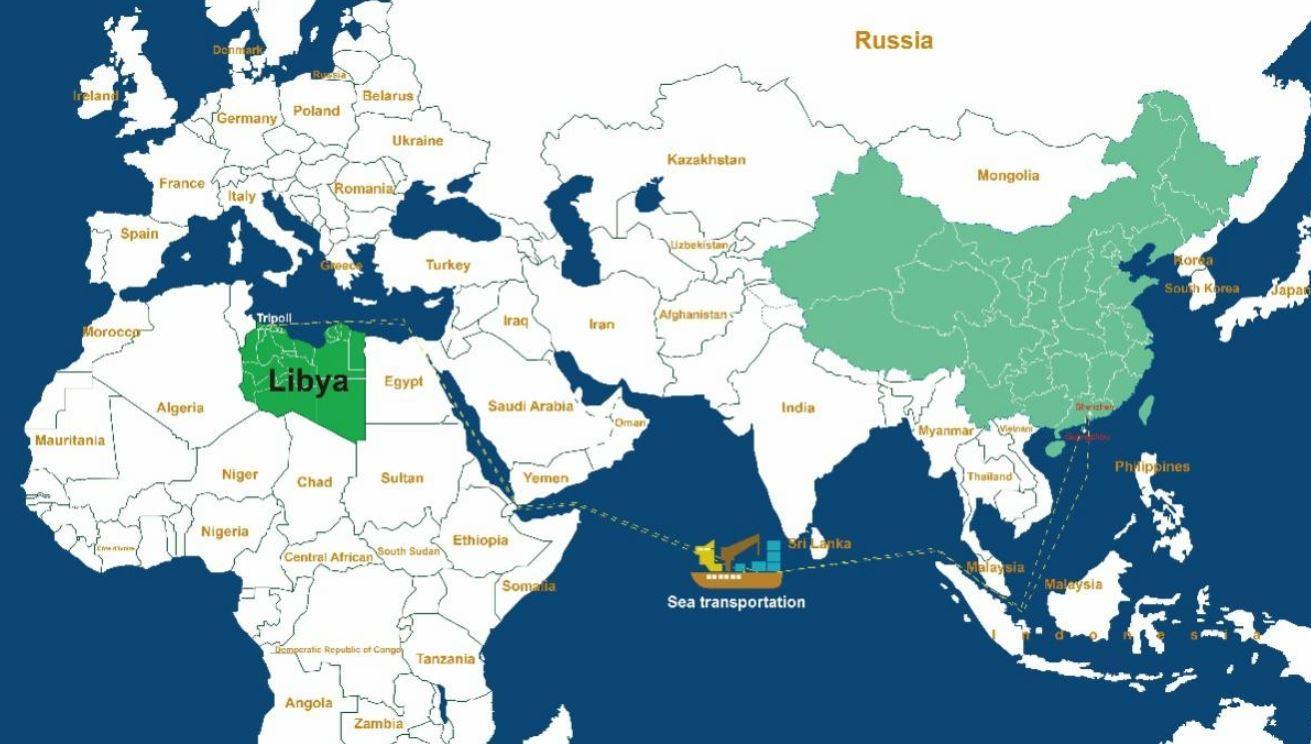
China views Libya as a potential gateway to Africa and Europe, considering it a strategic link in its Belt and Road Initiative amid competition with the Indian Middle Eastern European economic corridor announced in 2023 as part of the Silk Road project. Libya’s location on the Mediterranean Sea and its longest coastline in North Africa make it an ideal gateway for Chinese goods to Africa and Europe.
China aims to establish its economic presence in Libya through contributions to reconstruction and investments in infrastructure, including roads, airports, and ports, as part of the Belt and Road Initiative, in addition to increasing its energy purchases and exploiting the country’s abundant natural resources.
In this context, reports indicate China’s plan to transform the port of Tobruk in eastern Libya into a massive regional logistics and energy hub, building a giant oil refinery worth $10 billion capable of processing 500,000 barrels of oil per day, and a high-speed railway worth $20 billion to connect Tobruk and Benghazi to the Egyptian railway network.
However, China’s presence in Libya will not be easy, as it is expected to face numerous challenges, particularly given the existence of two governments, despite China’s attempts to maintain balanced relations with both.
Additionally, some Libyan regions still suffer from security fragility and the proliferation of weapons, placing the safety of Chinese citizens as a top priority, which drives China to adopt a gradual policy in its return.
Moreover, there are geopolitical challenges and international competition, as the United States and Europe fear that China’s economic presence could evolve into military and intelligence presence, especially if China gains access to strategic ports like Tobruk.
Furthermore, Libya is witnessing the presence of numerous regional and international powers, including Russia, Turkey, Italy, and France, which means that China will proceed cautiously to avoid friction and conflicts with these powers. Western Libya is linked to agreements with European powers, Turkey, and the United States, which reduces China’s opportunities for presence there, making it likely that China will focus on eastern Libya.
In another context, President Trump may seek to deter China in Libya and more broadly in Africa, as he aims to reduce China’s presence in various countries worldwide. Therefore, he may pressure Libya to reduce its cooperation with China by threatening to impose tariffs on it, as he did with Canada.
China is trying to expand its influence in Africa by increasing its investments there. The Chinese decision to eliminate tariffs on imports from all African countries that have diplomatic relations with it, including Libya, is likely to enhance trade cooperation between the two sides and strengthen China’s position in the continent. However, under Trump’s policies against Beijing, it is not unlikely that Libya could become a stage for a new power struggle between China and the United States.