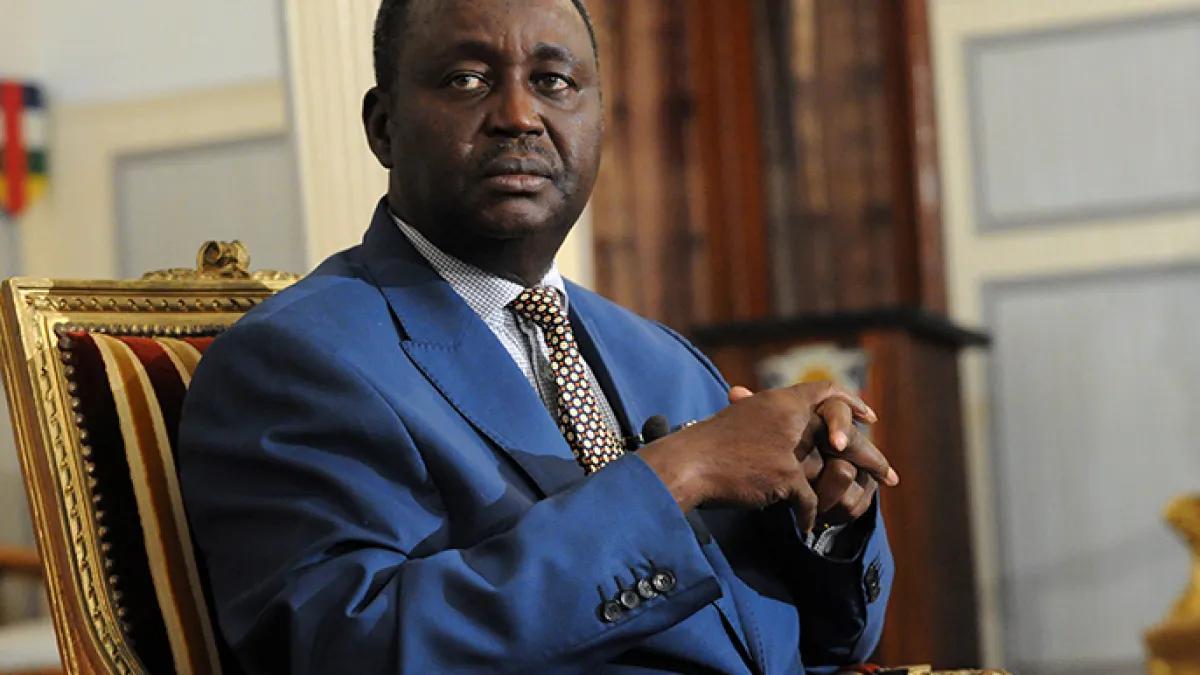
Africa-Press. The Special Criminal Court in the Central African Republic announced that next June 16 will be the date for the opening of the trial of former President François Bozizé, on charges related to war crimes and crimes against humanity, in what is considered the most prominent judicial file that the body has considered since its founding about 8 years ago.
According to the statement issued by the court, the file known in the media as the “Bossembili case” refers to the judiciary four defendants, led by Bozizé, along with three senior officers of his former regime, namely Eugene Barré-Ngaekwase, Viane Simendero, and Firman Junior Danbuye.
The charges against them revolve around committing acts of murder, detention and serious violations of freedom, allegedly committed between 2009 and 2013 in Bangui, Bouar and Bussembili, according to local radio “Ndiki Louka”.
The most dangerous criminal stage relates to the military training center in the town of Bossembili, located about 150 kilometers north of the capital, Bangui, where the Presidential Guard is accused of torturing and killing detainees during that period, according to what Radio France Internationale reported.
The specter of trial in absentia
It is noteworthy that Bozizé – who has reached the age of eighty – has been living in exile in Guinea-Bissau since the “Seleka” coalition overthrew his regime in 2013. The Special Criminal Court issued an international arrest warrant against him in April 2024, but the authorities in Bissau have not implemented it yet.
The Bangui Court of Appeal had convicted him in absentia in 2023 to life imprisonment with hard labor, on charges including conspiracy, rebellion, and harming state security, along with two of his sons and 20 other defendants.
The court gave the former president 20 days to appear before it, while the authorities acknowledged that the authority does not have an independent security apparatus to implement arrest warrants, but rather relies on international cooperation to achieve this.
It is likely that the trial will be held in absentia, which, according to Jeune Afrique magazine, weakens the symbolic impact of any ruling issued, as it deprives the accused of his right to direct defense.
In contrast, the other three defendants are in pretrial detention inside the country, awaiting the start of the hearings.
Special Criminal Court
The Special Criminal Court was established in 2018 as a hybrid judicial body that brings together national and international judges and prosecutors, and was entrusted with the authority to examine serious crimes committed on Central African soil since 2003, the same year in which Bozizé came to power through a military coup.
According to a statement by Amnesty International, the court is managing 15 investigative cases and 3 ongoing trials, while pursuing more than 30 suspects who are still at large. Bozizé’s case is the sixth of its kind before the Criminal Chamber, and represents the highest file referred to trial since its establishment.
The announcement of this trial comes in light of a severe financial crisis that threatens the continuity of the court, as Amnesty International warned of the possibility of running out of court resources by next June, that is, at the same time that Bozizé’s trial sessions are supposed to take place.
The organization attributed part of the crisis to the withdrawal of the United States from the donor list, which represented the second largest supporter after the United Nations, while only the European Union has so far committed to contributing to the current year’s budget, in light of a liquidity crisis afflicting the United Nations.
However, the biggest challenge remains linked to the court’s ability to translate its rulings into reality, in the absence of a coercive mechanism to implement international arrest warrants, and in light of the fragility of the cooperation of some neighboring countries, in addition to the fact that Bozizé – according to Jeune Afrique magazine – is also subject to prosecution before the International Criminal Court, which doubles the complexities of the judicial process.