What You Need to Know
Mali is facing a profound crisis as armed conflict transitions from peripheral regions to the core of political power. The coordinated attacks in April 2026 signify a shift from military skirmishes to a direct threat against the state itself. This transformation raises critical questions about the government’s ability to maintain control and stability amidst escalating violence and political uphe,
Africa-Press. The crisis in Mali, as presented by researcher Sidi Ahmed Ould El Amine, is no longer merely an armed rebellion in the peripheries or a traditional conflict on the margins far from the state. It has transformed into an existential test that impacts the very structure of power. The coordinated attacks that the country witnessed in late April 2026 were not just a fleeting military event; they were an announcement of the war’s shift from the periphery to the center, from depleting the army to threatening the political system at its core.
This transformation is key to understanding the entire scene, as it reveals that what has been presented for years as a security crisis that could be contained has now become a state crisis, intertwining military, political, social, and economic levels, raising a direct question: Is the authority in Bamako still capable of holding the threads of the country?
Changing the Rules of War
Sidi Ahmed Ould El Amine indicates that what is happening in Mali is not just an escalation in violence but a change in the nature of war itself. The “Group for the Support of Islam and Muslims” has shifted from sporadic attacks to a strategy based on suffocation, where the goal is no longer just to inflict losses on the army but to disrupt the state’s ability to function.
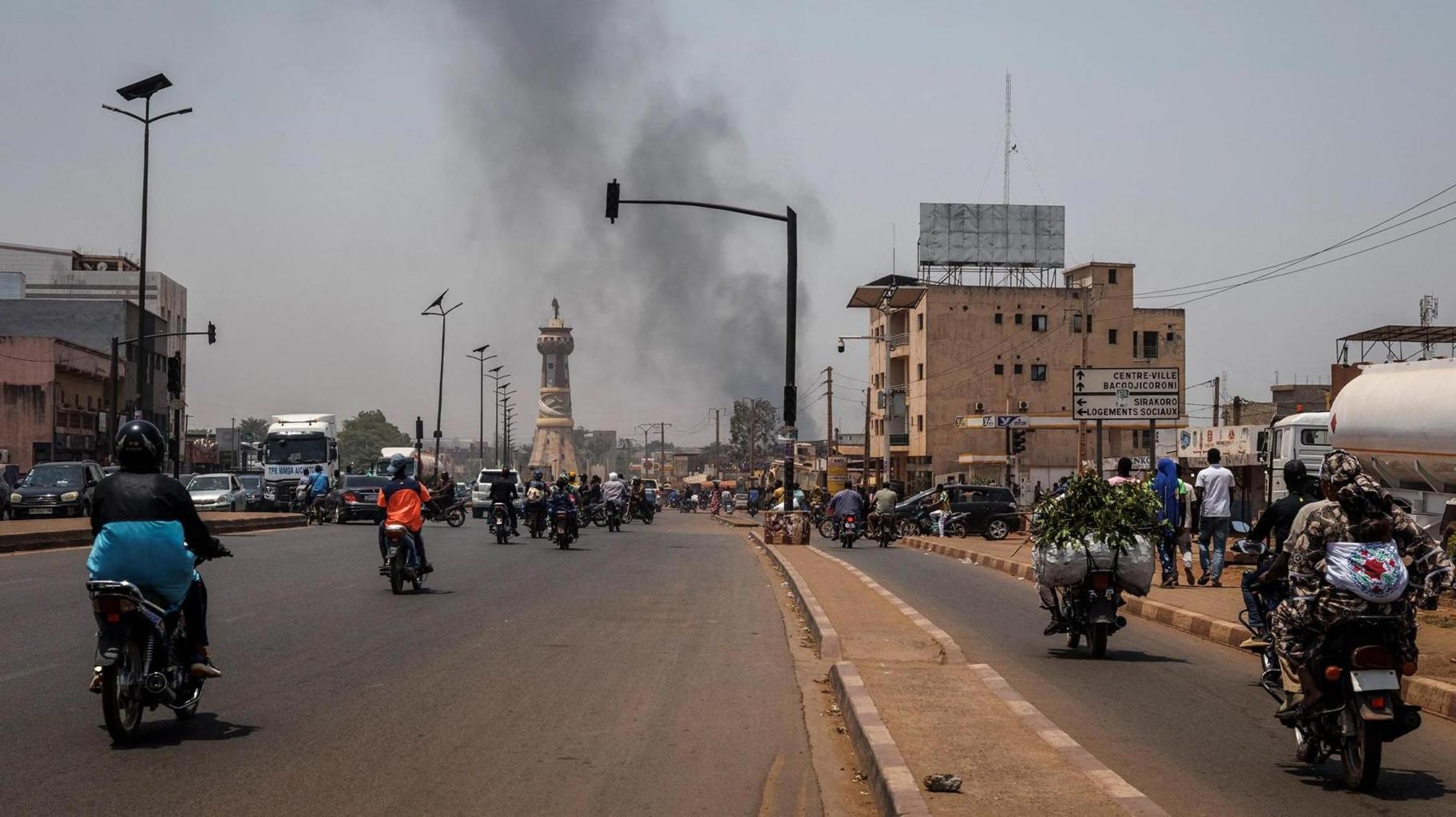
In this context, roads are no longer just transport routes; they have become battlefields. Fuel is no longer an economic commodity but has become a tool of pressure, and markets are no longer neutral civilian spaces but extensions of the war. This transformation places the capital itself under indirect pressure, as targeting supplies means striking daily life, thus transferring the crisis from the periphery to society as a whole.
It is a war not fought only with weapons but through slow strangulation, where a road is closed, a convoy is targeted, prices rise, and a city is disrupted. Here, the state faces an adversary that seeks not only to defeat it militarily but to exhaust it politically and socially.
The Collapse of the Old Equation
Since coming to power in 2020, the military council has built its legitimacy on a clear triad: sovereignty, independence from Western influence, and restoring security. However, the events presented by the researcher reveal that this equation has entered a phase of deep erosion. The withdrawal of French forces, the exit of the United Nations mission, and the shift towards partnership with Russia have not led to security stability but have coincided with the expansion of threats, moving into areas that were not previously targeted.
More dangerously, recent attacks have not only targeted traditional military sites but have also reached the symbols of power itself, including Kati, the military stronghold of the regime, and even led to the assassination of the Minister of Defense. This moment carries significance that transcends the event itself, as it indicates that the core circle of the regime is no longer fortified, and the war is no longer occurring outside the authority but within its immediate scope.
Here, the official discourse loses part of its persuasive power. When slogans of control are raised while attacks reach the heart of the capital, the contradiction between words and actions becomes more apparent, turning into an internal pressure factor, not only within society but also within the military institution itself.
Necessary Alliances
One of the most striking aspects of the study’s analysis is the operational convergence between the “Group for the Support of Islam and Muslims” and the “Azawad Liberation Front.” This convergence does not imply an ideological merger, as each party carries a different project; the former is transnational and linked to a jihadist discourse, while the latter is local and tied to political demands of the Tuareg. However, what unites them at this moment is the common enemy: the military state in Bamako and its allies.
This pattern of alliances reveals the nature of the conflict in Mali, where relationships are not governed solely by ideology but by changing interests and political vacuums. With the collapse of the Algiers Agreement and the absence of a unifying political framework, the north has returned to a logic of flexible alliances that can form quickly and dissolve just as fast.
In this context, the question is no longer: Who is fighting whom? But rather: Who is allying with whom, and why now? This question reflects the fluidity of the scene more than it reflects its stability.
The Symbol of Fragile Sovereignty
Kidal occupies a special position in this conflict, not only as a city but as a historical symbol of the northern rebellion and the limits of state control. Its recovery in 2023 with Russian support was presented as a strategic achievement for the military council and evidence of the success of its sovereign choice. However, the return of battles to it and the rebels’ announcement of control over sites there have raised the question about the nature of this control: Was it stable sovereignty or merely temporary military superiority?
This question does not pertain only to Kidal but to all regions where control is being re-established without a political framework to ensure its sustainability. A state that regains land by force without politically reintegrating it remains at risk of losing it again at the first imbalance in the power scale.
A Moment of Breach
The most significant transformation observed in the study is the transition of armed groups from threatening the peripheries to penetrating the center. The attacks that targeted symbolic sites in Bamako, from the airport to government headquarters, were not merely qualitative operations but clear political messages: the state is no longer capable of protecting itself in its heart.
This breach carries a psychological dimension that is no less important than its military aspect. The capital is not just a geographical location but a symbol of stability and control. When it is struck, people’s perception of the nature of the conflict changes, and fears of distant possibilities turn into daily realities.
The Silent Battlefield
The crisis does not stop at the boundaries of the state and armed groups but extends to society itself. As Sidi Ahmed Ould El Amine points out, the new war is not measured only by the number of attacks but by their impact on daily life: fuel, roads, prices, schools, and security.
At this level, a third type of actor emerges: society, which does not necessarily align with either side but judges the state based on its ability to secure life. This judgment may be more influential than political discourse, as it is shaped by daily experience rather than slogans.
Here lies the danger of the slow erosion of trust. States do not always collapse with a single blow; they may gradually disintegrate when they lose their ability to manage the small details that constitute people’s lives.
A Crisis Beyond Borders
What is happening in Mali does not remain within its borders. The study clearly highlights that neighboring countries, from Niger and Burkina Faso to Algeria and Senegal, are directly affected by what is happening, whether through trade routes or the movement of armed groups.
In light of the Triangular Sahel Alliance, which includes Mali, Niger, and Burkina Faso, any disruption in one of these states becomes a pressure factor on the others, especially given the similarity of political and security conditions in them. This makes the crisis regional in nature, and its trajectories cannot be separated from one another.
Russia… Partner or Burden?
One of the questions raised by the study concerns the Russian presence in Mali. This presence has been presented as an alternative to Western influence and a symbol of restoring sovereignty. However, the continuation and expansion of attacks open the door to a contrary reading: Has this presence contributed to solving the crisis, or has it become part of complicating it?
This question is not limited to the military dimension but extends to the political aspect, where it may be used by the opponents of the military council to undermine its legitimacy by portraying it as a choice that has not achieved the promised results.
Open Scenarios
In light of this scene, the study presents a range of scenarios that range from security tightening, reordering power, opening up to settlements, to a scenario of gradual erosion of the state, where the capital remains standing while actual control is distributed in the peripheries.
However, what unites these scenarios is that they all revolve around one question: How can the state be rebuilt in an environment where it has lost control over its peripheries and is beginning to lose control over its center?
Conclusion
What Sidi Ahmed Ould El Amine’s study offers is more than a description of a security crisis; it is an analysis of a moment of transformation, where Mali is no longer facing a rebellion but a test of survival. The war that began in the peripheries has reached the heart of power, and the legitimacy built on the promise of security faces its toughest exam.
Between armed groups that have proven their ability to adapt, an authority trying to maintain its cohesion, and a society that measures everything by the scale of daily life, Mali stands at a crossroads. The question that remains hanging, as the text implicitly poses, is not only how this war will end but what state will emerge from it, if it emerges at all.
Since gaining independence in 1960, Mali has experienced numerous challenges, including military coups, ethnic tensions, and the rise of extremist groups. The situation worsened in 2012 with the Tuareg rebellion and the subsequent takeover by Islamist militants. The military junta that seized power in 2020 promised to restore security and sovereignty but has struggled to address the deep-rooted issues that plague the nation. The recent shift in conflict dynamics highlights the fragility of the state and the urgent need for a comprehensive political solution.