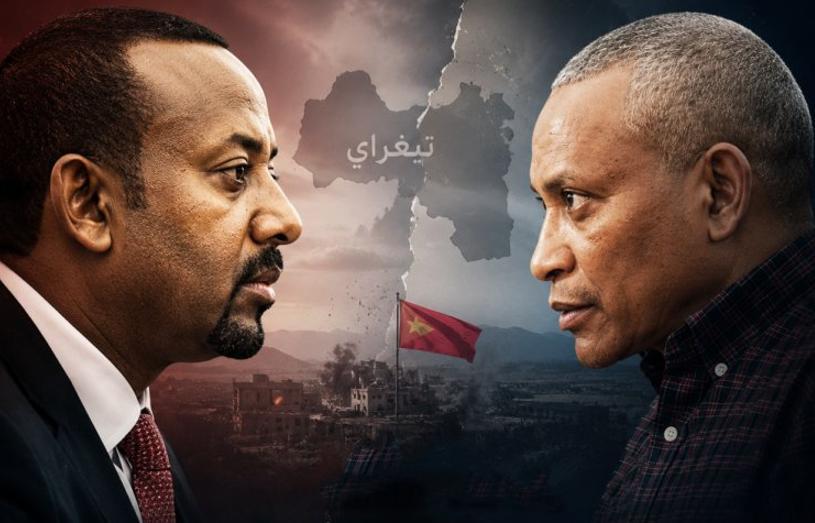
Africa-Press. The Tigray region in northern Ethiopia is entering a new phase of escalation following the announcement by the Tigray People’s Liberation Front on Tuesday of the reactivation of governance institutions that existed before the war, including the regional council, and the election of Debretsion Gebremichael as the head of government. This move puts the Pretoria peace agreement, which halted the war in Tigray (2020-2022), to a real test.
During the sixth regular session of the council, held after a hiatus of three and a half years, Kiros Hagos was elected as the council president, with Mehret Berha as her deputy. The members approved the resumption of legislative work, citing what they described as “the federal government’s violation of the peace agreement.” According to a statement, a report presented by Debretsion on the implementation of the agreement was approved before he was elected president by a majority vote and took the oath of office.
This step, which effectively represents the re-establishment of the political system that existed before the war, cannot be separated from the escalating conflict between Tigray’s front and the federal government led by Abiy Ahmed, especially after Addis Ababa’s recent decision to extend the interim administration in the region for an additional year, which the front considered a unilateral action undermining the peace process.
It was expected that the date in April regarding the extension or termination of the interim administration would be a point of contention, particularly amid the stagnation experienced by Tigray and the front before the upcoming Ethiopian general elections scheduled for June.
The election of the sixty-year-old Debretsion Gebremichael marks a clear return of the pre-war leadership of Tigray to the forefront of the political scene, as he was the man who led the front during the armed conflict with the federal government between 2020 and 2022.
This return reflects not just an administrative change but signifies the front’s recovery of its prominent political and military symbol, sending internal and external messages that Tigray has not abandoned its historical leadership and that the balance of power within the region still favors the front.
Moreover, Debretsion’s military and political background, which extends back to the guerrilla war against the military communist Derg regime, enhances the likelihood of adopting a more hardline approach in dealing with the Ethiopian federal government.
Before the outbreak of the war in Tigray on November 4, 2020, few outside the region had heard of Debretsion. During his time as a fighter within the front, he specialized in communications, establishing a clandestine radio station called “Dimtsi Weyane Tigray” (Voice of the Revolution in Tigray).
This station broadcast news of the fighting against the Derg regime and relied on mobile transmission devices that could be dismantled and transported to caves to avoid detection. During the early years of his activity, Gebremichael participated in training these teams deployed behind government lines.
After the Tigray People’s Liberation Front, with the support of allied rebel groups, overthrew the Derg regime in 1991, Gebremichael worked with Kinfe Gebremedhin, one of the key advisors to the late Prime Minister Meles Zenawi on intelligence and internal security matters, until his death in 2001 at the hands of a military officer.
During that period, Gebremichael completed his postgraduate studies in electrical engineering, and reports strongly suggest that he played a significant role in developing and deploying a wide surveillance network within Ethiopia.
In 2005, after years of working in the shadows, he was appointed director of the Information and Communications Development Agency, overseeing the expansion of the country’s communications network. He also maintained close relations with the main intelligence agency, the National Security and Intelligence Service.
By 2012, Debretsion Gebremichael had gained enough influence to be appointed Minister of Communications and Information Technology. As internet and mobile communication usage expanded in Ethiopia, the government’s ability to monitor these communications increased.
As the official responsible for this sector, Gebremichael played a pivotal role in enhancing government surveillance capabilities and was described as “the last guardian of state secrets,” which granted him significant power, though he used it quietly throughout his tenure.
In addition to his role in the communications sector, Gebremichael was tasked with overseeing key aspects of hydropower projects in Ethiopia. As head of the Ethiopian Electric Power Corporation at the time, he led negotiations with investors and supporters for the Grand Ethiopian Renaissance Dam project on the Blue Nile, which is the largest hydropower project in the country.
This strong record was supposed to ensure Debretsion Gebremichael’s continued rise within power; however, his calm demeanor did not withstand the rise of his rival Abiy Ahmed, who surpassed him in the ruling coalition’s presidential election in 2018 before becoming Prime Minister.
Observers were surprised when Abiy Ahmed quickly launched a wide-ranging political reform package, including the release of thousands of political prisoners, settling the border dispute with Eritrea, and implementing security sector reforms.
In November 2019, Abiy announced the dissolution of the ruling coalition and its replacement with the Prosperity Party, which the Tigray People’s Liberation Front rejected, leading to its effective withdrawal to the Tigray region.
Debretsion was elected president of the front in 2017, and with Abiy Ahmed’s rise, he focused on regional politics in Tigray, realizing that the front’s influence at the national level had diminished.
As the government moved towards reducing the ethnic federalism system, the front insisted on defending its regional authority, which was manifested in its decision to hold regional elections in September 2020, despite the federal government’s postponement of elections due to the COVID-19 pandemic.
The government deemed these elections illegitimate, while the front described them as a constitutional right.
On November 4, 2020, clashes erupted between the Ethiopian army and the forces in the regional capital, Mekelle. After confrontations, government forces took control of the main roads and announced their control of the city on November 28, while the forces tactically withdrew to the mountainous areas.
With his extensive experience in guerrilla warfare, Gebremichael recognized the importance of the mountainous terrain, where the forces repositioned themselves, benefiting from extensive military and intelligence expertise, in addition to possessing stockpiles of weapons.
The rise of Debretsion and his return to lead the forces does not bode well for the possibility of a near-term negotiated solution between Mekelle and Addis Ababa, especially given the man’s historical background and the forces’ significant experience in irregular combat, along with broad local support.
If war returns to Tigray and Gebremichael resumes a long-term guerrilla war against the government of Abiy Ahmed, he has the capabilities and experience for that, but such a scenario remains costly in human and economic terms, regardless of its outcomes.
The reactivation of the regional council in Tigray reveals a real collapse of the consensus that was supposed to govern the transitional phase following the Pretoria peace agreement of 2022.
While the government of Abiy Ahmed insists on the legitimacy of the interim administration it elected, the Tigray forces view the pre-war elected council as the only source of legitimacy, especially after its re-election under Debretsion’s leadership.
The roots of the legitimacy crisis in Tigray trace back to the decision of the Addis Ababa government to extend the term of the interim administration led by General Tadesse Worede for an additional year on April 8.
At that time, the office of Prime Minister Abiy Ahmed announced that General Tadesse Worede’s term as head of the interim administration in Tigray was extended for another year, effective from April 9, 2026.
Tadesse was first appointed on April 8, 2025, succeeding Getachew Reda. At that time, Prime Minister Abiy Ahmed stated that Tadesse “is widely believed to be ready to lead Tigray during this critical period,” referring to his knowledge of the region’s challenges.
Although the decision was based on constitutional legal frameworks, the Tigray People’s Liberation Front considered it a unilateral action that violates the spirit and text of the Pretoria agreement, which stipulates managing the transitional phase through consensus among the concerned parties.
The forces believe that the continuation of the interim administration without elections or genuine restructuring reflects an attempt to politically marginalize them, especially in light of the absence of a clear path to restore full civilian governance in the region.
This institutional division reproduces the same causes of tension that preceded the outbreak of war in Tigray and undermines any possibility of a smooth political transition, with the emergence of two parallel authorities within the region:
The Tigray forces are trying to legitimize their steps by asserting that the resumption of the council’s work was conducted according to constitutional procedures and under judicial oversight, which provides their actions with institutional cover.
The forces have clearly expressed this position in several statements, emphasizing that the pre-war elected regional council remains the legitimate source of authority, demanding its reactivation. At a time when reports were already indicating that the forces had indeed supported their leader Debretsion Gebremichael to lead the regional administration.
However, the Ethiopian federal government views these steps as a blatant violation of the Pretoria agreement, especially since they exceed the agreed-upon arrangements for the transitional phase.
Tadesse had previously rejected the forces’ objections to his extension, leaving the interim administration in a disputed position, as was the case during his predecessor Getachew Reda’s tenure.
The military leader confirmed that he does not intend to leave the region despite the forces’ rejection of his leadership, but the course of developments in the coming days and weeks remains unclear.
This divergence in interpreting legitimacy—between internal constitutional and international agreement—reflects a deeper struggle over the definition of authority and complicates the chances of reaching a settlement.
These developments come in a fragile security and humanitarian context, where the repercussions of the war are still strongly felt in the region, whether in terms of displacement, weakened services, or ongoing tensions in border areas.
Given these circumstances, any political escalation could quickly turn into security tension, especially with the presence of irregular forces among several fronts besides Tigray, the continued spread of weapons, and the overlapping roles between civilian and military leaders.
The return of the pre-war government in Tigray reveals a pivotal moment in the post-conflict trajectory, where the dispute is no longer limited to implementing the Pretoria peace agreement of 2022, but has transformed into an open struggle over legitimacy and power.
While the Tigray People’s Liberation Front seeks to impose a new political reality by restoring its institutions, the federal government insists on managing the transitional phase according to its vision, without a common ground for dialogue.
In light of this division, the Tigray region, in particular, and Ethiopia, in general, face open scenarios, ranging from renegotiating the issue of legitimacy in the region, to continued stalemate, or slipping into new confrontations, making peace in Tigray more fragile than ever.