Thabet Al-Amour, researcher in political science and international relations
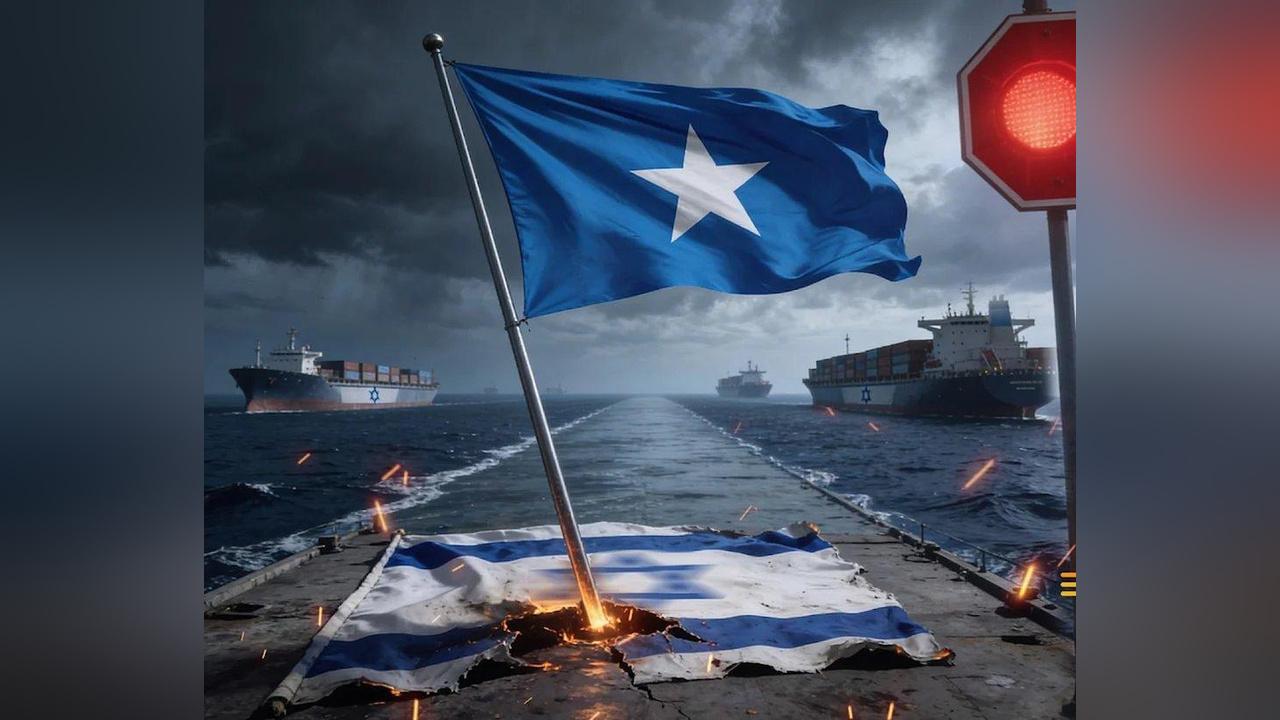
Africa-Press. Somalia has announced a decision to ban Israeli ships from passing through the Bab el-Mandeb Strait, a move described as a direct response to Israel’s recognition of the Somaliland region and its appointment of an ambassador there. The Somali ambassador to Ethiopia and the African Union warned that any interference in Somalia’s sovereignty would face consequences, stating, “Any country that interferes in Somalia’s internal affairs and harms its territorial integrity and sovereignty will face severe consequences, including potential restrictions on access to the Bab el-Mandeb Strait.”
What Does Somalia’s Decision Mean?
Does Somalia have the actual capability to enforce the ban on Israeli ships in Bab el-Mandeb? At first glance, it may seem that Somalia cannot militarily threaten Israel due to the disparity in power. However, targeting Israeli ships in Bab el-Mandeb does not require a significant power differential; a few small, fast boats could suffice, especially in an area known for piracy. Somalia has not claimed it will close Bab el-Mandeb but stated that its decision is limited to areas in the Gulf of Aden and the Red Sea, specifically the entrances to the Bab el-Mandeb Strait, and that the ban applies only to Israeli vessels. Practically, this is possible and feasible for Somalia to implement.
It is accurate to say that Somalia’s threat to Israel has limited impact; however, Somalia’s decision is not solely military; it is a political stance more than a military action. Therefore, its symbolic, strategic, and political significance is greater and more serious than merely a show of military force.
Somalia’s decision indicates that a new regional African actor has emerged, crossing the geography of the ongoing war, even if it has limited power. This actor has joined the threat to navigation associated with Israel, suggesting that the scope of the threat has expanded beyond Iran and its traditional allies to a rolling regional phenomenon. New regional parties have joined this axis, even if they are not traditional allies. The Red Sea, which Israel sought to dominate and position itself in, has now become a declared threat.
Somalia’s move towards escalation and threats in the entrances of Bab el-Mandeb and the Red Sea, which hold geographical and strategic value connecting Asia and Europe via the Suez Canal, represents a global strategic artery where the interests of major powers intersect. This means that any threat, even if limited, will raise insurance costs and compel shipping companies to reassess their strategies, placing the world on the brink of an energy crisis that could escalate into a global economic crisis.
Somalia’s rhetoric and its threat to Israeli ships transcend direct military dimensions to unconventional strategic political dimensions. The translation of this threat could lead to the formation of new alliance relationships between Mogadishu and Sana’a, and possibly develop into allied relations between Mogadishu and Tehran. This will not only be perceived as a threat to Israeli ships but also signifies that a maritime alliance extending from Bab el-Mandeb to the Strait of Hormuz may have formed, placing American and Israeli interests in the eye of the storm.
On the other hand, the significance of Somalia’s threat, even if its military implications are limited, as a media discourse and political stance means that Netanyahu’s dreams and promises of penetrating and infiltrating the African continent have evaporated. They now face warnings and threats from Somalia, which Netanyahu believed was a weak flank that he could exploit through recognition of the Somaliland region. This short-sighted assessment, instead of securing Israel a foothold on the Red Sea, has placed it in the crosshairs of Somalia from point-blank range.
Somalia’s Threat to Israel
Somalia’s decision to threaten Israel signifies a setback for the latest Israeli security assessments. On December 10, 2025, the former head of military intelligence recommended in a periodic publication from a national security institute that Israel views Somaliland as a potential partner in countering Islamic influence in the Horn of Africa and as a possible source of strategic support near sensitive shipping routes.
The miscalculation in the Israeli bet on Somaliland through coercion for recognition followed by separation has led to two developments. The first is Somalia’s public threat to Israeli ships in the Bab el Mandeb, indicating a new maritime front is emerging. The second is the mobilization of public support, as demonstrators in the Somali capital, Mogadishu, protested against Israel’s recognition of the separatist Somaliland region, suggesting that Somalia’s decision against Israeli ships is backed by public sentiment.
Israeli interference in Africa through the recognition of Somaliland and the appointment of an ambassador there has raised legitimate African concerns that Israel could encourage any region on the continent seeking separation and expedite recognition and ambassadorial appointments. This is a chronic historical issue that Africa has suffered from and continues to face. Consequently, an African coalition has begun to form to counter Israeli coercion, indicating that Somalia’s decision was not made in isolation but in coordination with several countries friendly to Somalia, all agreeing that Israeli intervention in the Red Sea threatens the safety, stability, and unity of these nations.
This means that Somalia’s decision is supported by other countries, even if that support is not publicly declared. This backing resolves the debate over strength and capability, indicating that there is an alliance supporting Somalia’s geographical strength and military power, not only to threaten Israeli ships in the Bab el Mandeb but also to confront any American or Israeli threat to Somalia or militarization of the Red Sea or presence therein.
Somalia’s decision to build cross-geographical alliances appears closer than one might think, reflecting a form of unannounced coordination and understanding. It is noted that Somalia’s decision coincided with statements from Ansar Allah in Yemen, expressed by leader Mohammed al-Bukhaiti in a post on a social media platform, asserting that any Israeli presence in Somalia would be a target for the Yemeni armed forces. He revealed that the authority in Sana’a is ready for a strong and painful strike against Israel, which will not be limited to maritime waters and airports but will extend to any presence on Somali soil.
Somalia’s threat to Israeli ships in the Red Sea, in coordination with Ansar Allah in Yemen, alongside the risks of Israeli coercion in Africa and fears of Israel’s foothold in the Red Sea amid rising Arab and African public anger against Israeli crimes, suggests that the conflict may expand. The war on Iran is no longer tied to a specific geography, and military confrontations may also occur in maritime corridors.
Somalia’s threat to Israeli ships should not be underestimated, even if it appears limited in capabilities. The significance lies in the political will’s impact more than military capability; Somalia’s threat to Israel represents a precedent that transcends assessments, as Israel now faces a more hostile regional environment in the three circles of Arab, African, and Islamic nations, not just in its immediate surroundings. This environment openly rejects and threatens Israeli presence, even if its military capabilities are limited; its political will is present and capable of translating the threat.
The repercussions and implications of Somalia’s decision also extend to the American-Israeli war on Iran, opening new fronts and introducing new actors, expanding the geography of confrontation to the extent that some chess pieces are tilting towards Iran. This raises the cost of war, broadens the scope of attrition, diverts military efforts, opens a front in the Red Sea, disrupts navigation, raises energy and shipping prices, and pressures the global economy, leading to international pressure to halt the war and prevent its spillover into new areas.
The last thing Israel or the U.S. expected or wanted, especially during their war on Iran, is Somalia’s threat to Israeli ships. This means the entry of new countries into the confrontation arenas, even if indirectly; how much more so if that country is African, standing on the shores of the Red Sea, facing the Bab el Mandeb.
In conclusion, Somalia’s threat to Israel indicates that it is not necessarily about possessing surplus military power; it is sufficient to have political will. Somalia’s decision rearranges the map of awareness and confirms that Israel is susceptible to threats and defeat.