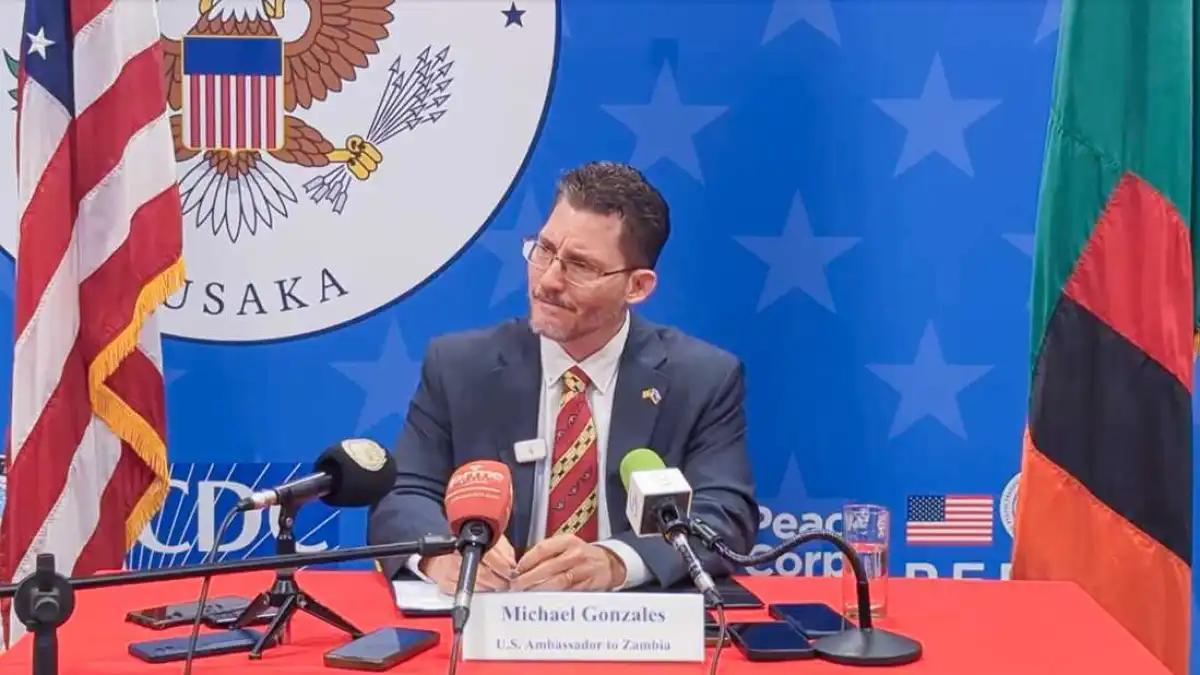
Africa-Press. The outgoing U.S. ambassador to Zambia, Michael Gonzalez, broke from usual diplomatic protocol during his farewell event last week at his official residence in Lusaka, making direct accusations against President Hakainde Hichilema’s government of “systematic and evolving corruption.” He emphasized that the authorities’ rhetoric on combating corruption has become eloquence unsupported by action, according to a local source.
In his speech, Gonzalez stated that U.S. aid to Zambia since 2000 has exceeded $7 billion in the health sector alone, revealing that “successive Zambian governments have failed to build sustainable systems,” accusing officials of diverting public resources “into their pockets” while leaving Washington to bear the burden of funding healthcare. He added that the country loses nearly $4 billion annually through illicit financial flows.
The ambassador also complained about the Zambian side’s disregard for official channels, saying: “Since January, we have received virtually no substantive communication; our calls are ignored, our questions remain unanswered, and our meetings are canceled.”
Context of the Crisis
These statements come amid a crisis that began a year ago when Gonzalez announced a reduction in U.S. aid to the Zambian health sector by $50 million annually, citing what he described as the systematic theft of U.S.-funded medicines. According to a statement from the U.S. embassy in Lusaka, American investigators found that between 2021 and 2023, 95% of nearly 2,000 pharmacies they visited were selling stolen products from U.S. aid, including antiretrovirals.
Gonzalez stated in his farewell address that “a year after that announcement, not a single prominent person has been arrested, and no significant legal proceedings have begun.”
Also in the background of the crisis is a collapsed $2 billion deal in the health sector. A local source reported that Zambian Foreign Minister Mulambo Haimbe accused Washington of linking this deal to conditions for access to critical minerals in the country, which the ambassador denied, calling it “disgusting claims that are completely false.”
In response, the Zambian government quickly described the ambassador’s remarks as “regrettable and undiplomatic, contradicting the spirit of mutual respect between sovereign nations,” citing Articles 3 and 41 of the 1961 Vienna Convention on Diplomatic Relations, which prohibit foreign missions from interfering in the internal affairs of the host state.
Zambian officials confirmed that Gonzalez did not file any formal diplomatic complaint despite available opportunities, considering that raising such a significant issue at a social event is not the appropriate context.
Conversely, part of the opposition supported the ambassador’s statements. A local source reported that the “Citizens First” party backed the ambassador’s narrative, while former diplomat Emmanuel Mwamba urged the government to respond to the accusations instead of resorting to threats.
Personal Stance or Message?
However, the key question raised by observers concerns the limits of speech for outgoing ambassadors: Did Gonzalez speak in a personal capacity at the end of his mission, or was he conveying a political message from the Trump administration?
According to a local source, Lusaka announced it would resort to diplomatic channels to ascertain whether the ambassador “spoke on behalf of the U.S. administration or in a personal capacity.”
The Associated Press interprets the speech in light of the re-engineering of U.S. aid to Africa under Trump towards a “transactional model” linking support to economic and strategic interests, particularly critical minerals. In this context, the ambassador’s sharp tone appears consistent with Washington’s new direction rather than a departure from it.
The crisis is also unfolding at a highly sensitive time as Zambia prepares for general elections on August 13. Analysts quoted by a local source believe the speech “has brought the issue of corruption back to the forefront of electoral debate,” providing the opposition with political material to confront Hichilema’s government.
The question remains open as to whether the “final speech” was merely a personal farewell reflecting a diplomat unable to hide his frustration, or an early signal of a new phase of tension between Lusaka and Washington.