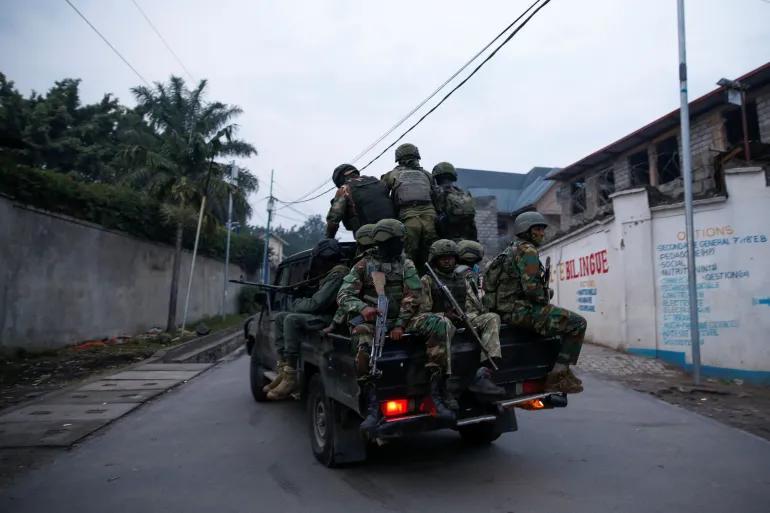
Africa-Press. An international human rights investigation has reported that the March 23 Movement, alongside the Rwandan Defense Forces, committed a series of serious violations of international humanitarian law in the city of Uvira in the South Kivu province of the Democratic Republic of the Congo during an occupation that lasted from December 10, 2025, to January 17, 2026.
According to investigations by a local source, many of these violations amount to “war crimes,” including unlawful killings, summary executions, rape and sexual violence, enforced disappearances, as well as the forced recruitment of civilians.
Uvira fell into the hands of the attacking forces just days after a peace agreement brokered by the United States between Rwanda and Congo, an agreement that did not prevent the escalation of military operations and was followed by widespread security collapse and the displacement of tens of thousands of residents.
Background of the Attack and Fall of the City
On December 10, 2025, the March 23 Movement and Rwandan forces entered Uvira following clashes in the South Kivu area. By the morning of the same day, fighting within the city had significantly decreased, indicating that military control was achieved after the withdrawal of Congolese forces and the “Wazalendo” militias.
Witnesses reported that the Congolese army and its allies fled almost entirely before the attacking forces entered, leaving civilians unprotected. As the new forces entered, searches began in residential neighborhoods, accompanied by random gunfire targeting men and boys in particular.
The killings included repeated accusations against victims of belonging to the “Wazalendo” militias, local groups loyal to the Congolese government.
Summary Executions in Eastern Congo
The local source documented at least 62 cases of unlawful killings and summary executions during the occupation, while field estimates suggest that the actual number may be much higher.
Violations were concentrated in the Kasenga and Rugingyi neighborhoods, where the attacking forces conducted house-to-house searches, ending with the execution of men and boys on the spot or taking them to unknown locations.
In one attack, the forces opened fire on civilians inside a restaurant in the port neighborhood, resulting in the deaths of five people. In another incident, fishermen on the shores of Lake Tanganyika were shot at, leading to the deaths of at least three individuals.
Survivors documented killings while attempting to flee towards Burundi or the surrounding hills, where entire family groups were shot at during their escape.
One witness reported losing four family members when they were shot while trying to leave the city, describing the scene as chaotic and violent, according to the human rights investigation.
House-to-House Searches
With the onset of complete control over the city, military operations shifted to search campaigns within neighborhoods, particularly in Kasenga.
In many cases, armed groups stormed homes, asking questions about residents’ connections to the “Wazalendo” militias before immediately opening fire on them.
The “Wazalendo” militias, also known as “Mai Mai,” are a broad network of local self-defense groups that emerged to resist what they perceive as “Rwanda’s expansionist ambitions.”
According to the local source’s investigation, multiple cases of entire families being executed were documented, including four siblings killed in their home, as well as a man and his son, while a child survived in one case despite being shot and stabbed with a bayonet.
A seven-year-old girl was also killed after being shot in front of her mother, while her father remains missing.
Testimonies indicate that the killings were systematic and often accompanied by threats and insults directed at civilians, including false justifications that the deceased “bring peace.”
Sexual Violence and Health Collapse
The period of occupation saw a sharp increase in sexual violence, with the local source documenting cases of rape committed by March 23 Movement forces and individuals suspected of belonging to the Rwandan forces, targeting women and girls in homes and fields.
Some victims were raped under threat of weapon, while family members were killed when they attempted to intervene.
The United Nations Population Fund reported over 80,000 cases of rape in eastern Congo during 2025, reflecting the extent of the crisis.
Many victims were deprived of psychological or legal care, with some resorting to pharmacies or rudimentary treatments without medical supervision.
Disappearance and Forced Recruitment
The local source documented 12 cases of enforced disappearance during the occupation, involving men, women, and a boy, who were taken by the forces to military bases without clear charges.
In several cases, individuals were stopped in public places and taken directly, with their fate unknown to this day.
Investigations also indicate that these cases may be part of a broader pattern of forced recruitment practiced by the March 23 Movement, where civilians were detained in training camps or military bases.
In one documented incident, a 16-year-old boy was taken in front of his friends and has not been heard from since.
Legal Framework and International Responsibility
The violations that occurred in Uvira are part of an armed conflict governed by international humanitarian law, including the Geneva Conventions.
According to the organization’s assessment, the nature of military operations and the actual control over areas in eastern Congo indicate that Rwanda exerts direct influence over the March 23 Movement, placing it in a position of potential legal responsibility as an occupying power.
Furthermore, the systematic nature of the violations, especially summary executions and mass killings, suggests possible involvement of military and political leadership in war crimes that warrant investigation and accountability.
General Findings and Implications
The local source’s investigation concluded that what happened in Uvira does not represent a series of isolated incidents, but rather a wide and organized pattern of violations against civilians, particularly targeting men and boys, alongside women who suffered sexual violence.
The investigation warns that the absence of accountability may lead to a recurrence of these violations in other areas of eastern Congo, especially amid ongoing armed conflict and weak judicial institutions.
It also emphasizes that protecting civilians requires independent international investigations and accountability for all responsible parties, whether from the March 23 Movement, Rwandan forces, or any local parties involved.
Recommendations from the Local Source
To the Rwandan Government:
– Commit to international humanitarian law in all military operations within the Democratic Republic of the Congo.
– Cease all forms of support provided to the March 23 Movement that facilitate or materially contribute to its military operations within Congo.
– Suspend the work of Rwandan forces involved in violations of international humanitarian law in eastern Congo and take appropriate disciplinary actions or prosecute them in fair and transparent trials, including leaders responsible for violations within the Rwandan Defense Forces.
– Conduct prompt, transparent, and impartial investigations into all allegations of human rights violations and international humanitarian law committed by elements of the March 23 Movement and prosecute them in fair and transparent trials.
– Provide urgent and adequate compensation to victims of violations by Rwandan forces and the “M23” Movement in Congo and their families.
To the March 23 Movement and Rwandan Forces:
– Ensure the immediate and safe release of civilians and others who have been arbitrarily detained, including those subjected to forced recruitment within Congo, and guarantee humane treatment for all detainees in accordance with international human rights and humanitarian law.
– Allow investigations by regional and international bodies and independent human rights monitors regarding human rights conditions in areas controlled by the March 23 Movement and Rwandan forces.
To the Government of the Democratic Republic of the Congo:
– Commit to international humanitarian law in all military operations in eastern Congo.
– Conduct prompt, transparent, and impartial investigations into all alleged human rights violations and international humanitarian law committed by all armed forces and armed groups involved in the conflict in North and South Kivu provinces, and ensure accountability for those responsible through fair and transparent trials.
– Establish specialized mixed judicial chambers or a similar court within the national judicial system, comprising Congolese and international judges, military and civilian, to address serious past and ongoing crimes.
– Provide urgent and adequate compensation to victims and their families and survivors of violations by Congolese armed forces and allied armed groups, including the “Wazalendo” militias.
– Allow investigations by regional and international bodies and independent human rights monitors in government-controlled areas in eastern Congo, directing military and administrative authorities to facilitate access, protect witnesses, and preserve evidence.
– Seek assistance from the United Nations, the African Union, partner countries, and NGOs to conduct proper exhumations of bodies from mass or shared graves in Uvira and return the remains to the victims’ families.
– Cease all forms of material support to the “Wazalendo” militias and other armed groups involved in violations and allied with Congolese forces.
To the African Union:
– Publicly call for an independent international investigation into the violations committed in Uvira and other areas in eastern Congo.
– Task the African Commission on Human and Peoples’ Rights with investigating the violations in eastern Congo and reporting on them.
– Pressure member states of the African Union to cooperate with accountability mechanisms, including the International Criminal Court.
To Other Governments:
– Support the independent investigation committee regarding human rights conditions in North and South Kivu provinces, mandated by the United Nations Human Rights Council in 2025, ensuring its ability to carry out its tasks.
– Impose sanctions on leaders of the March 23 Movement, Rwandan leaders, and other individuals reliably involved in serious violations committed in Uvira, including through targeted sanctions regimes.
– Enhance support for the International Criminal Court and its investigations regarding serious international crimes committed in eastern Congo, as well as support local efforts for investigation, prosecution, and compensation for serious past and ongoing violations committed by all parties to the conflict.
– Support the establishment of specialized mixed judicial chambers or a similar court within the Congolese judicial system, comprising Congolese and international judges, military and civilian, to prosecute serious past and ongoing crimes in Congo.
– Review military and security assistance and cooperation with Rwanda to ensure that this support does not contribute to fueling serious violations in eastern Congo.