
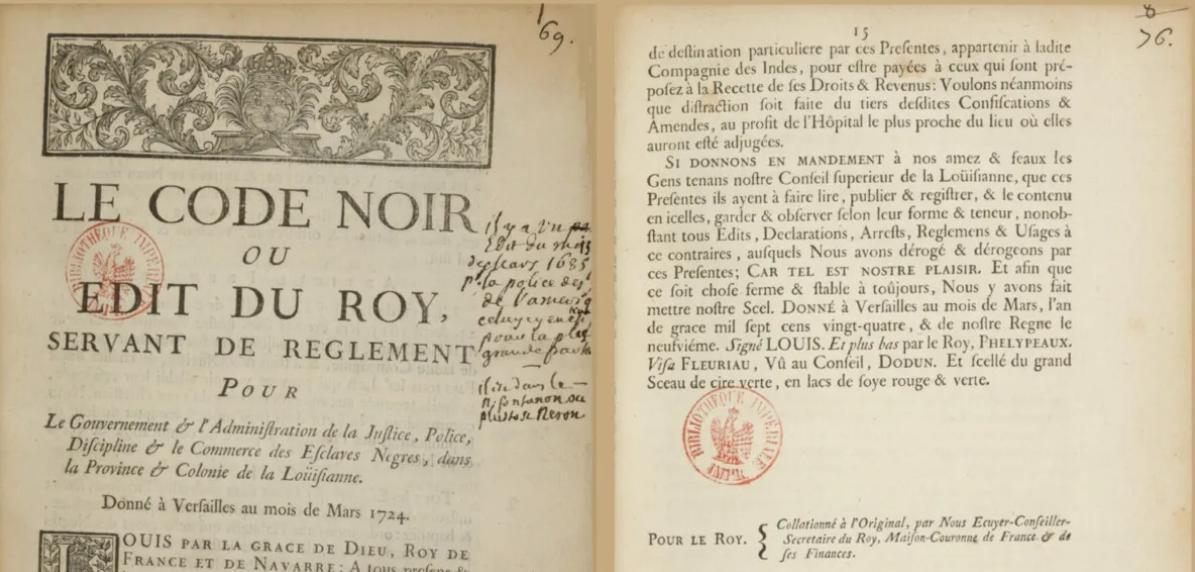
Africa-Press. The French Parliament voted unanimously to repeal the “Black Code” and all texts that regulated slavery in French colonies until 1848, in a symbolic move aimed at officially removing these laws from the French legislative system, as expressed by President Emmanuel Macron, as they “contradict the values of the Republic.”
The bill is carried by the deputy from the Guadeloupe region, Max Mathiasin, with support from a wide political spectrum ranging from the leftist “France Insoumise” party to the right-wing “Les Républicains” party. The legislative process for the bill is expected to continue before its final adoption.
This initiative coincides with the 25th anniversary of the “Taubira Law” issued in 2001, which recognized slavery and the slave trade as crimes against humanity.
The “Black Code” dates back to a series of royal decrees issued starting in 1685 during the reign of Louis XIV, aimed at regulating slavery in French colonies during the 17th and 18th centuries.
The “Black Code” defined enslaved individuals as “movable property,” treated as goods owned by their masters, and imposed harsh penalties on runaway slaves, ranging from branding with hot iron to the death penalty.
Although these texts lost any legal effect after the official abolition of slavery in 1848, they have not been officially removed from the French legislative record until today.
Last week, President Emmanuel Macron announced his support for the symbolic repeal of the “Black Code” during a ceremony held at the Élysée Palace to mark the 25th anniversary of the “Taubira Law.”
Macron considered the continued existence of these texts within French laws to be a “mistake” and a “betrayal of the values of the French Republic,” urging the government to support the bill, which had previously received unanimous approval within a parliamentary committee.
During his speech at that time, the French president addressed the issue of reparations related to slavery, a topic that continues to generate renewed debate within France and internationally.
Macron described the discussion on reparations as “an unfinished thought,” asserting that the first form of reparations lies in the “recognition” of the crimes committed, while emphasizing the need to avoid making “false promises.”
He stated, “We must be honest and acknowledge that we will never be able to fully rectify this crime, as that is impossible.”
During the event, former French Minister of Justice Christiane Taubira commented on a recent decision by the United Nations General Assembly, led by Ghana, which described slavery and the trafficking of enslaved Africans as “the gravest crimes against humanity.”
France, along with several European countries, abstained from voting on the resolution, justifying its position by rejecting the establishment of a hierarchy among crimes against humanity, a stance that Macron reaffirmed during his speech.
Nevertheless, the French president acknowledged that the demands for justice and reparations raised by several African countries and civil organizations “cannot be ignored.”
This initiative is part of France’s declared efforts to continue working on the memory related to slavery and its historical repercussions, at a time when the debate over reparations is increasingly intensifying on the international stage, particularly from African countries and human rights organizations calling for broader recognition of the historical responsibility of European colonialism and the slave trade.