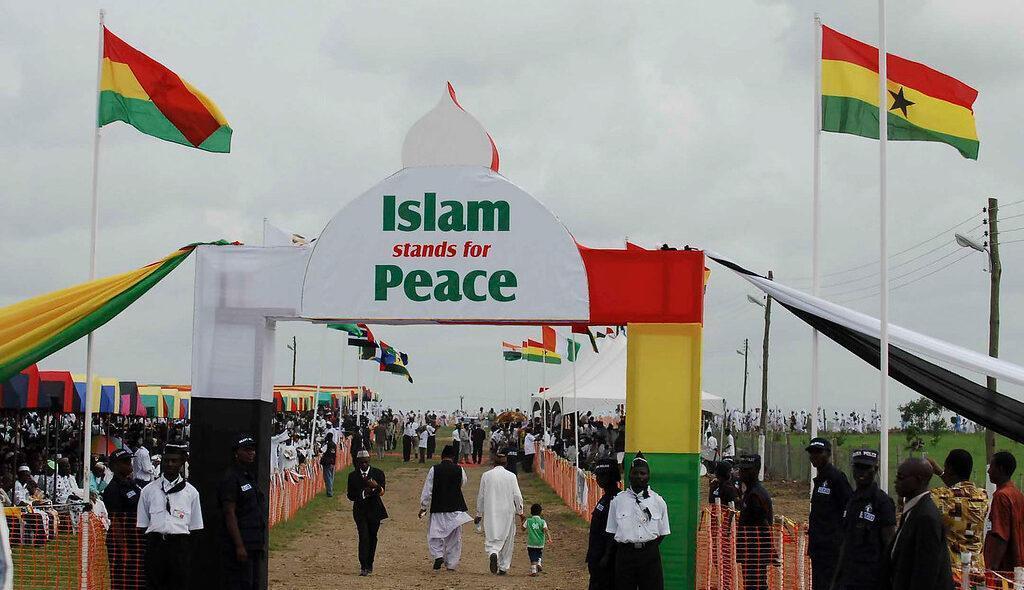
Africa-Press. The President of Ghana, John Dramani Mahama, announced the hiring of six thousand Arabic language teachers through a youth employment agency as part of a government program aimed at supporting Islamic education and providing job opportunities for young people. This initiative coincides with plans to rehabilitate the predominantly Muslim “Zongo” communities and enhance infrastructure and services in these areas.
The announcement was made during the Eid al-Adha celebrations held at the Black Star Square in the Ghanaian capital, Accra. The project was presented as part of a broader vision for national reconstruction following years of economic difficulties. The president emphasized that his government seeks to create sustainable job opportunities, improve living conditions, and strengthen national cohesion in a country recognized as one of the leading examples of religious coexistence in West Africa.
The announcement regarding the hiring of Arabic teachers was not merely an administrative event; it carried deep political and cultural implications, considering the historical significance of the Arabic language and Islam in Ghana, as well as the transformations in the state’s relationship with Islamic education since the colonial era.
The president stated that the hired teachers “have already received their full financial entitlements,” stressing that the government does not owe them any arrears.
Mahama confirmed that his government intends to expand the program in the coming years to hire more Arabic language teachers, viewing the project not only as support for Islamic education but also as a tool to address youth unemployment.
The president praised the executive director of the youth employment agency, Malik Basintali, and his team, commending what he described as the “smooth implementation” of the program.
In his speech during the Eid celebrations, the president was keen to link the issue of Islamic education with a unifying national discourse, urging citizens to protect peace and unity and to reject extremism, intolerance, and division.
He stated that Ghana continues to present a model of peaceful coexistence among various religious and ethnic backgrounds, emphasizing the need to uphold values of tolerance, respect, and mutual understanding.
The president paid special attention to the “Zongo” communities, announcing the imminent launch of projects to construct and rehabilitate roads and infrastructure in several of these communities spread across the country.
The “Zongo” communities are known as residential neighborhoods often inhabited by Muslim groups originating from northern Ghana and the Sahel and West Africa. Historically, they have formed centers of stability for Muslim migrants and traders.
These areas serve as the social and cultural incubators of Islam in southern Ghana, where multiple ethnicities blend under the umbrella of a shared Islamic identity, granting them a distinct cultural and religious uniqueness within Ghanaian society.
Mahama affirmed that his government is “determined to improve infrastructure, sanitation, education, healthcare, and economic opportunities in all Zongo areas.”
According to historical and anthropological studies, the presence of Islam in the country dates back to at least the 14th century when Muslim traders from Mali and the Sahel regions arrived in Ghana through trans-Saharan trade routes.
The “Jula” and “Wangara” groups were among the prominent groups that played a role in spreading Islam, trade, and Arabic education in the region, settling in various economic and commercial centers and contributing to the introduction of Arabic as a language of knowledge, administration, and documentation.
Over time, some Muslim scholars became writers and advisors in the courts of local kings, and Arabic was used to document historical events and official correspondence.
Historical sources indicate that some Ashanti kings employed Muslims in administration and judiciary roles, with some even influenced by Islam to the extent of using Sharia in certain civil matters.
Before the arrival of European colonialism, Arabic had already established itself in Ghana as a language of religion, education, and culture, with some researchers considering it the first non-African foreign language to enter the country.
With the spread of Islam, Quranic schools and educational institutions emerged, making the learning of Arabic an essential part of the religious life of Muslim communities.
However, the most significant shift occurred during the British colonial era when Arabic and Islamic education were marginalized in favor of a Western educational model linked to the English language and Christian missionary institutions.
Missionary missions took over the management of formal education, while Muslims faced discrimination and exclusion, prompting many to boycott colonial schools for fear of missionary influence on their children.
In one of the most telling incidents, colonial authorities in 1948 refused to grant a license for the importation of Arabic books for educational purposes, arguing that Arabic was not an officially recognized language in educational institutions in the Gold Coast, the name by which Ghana was known before independence.
Despite colonial pressures, Arabic and Islamic education continued to develop within the Muslim community, before entering a new phase after independence, particularly with the introduction of educational reforms aimed at integrating Islamic schools into the formal system.
During the 1970s and 1980s, state-supervised Arabic Islamic schools expanded, and the “Islamic Education Unit” was established as part of the government educational structure.
This period witnessed lengthy discussions between the state and Islamic schools regarding curriculum nature, integration of modern subjects, and teaching methods, but the final outcome was the gradual recognition of Islamic education and its incorporation into the national system.
Notably, Islamic schools became more numerous than schools affiliated with some major Christian educational units at certain times, reflecting the significant presence of Islam in the country.
With the dawn of the new millennium, Arabic in Ghana transitioned from merely a religious language to an academically recognized language in higher education institutions.
Arabic is now taught in prominent public universities such as the University of Ghana and the University of Education Winneba, alongside the Institute of Linguistic Studies, contributing to the graduation of new generations of specialists in language and Islamic studies.
Recent years have also seen significant official steps, including the adoption of Arabic as an elective subject in national secondary school examinations, a development many consider a qualitative shift in the state’s perspective on the Arabic language.