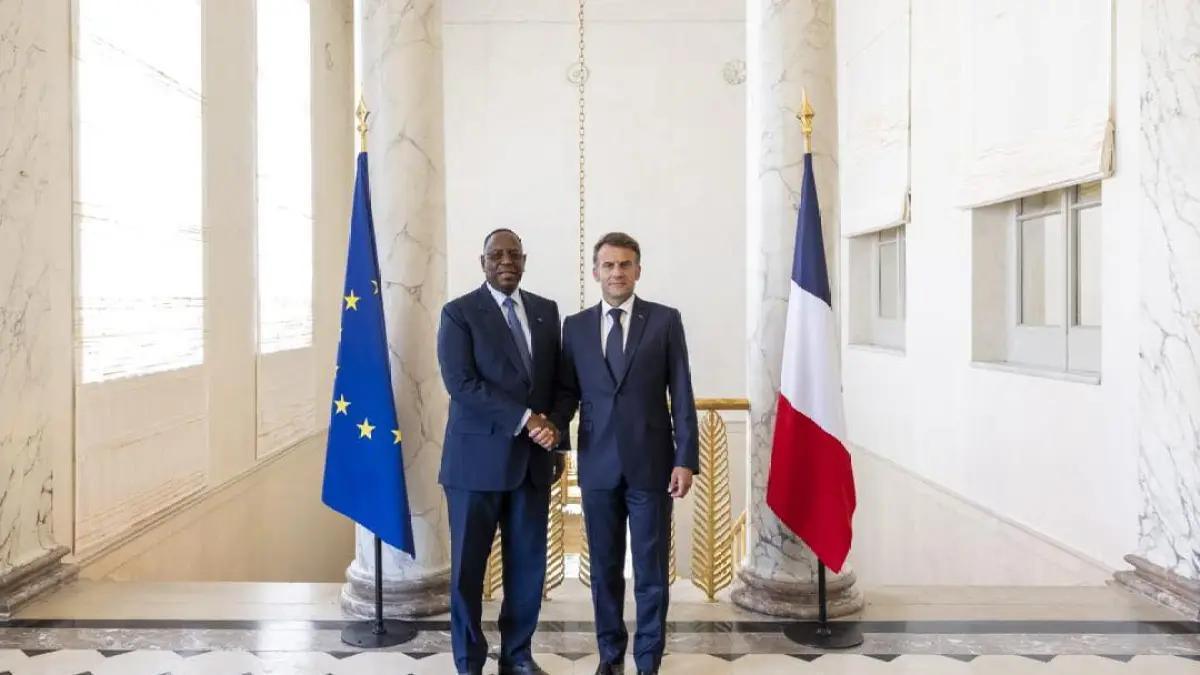
Africa-Press. The reception of former Senegalese President Macky Sall by French President Emmanuel Macron at the Élysée Palace in Paris this week has raised widespread questions regarding the background and timing of the meeting, especially as it comes amid diplomatic efforts led by Sall to support his candidacy for the position of Secretary-General of the United Nations, succeeding the current Secretary-General António Guterres, whose term ends at the end of this year.
Although the meeting appeared to be a routine gathering between a French president and a prominent African figure, its timing and political context suggest broader implications that extend beyond diplomatic niceties, touching on French influence in Africa, the future of the United Nations, as well as the complex international balances that govern the selection of its Secretary-General.
A Meeting at a Sensitive Time
Macron welcomed the former Senegalese president at the Élysée as part of a series of intense international moves that Sall has been making for months, aiming to enhance his chances in the UN race. The former Senegalese president is trying to present himself as a candidate capable of representing the Global South, with political, economic, and diplomatic experience that qualifies him to lead the international organization at a time marked by escalating crises, wars, and geopolitical divisions.
After the meeting, Sall expressed his satisfaction with the discussions, confirming a convergence of views with the French president regarding the future of the United Nations. He stated in a comment published after the reception: “I warmly thank President Emmanuel Macron for his kind reception and for our fruitful discussions at the Élysée. We share a vision of an ambitious and renewed United Nations to enhance its effectiveness, representation, and ability to respond to the aspirations of peoples and nations.”
He added that the discussion focused on the need for a “deep reform” within the international organization, making it more capable of keeping pace with international transformations and responding to the multiple crises facing the world, referring to ongoing wars and conflicts, economic tensions, and climate and migration crises.
However, it is noteworthy that the Élysée Palace did not issue any statement containing explicit or official support for Sall’s candidacy, leaving the door open for interpretations regarding the true nature of the French position.
Why Paris Specifically?
France does not seem to be an ordinary stop in Macky Sall’s international campaign. Senegal is considered one of Paris’s closest traditional partners in West Africa, and Sall maintained close relations with France during his presidency from 2012 to 2024, despite a rising popular sentiment against French influence in parts of the continent.
During his presidency, Sall played an important role in various regional and international issues, also serving as the chair of the African Union and emerging as a mediator in several political crises on the continent. This experience provides him with a diplomatic capital that can be built upon in a highly complex international race such as the position of Secretary-General of the United Nations.
From a French perspective, Paris may view a figure like Macky Sall as a relatively comfortable option, combining political experience and extensive international relations, without being fully aligned with any competing international bloc. Additionally, supporting him, even indirectly, could provide France with an opportunity to maintain its moral influence within Africa at a time when it faces a clear decline in several African countries, especially in the Sahel region.
However, France also appears cautious. An early official endorsement could place it in opposition to objections within the African Union or with other international powers that have their own considerations regarding the identity of the next Secretary-General.
A Highly Complex UN Race
The position of Secretary-General of the United Nations is one of the most sensitive international posts, as it is not only determined by the candidate’s competence or political weight but is also governed by delicate geopolitical balances, starting from consensus within the Security Council and ending with regional and geographical considerations.
According to unwritten norms within the organization, the selection of the Secretary-General takes into account a kind of geographical balance among regions. Some observers believe that Africa may push for the position this time, considering that the continent has not held it for decades, which gives African candidates, including Macky Sall, an additional opportunity.
However, the road remains complicated; any candidate practically needs the acceptance of major powers, especially the five permanent members of the Security Council, which hold veto power. This explains Sall’s efforts to intensify his communications with influential capitals, with Paris at the forefront.
The former Senegalese president had delivered a speech at the United Nations General Assembly last April, presenting his vision for UN reform, discussing the need to make the organization more representative and equitable for developing countries, and more capable of making effective decisions in the face of global conflicts.
Candidacy via Burundi, Not Senegal
One of the most intriguing points in Macky Sall’s candidacy path is that Senegal itself has not officially endorsed his candidacy. Burundi officially informed the United Nations in March of Sall’s nomination, fulfilling the requirement to submit nominations through a member state.
The notification was made in the name of the Burundian president as the current chair of the African Union at the time, which provided the step with an African political cover, even if it did not reach the level of continental consensus.
This detail reflects an important political complexity, as the nomination did not come from the country that Sall ruled for over a decade, but from another African party, raising questions about the level of real support he enjoys within his own country.
Dakar’s Neutrality… and Political Messages
In contrast, the current Senegalese government has adopted a neutral stance regarding the former president’s candidacy, a notable position given the symbolism and importance of the post.
Current Senegalese President Bassey Diumai Faye clarified, according to Senegalese media, that he was not officially informed of his predecessor’s candidacy, but learned about it through other African leaders, before later knowing that Burundi had submitted the nomination.
He also indicated that the issue had not been discussed within the African Union in a consultative manner, expressing regret over the absence of a collective discussion regarding such a significant candidacy. He concluded by affirming that Senegal is “not a party” to this initiative and that its official position is one of “neutrality.”
This position also carries internal political dimensions. The new administration in Senegal has come amid a political discourse different from that of Macky Sall’s era, adopting a greater degree of independence from Western powers and reflecting a desire to reshape the priorities of Senegalese foreign policy.
What Does the Élysée Meeting Mean?
In conclusion, it cannot be definitively stated that the meeting between Macron and Macky Sall signifies clear French support for the former Senegalese president’s candidacy, but it is also difficult to consider it merely a passing protocol meeting.
The reception at the Élysée provides Sall with an important symbolic and diplomatic boost in his international campaign, indicating that he still has the ability to reach major decision-making circles. Meanwhile, it offers France an opportunity to closely monitor the scene and perhaps test the Senegalese candidate’s prospects before taking a clearer position.
As Macky Sall continues to build an international support network for his UN ambitions, the most notable paradox remains that he is seeking one of the highest international positions based on his personal moves and external relations, while his own country is taking a clear distance from his project, preferring to maintain neutrality rather than engage in a diplomatic battle whose outcomes may be uncertain.