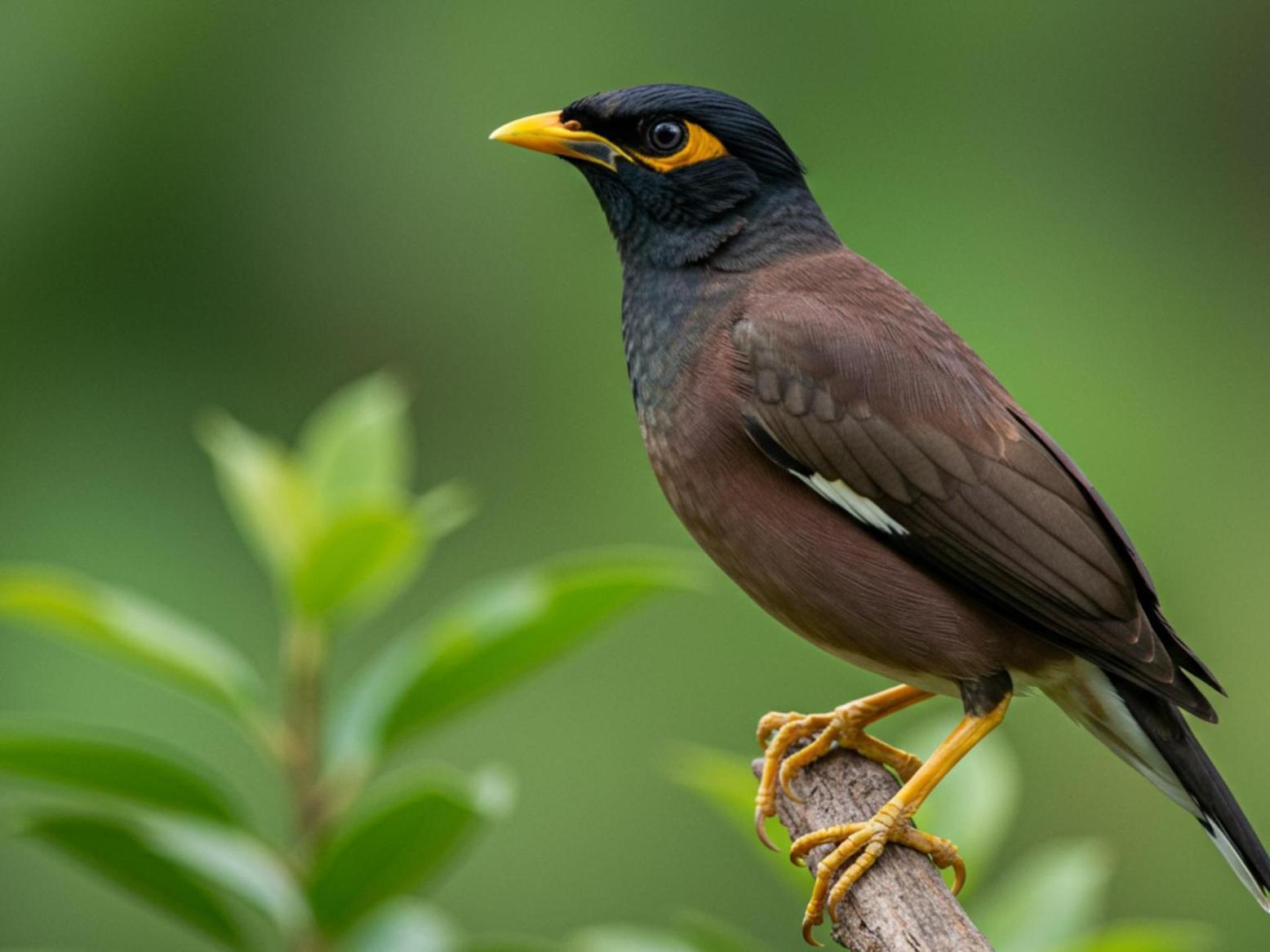
Africa-Press. In recent years, many residents of Egyptian cities have begun to notice a relatively strange bird in their daily surroundings. It is medium-sized, with a brown body, a black head, a prominent yellow beak, a yellow patch around the eye, yellow legs, and a loud voice that varies between whistling, screeching, and chattering.
The bird can be seen on streetlights, walls, in public parks, and sometimes near garbage bins and open food areas. Unlike small sparrows, it does not hop but walks steadily on the ground.
This bird is the “common myna” or “Indian myna,” scientifically named “Acridotheres tristis.” At first glance, it may seem like a pleasant addition to the diversity of birds in Egyptian cities, but to environmental scientists, it is not just a new visitor; it is an invasive species capable of spreading, reproducing, and competing with local species, especially in urban and semi-urban environments.
What is the Indian myna?
The common myna belongs to the same family as the European starling and other species known for their intelligence and ability to live near humans. Its native habitat extends from South Asia to parts of Central and Southeast Asia, in areas close to Iran and Afghanistan, reaching the Indian subcontinent, Sri Lanka, and Southeast Asia.
However, this bird has not remained confined to its original range; it has been intentionally or accidentally introduced to many parts of the world, including Australia, New Zealand, Pacific and Indian Ocean islands, South Africa, and parts of the Middle East.
The myna’s success comes from its adaptability; it eats insects, fruits, seeds, food scraps, and small invertebrates, and it can benefit from human waste. It nests in cavities of all kinds, from tree holes to building crevices to wall openings. These traits make it very suitable for urban areas, where food is abundant, buildings are numerous, and natural competition is less than in stable wild habitats.
How did it enter Egypt?
According to a study published in “Sandgros” in 2015, the first known record of the common myna in Egypt was of a single bird seen in Ain Sokhna south of Suez in April 1998.
Another unpublished record from Sharm El Sheikh in South Sinai appeared between 1998 and 2000. These early sightings are significant as they indicate that the bird’s entry into Egypt was not entirely new but likely began in the late 1990s before becoming more apparent in recent years.
Subsequently, observations intensified in North Sinai, where researchers recorded the myna’s presence in areas such as Zaraniq, Al-Arish, and Rafah between 2008 and 2010.
Most importantly, the study documented the first evidence of its breeding in Egypt in 2009, near the Zaraniq Protected Area, when a pair was found nesting in a cavity inside a salt factory building.
This was a pivotal moment in research; seeing an invasive bird is one thing, but confirming its breeding is entirely different. Breeding means that the species is no longer just a transient bird or an escapee but is capable of forming local populations.
Geographically, Sinai and the Suez Canal area seem logical starting points for its spread, as they are close to dense human, commercial, and tourist movement routes. They are also near regions in the Middle East where the myna has been recorded, such as Jordan, Palestine, and Gulf countries.
Although the myna does not typically fly very long distances alone, human movement, transportation, ports, bird trade, and the fragmentation of its journey into suitable urban stops may all aid its expansion.
A wide Egyptian map
The most recent and significant study was published in 2024 in “Sustainability,” focusing on predicting the range of the common myna’s invasion in Egypt under the influence of climate change. The study conducted monthly surveys between February and December 2023 at numerous Egyptian sites.
The study included locations in Cairo, Giza, Alexandria, Matrouh, Dakahlia, Port Said, Damietta, Ismailia, Suez, Sharqia, Kafr El Sheikh, the Red Sea coast, Asyut, Aswan, as well as North and South Sinai.
Researchers recorded 117 sites of invasion or presence of the myna in Egypt. This number does not necessarily mean that the bird fills all these governorates with the same density, but it indicates that its range of appearance is no longer confined to one or two points; it has become distributed across multiple urban, coastal, agricultural, and Nile pathways.
The results showed that the most suitable habitats for the myna in Egypt are concentrated near the Nile Delta, the Suez Canal area, North Sinai, some areas along the Red Sea coast, regions along the Nile in Upper Egypt, and limited areas in the northwest of the Western Desert, as well as areas in South Sinai.
The study estimated that the currently highly suitable areas for the myna cover about 8,240 square kilometers, approximately 0.8% of Egypt’s area, while moderately suitable areas cover about 16,972 square kilometers, roughly 1.7%.
Although these percentages may seem small, they are not environmentally negligible, as they are not randomly distributed in the vast desert but are often concentrated where humans live, and agriculture and green spaces exist.
Climate change
The 2024 study indicates that thermal factors were among the most influential in habitat suitability, particularly the lowest temperature in the coldest month and the average temperature of the coldest quarter, along with elevation above sea level.
This is important because cold can be a natural limit restricting the spread of some species coming from warmer areas. As temperatures rise, new areas may become less harsh and more suitable for the bird’s survival and reproduction.
The study predicted that by 2100, the area of highly suitable habitats for the myna in Egypt would increase under warming scenarios, with a more pronounced increase in high-emission scenarios.
However, these models do not state that the bird will “inevitably invade” every suitable area; they indicate that environmental conditions may become favorable. The actual invasion depends on other factors, including the bird’s arrival at the location, food availability, successful nesting, competition with local species, and the extent of human intervention in monitoring or management.
Why are scientists concerned?
The primary concern is that the myna is not just an invasive bird; it is globally classified among the highly dangerous invasive species and has been listed in the Global Invasive Species Database as one of the “100 worst invasive species in the world.”
The first danger is competition for nesting sites, as many birds require cavities in trees, buildings, or rocks to lay their eggs. The myna is relatively strong and aggressive and may fiercely defend nesting and food sites.
In an environment like Egyptian cities, where old trees and natural cavities are scarce and modern buildings are less suitable for wildlife, suitable openings become a limited resource. If the myna takes over a significant portion of these sites, it could pressure local or resident birds that use the same type of resources.
The second danger is the impact on small birds. Studies from Australia and the Seychelles have shown that the myna may be associated with a decline or slowdown in the growth of some small bird populations or cavity-nesting birds. The removal of the myna on some islands has helped threatened local species recover.
These results do not mean that the same scenario will occur in Egypt to the same extent, but they provide an early warning. When a globally recognized species for its aggressive behavior and ability to occupy cities appears, it is wise not to wait until losses become evident.
The third danger is agricultural; the myna eats fruits, and its flocks can feed on various fruit crops. So far, it seems there is no extensive Egyptian study accurately measuring its agricultural losses, but global experience indicates that the bird can cause problems in orchards and fields, especially if its numbers increase near fruit-growing areas.
Finally, there is a health and urban risk. Birds living near humans and moving around garbage, restaurants, and markets may transmit parasites or pathogens. Additionally, their large gatherings may cause noise disturbances and pollution from droppings.
This does not mean that every myna is a direct threat to public health, nor should panic be spread, but waste management, preventing random feeding of birds, and reducing their gathering places near sensitive facilities remain important preventive measures.
What does Egypt lack?
Despite the importance of the 2015 and 2024 studies, the Egyptian file is still in its early stages. There is documentation of breeding and a good predictive model, but more long-term studies are needed to answer more precise questions such as: What is the population of mynas in each governorate? Is it increasing annually? What are the most successful habitats? Does it compete with specific Egyptian species? Does it affect the nesting success of hoopoes, local starlings, sparrows, small owls, or other species that may use cavities? Does it cause measurable agricultural losses? Are there hotspots that require early intervention?
In this context, the solution does not begin with panic or random calls to kill the birds, but with early scientific management, starting with regular monitoring, then reducing what makes cities attractive to it, and monitoring the trade and release of birds, as introducing more of this bird increases the chances of forming new populations.