Africa-Press. The four agreements signed between Niger and Turkey in Ankara open a new chapter in the bilateral relations between the two countries, while also raising broader questions about the nature of the geopolitical transformations occurring in the Sahel region and Ankara’s growing role within it. The visit by the head of the ruling military council in Niger, Abdrahmane Tiani, to Turkey was not merely a routine diplomatic stop, but appeared to be an attempt to redraw the network of external alliances for Niamey amid deep security, political, and economic changes since the coup in 2023.
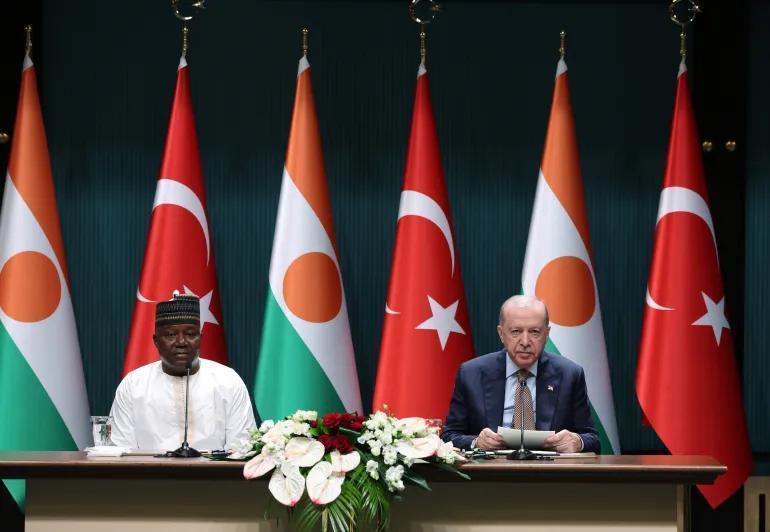
During the visit, Tiani met with Turkish President Recep Tayyip Erdoğan in the capital Ankara, where four official agreements were signed covering higher education, trade, health, and diplomatic training, alongside extensive discussions on more sensitive issues such as military, security, energy, and mining cooperation.
The agreements included a protocol for cooperation in higher education for the period from 2026 to 2030, a joint declaration to establish a joint economic and trade committee, a protocol for joint operation and expansion of the Turkish-Niger Friendship Hospital, as well as a memorandum of understanding for cooperation between the Turkish Ministry of Foreign Affairs’ Diplomacy Academy and the National Institute for Diplomatic and Strategic Studies in Niger.
A Visit Beyond Protocol
Tiani’s visit to Ankara carries dimensions that go beyond the announced agreements, as it marks his first official trip outside the African continent since taking power after the ousting of President Mohamed Bazoum in July 2023. According to a local source, Tiani arrived at the head of a large delegation that included ten ministers, reflecting the significance of the visit for the Nigerien authorities.
This move comes as Niger seeks to diversify its international partnerships following a sharp deterioration in relations with France, the former colonial power, and the withdrawal of French troops from the country, as well as the cooling of relations with some Western partners who criticized the military coup.
In this new equation, Niamey aims to build an alternative network of alliances based on partners who do not tie political cooperation to conditions related to governance or democracy, which gives Turkey, alongside Russia and China, a prominent position in Niger’s strategic calculations.
Why Niger Matters to Turkey
For Ankara, Niger does not appear to be just a new African partner, but represents an important gateway to enhance Turkish influence in the Sahel, a region that has become increasingly competitive due to its geographical location, natural resources, and security challenges.
During the joint press conference, Erdoğan described Niger as one of Turkey’s “closest friends” in Africa, affirming his country’s support for Niamey in facing armed groups that threaten stability, particularly in the Sahel region.
Turkey has been striving for years to solidify its presence in Africa through a multi-faceted strategy that combines economics, diplomacy, humanitarian aid, and military cooperation. Ankara has strengthened its presence on the continent through embassies, Turkish Airlines, development projects, as well as educational and charitable institutions.
In Niger specifically, the Turkish “Knowledge Foundation” operates 12 schools in the capital Niamey, serving over 1,700 students, while around 500 Nigerien students study at Turkish universities, reflecting Ankara’s reliance on soft power tools alongside economic and military partnerships.
Security and Defense: The Most Important File
Although the four agreements focused on education, health, and trade, the security aspect appears to be the most significant in the visit. Erdoğan confirmed that discussions included cooperation in military and intelligence training, at a time when Niger faces increasing threats from armed groups linked to ISIS and al-Qaeda in the Sahel.
For his part, Tiani emphasized the importance of Turkish military support, noting that the Nigerien armed forces are now equipped with Turkish military vehicles and systems that have contributed to enhancing security and stability.
In recent years, Turkey has emerged as one of the leading suppliers of military drones to Africa, especially to Sahel countries facing complex security challenges. International media reports indicate that Niger has received Turkish “Bayraktar TB2” drones and “Akinci” drones produced by the “Baykar” company, which gained widespread fame due to their use in several regional conflicts.
Niamey views this military technology as an effective tool to compensate for the decline in Western security support and to confront armed groups through less costly and more capable means of monitoring vast desert borders.
Economy and Minerals: The Unannounced Dimension
Although official statements focused on health and education cooperation, observers believe that one of the main objectives of the visit is to pave the way for broader Turkish investments in the mining and energy sectors.
Niger possesses significant natural resources, including uranium, gold, and oil, sectors that the military government seeks to invest in more extensively to achieve economic independence and reduce reliance on traditional Western companies.
Nigerian media reported that discussions included attracting Turkish investments in uranium, gold, and oil sectors, which aligns with Ankara’s desire to secure new sources of energy and strategic minerals, especially amid the increasing global competition for African natural resources.
The announced joint economic and trade committee could also contribute to increasing trade volume between the two countries, which remains below expectations compared to the available economic potentials.
From Break with France to Diversifying Partners
This step also comes in the context of the transformations occurring in the Sahel region following a series of military coups in Mali, Burkina Faso, and Niger, which have accompanied a decline in French and Western influence.
Niger, which was considered a key ally of the West in the fight against terrorism, has chosen since the coup to reposition itself strategically by diversifying partners and opening up to new powers. In this context, Turkey appears to be an attractive option; it combines military capabilities, economic expertise, and less sensitive political engagement compared to Western powers.
Conversely, Niger offers Ankara an opportunity to enhance its presence in the Sahel, which has become one of the new arenas of international competition, whether between Western powers and Russia or among emerging economic powers seeking a foothold in Africa.
Do the Agreements Establish a Broader Partnership?
It is difficult to view the four agreements as merely limited sectoral cooperation, as they seem closer to a foundational step for a broader strategic partnership between the two countries. The defense, energy, and mining files discussed on the sidelines of the visit suggest that what has been announced represents only a part of larger understandings that may crystallize in the coming years.
For Niger, rapprochement with Turkey provides a partner capable of offering security support and economic investment without significant political pressures. For Turkey, Niger represents an important pivot to enhance its presence in West Africa and the Sahel, as part of a broader strategy to strengthen Turkish influence on the continent.
Thus, the four agreements may only mark the beginning of a new phase in relations between Ankara and Niamey, a phase that transcends education and health to encompass security, influence, and natural resources in a region where power balances are changing rapidly.