
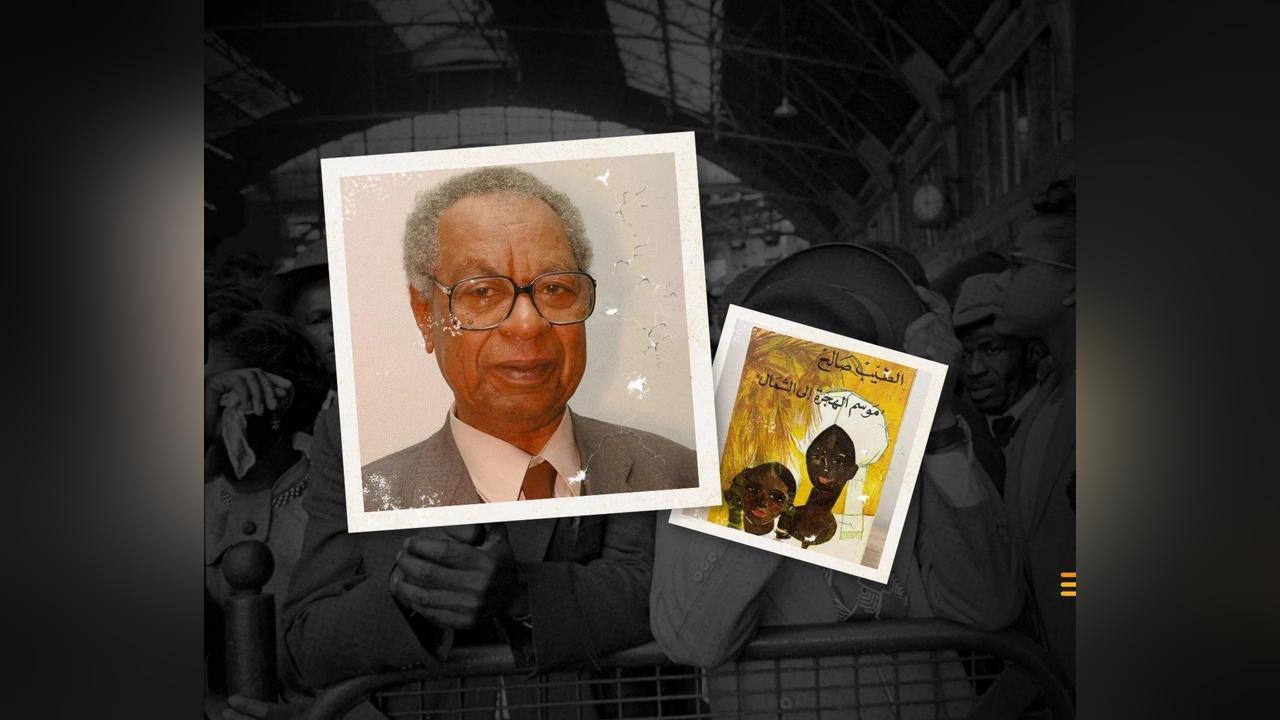
Khalil Suwaileh, novelist and journalist
Africa-Press. The publication of the novel “Season of Migration to the North” by Sudanese novelist Tayeb Salih (1929-2009) 60 years ago was a significant event that shook the Arab literary scene for many reasons. Aside from the importance of its content and the originality of its experience, this novel explores intense atmospheres as it tells the story of a novelist who writes his most famous work about an environment that is closer to magical realism before it became widespread in Latin American literature.
The novel was published in the Beirut magazine “Dialogue” before being released as an independent book, but it was banned in most Arab countries due to its boldness in breaking taboos and its association with exposed literature and harsh realism.
The protagonist, “Mustafa Said,” studied in Cairo and then migrated to London as more of a conqueror than an immigrant, facing European post-colonialism with his Eastern masculinity. He acted as a womanizer, luring many women into his room filled with the scents of the East and the lascivious poetry of Abu Nuwas that captivated his lovers before they fell into his destructive traps.
The Self and the Other and European Centrality
The seduction ends in suicide, and love leads to humiliation and contempt, as “Jean Morris” submits to him after he pursued her for three years, agreeing to marry this “savage bull.” However, the tragedy becomes more tense and complicated between them, prompting Mustafa Said to kill her, resulting in a seven-year prison sentence. He ends up wandering in distant lands before returning to a Sudanese village as a stranger, quickly integrating into the lives of farmers after acquiring land, marrying, and having children, leaving his academic credentials forgotten in drawers.
On the other hand, the narrator, who has just returned from London, traces the story of this mysterious person through another lens. His character reveals a tense being whose life is filled with enigmas, and he decides to get to know him closely, hoping to uncover some of his secrets.
At this point, Tayeb Salih decides to end Mustafa Said’s life by drowning him in one of the Nile’s floods, taking over the narrative himself and occupying his place. He proposes to marry Mustafa’s widow, “Hasna bint Mahmoud,” but her family forces her to marry “Wad Al-Rais,” prompting her to decide to kill him and then commit suicide as a form of rejecting slavery.
The novel involves narrative workings about the self and the other, the distances between the North and the South, the meaning of alienation, national identity, and black skin. As Edward Said describes this novel, it represents a counter-journey to Joseph Conrad’s protagonist in “Heart of Darkness,” serving as a highly significant literary and intellectual document for deconstructing the binary of East and West and the processes of “post-colonialism.” It also sheds light on “cultural hybridity” and the fragmentation experienced by the immigrant between his admiration for Western civilization and his retention of his Eastern instincts and resentment towards its political oppression, exposing the ailments of European centrality.
Between the Nile and the Thames
Thus, Tayeb Salih depicts two opposing paths in the fates of his characters, as if he is rowing between the Nile and the Thames with a single oar: the warmth of Sudan and the coldness of London, obedience and rejection, desire and contempt, the troubled values of the West, and the lies of the East narrated by Mustafa Said to satisfy the Western imagination.
He triumphantly declares, “I have come to you as a conqueror,” but he ends up as a killer, his physical authority fading into defeat and loss as he returns to his original source in an attempt to reaffirm himself in another way, by engaging with rural values and attempting to uplift them. The narrator will continue what Mustafa Said began: “We will destroy and build, and the sun itself will submit to our will, and we will defeat poverty by any means.”
On another front, the novel critiques the colonial era in loud debates, accusing it of settling backwardness to control the country’s wealth. “The ships first sailed down the Nile carrying cannons, not bread, and the railways were originally built to transport soldiers, and they established schools to teach us how to say ‘yes’ in their language.”
From this perspective, the novel addresses the cultural shock and identity struggles without bias towards either side. Above this narrative canvas, the image of the ongoing conflict between village values and imperial violence unfolds. “Learn silence and patience from the river and the trees,” but the narrator diverges from Mustafa Said in his shameful behaviors as a symbol of vulgar and primitive masculinity, and a compensatory image for his military losses.
The narrator states, “I want love to overflow from my heart, to spring forth and bear fruit. There are fruits that must be picked, many books to be read, and blank pages in the record of life. I will write clear sentences in bold handwriting.”
The Response Through Writing
Courage, then, lies at the heart of the narrative architecture, which has granted this novel an exceptional status. In the classifications of the history of Arabic literature, “Season of Migration to the North” ranks among the top 100 Arabic novels of the 20th century, having been translated into about 30 languages and inspired numerous critical readings that deconstruct its narrative structure, as seen in the writings of George Tarabishi, Rajiha Al-Nakhas, Jaber Asfour, Ali Al-Ra’i, and Fakhri Saleh. They viewed the significance of this novel as lying in the “response through writing” against European colonialism, in a unique architectural construction that transported Arabic literature to an experimental area distinct from the stable classical text.
Critically, the novel “The North” stands out as a unique gem compared to other works by Tayeb Salih such as “The Wedding of Al-Zein,” “Bandar Shah,” “The Light of the House,” and “Miryud.” But wait, what if this novel were published today? Would it receive the same critical acclaim? In the absence of a strict critical compass and the abundance of novels, perhaps someone would write a quick review of the novel or a brief news piece on one of the fleeting platforms.
Most likely, this novel would be hastily folded in response to new questions about identity struggles, not with the other, but with identity itself in its current fractures, in addition to the surge of Arabic novels following the “invasion” of new immigrants to Europe and their attempts to integrate, where “Mustafa Said” would find no place for himself in the lost paradise!