Africa-Press. Congolese opposition leader Martin Fayulu was injured in the capital Kinshasa during a gathering organized by coalitions of opposition parties protesting a proposed constitutional amendment.
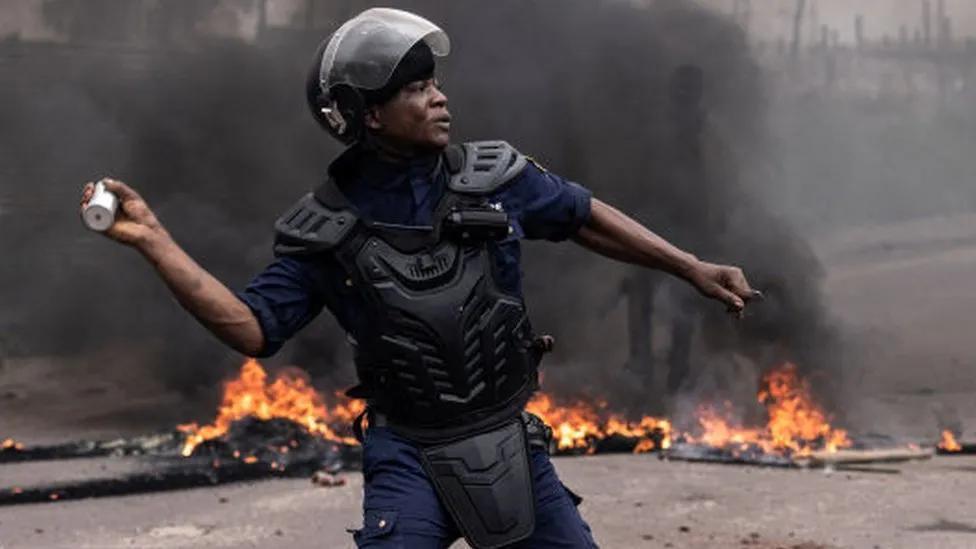
The demonstration, which was heading towards parliament, turned into clashes between opposition supporters and government backers, along with police forces, who dispersed the protesters using tear gas.
Fayulu, who came in second in the presidential elections held in December 2018, was participating in a procession that included several prominent opposition parties, which accuse President Felix Tshisekedi of seeking to remain in power.
Tshisekedi has been in power since 2019, and his second five-year term is set to end in 2028. The Congolese constitution limits the presidency to two terms only.
However, the presidential majority has been pushing for a constitutional amendment for several weeks, and the Congolese president stated in early May that he would accept running for a third term “if the people want it,” following a referendum.
In this context, a coalition of major Congolese opposition parties attempted to organize a gathering in front of parliament in Kinshasa on Friday to protest the proposed constitutional amendment.
The gathering quickly escalated into clashes between opposition supporters and government backers, before the confrontations extended to police forces.
The police dispersed the procession, which included around one hundred activists, using tear gas, and during these events, Martin Fayulu was injured. He finished second in the 2018 elections and third in the 2023 elections.
Additionally, Fayulu’s communication team reported via a social media platform that he “was shot in the leg by police,” although this claim has not been officially confirmed.
Following these confrontations, several opposition supporters sought refuge at Fayulu’s party headquarters, “Engagement for Citizenship and Development (ECIDE),” while reports indicated that police officers and government supporters attacked the party’s headquarters, throwing stones and using water hoses to disperse those inside.
The proposed referendum law has become a focal point of increasing polarization between the government and the opposition, where legal and political issues intersect, turning the legislative text into a battleground over the future of the constitutional system and the limits of power.
An analysis of the official and opposition discourses reveals a deep divergence in interpreting the law’s function and implications, which exacerbates the crisis of trust between Tshisekedi’s government and the Congolese opposition regarding the referendum law.
Tshisekedi’s government presents the proposal as a reformative step aimed at updating the legal framework related to the referendum law, which, according to the official narrative, still relies on a law from a transitional period over 20 years ago that is no longer aligned with the political and institutional transformations in the Democratic Republic of the Congo.
The new law is also presented as a mechanism to fill a legislative gap and organize a practice enshrined in the constitution, based on Article 5, which recognizes the referendum as one form of expressing popular sovereignty.
In contrast to the official efforts to dispel doubts about the law’s objectives, the opposition adopts a radically different interpretation, describing the proposal as “an additional step towards a disguised constitutional coup.”
The opposition camp believes that the proposal aims not to organize the referendum but to create an alternative legal pathway that allows for the reformation of the constitutional system outside the explicit constraints currently in place.
The “Lamuka” coalition, led by Martin Fayulu, has adopted a similar stance, with its spokesperson emphasizing that the country’s primary priorities include addressing deteriorating economic and social conditions, including the crisis in basic services, rising unemployment, and ongoing security challenges in several regions.