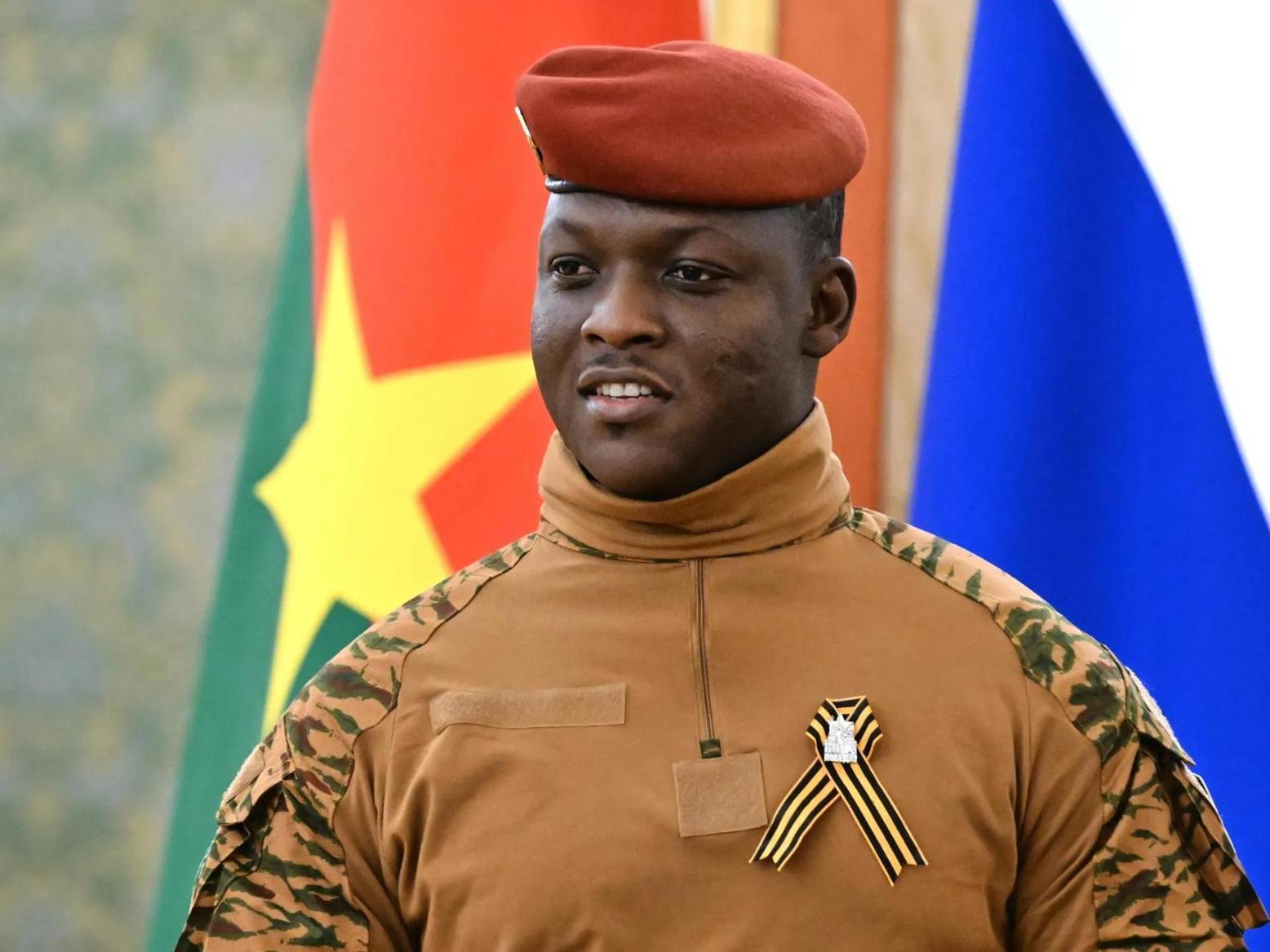
Africa-Press. The transitional leader in Burkina Faso, Ibrahim Traoré, issued one of his strongest warnings to date regarding what he described as religious extremism, stating that “radical Islam” has no place in the country. Addressing preachers whom he accused of extremism, he said, “If this is your Islam, we will fight it. Extremists must change, and if they do not, the battle has begun.”
Traoré emphasized that religion should attract its followers through good behavior, not through intimidation or violence. He questioned why some Muslims oppose the new law on religious freedoms in the country and warned that authorities would suspend the activities of imams who use their sermons to spread extremist messages. He pledged government financial support for imams who promote what he described as peaceful and responsible religious discourse. He mentioned that external forces are seeking to use religion to destabilize Burkina Faso.
He also announced a plan to repatriate students studying Sharia in Arab countries, claiming that over 800,000 students are pursuing Islamic studies abroad without acquiring practical professional skills. He warned that those who refuse to return risk losing their Burkinabé nationality. This announcement follows a government directive issued in late June requiring those wishing to study abroad to obtain prior approval from the Ministry of Higher Education to ensure their programs align with government priorities.
The transitional parliament unanimously adopted the controversial law on religious freedoms on June 20, which authorities stated aims to “entrench the secular nature of the state.” The law imposes criminal penalties and fines for practices deemed arbitrary by the authorities related to religion, notably forced child begging and lack of financial transparency among religious organizations.
From Ally to Adversary
The law’s approval was preceded by street clashes. In late May, Imam Mohamed Ishaq Kindo, a prominent figure in the Sunni movement, was arrested after criticizing the draft law. In his recent speech, Traoré referred to this arrest and the protests that followed, stating that “a small minority of extremists” are responsible for creating problems.
Following a gathering of worshippers demanding his release, authorities closed the largest Sunni mosque in the capital, Ouagadougou, citing risks of “disruption of public order.” A security source reported that around a hundred of the imam’s supporters were taken to a camp described by authorities as “civil training.” Earlier, in mid-April, Imam Mahmoud Barro of Bobo Dioulasso was arrested under similar circumstances, and the Timbuktu Institute noted that no information about Kindo’s fate has been released since the crackdown on protests.
The Timbuktu Institute for Studies believes this rupture reveals the structural limits of the “implicit contract” between the government and Islamic circles, which Traoré relied on for part of his popular legitimacy. By turning against former allies, he risks draining a significant source of this legitimacy without resolving the security issues that justify his measures.
An Israeli Thread in the Background
In parallel with internal hardening, Ibrahim Traoré officially received the new Israeli ambassador, Simon Sarosi, in Ouagadougou to present his credentials. Previously, the magazine “Africa Intelligence” revealed that the accreditation request submitted in the summer of 2025 had remained pending until it was quietly approved. This public reception marks the end of the caution and restraint imposed by Traoré’s circle to maintain his anti-Western image, at a time when Israeli intelligence is intensifying exchanges with Sahel coalition countries interested in its security technologies.
Between a speech threatening “extremists” that “the battle has begun,” a law passed unanimously, and imams whose fates remain unknown, the question posed by the Timbuktu Institute remains: Will control over the “production of public legitimacy” shift from a tool of regulation in the hands of the government to a new source of confrontation with it?