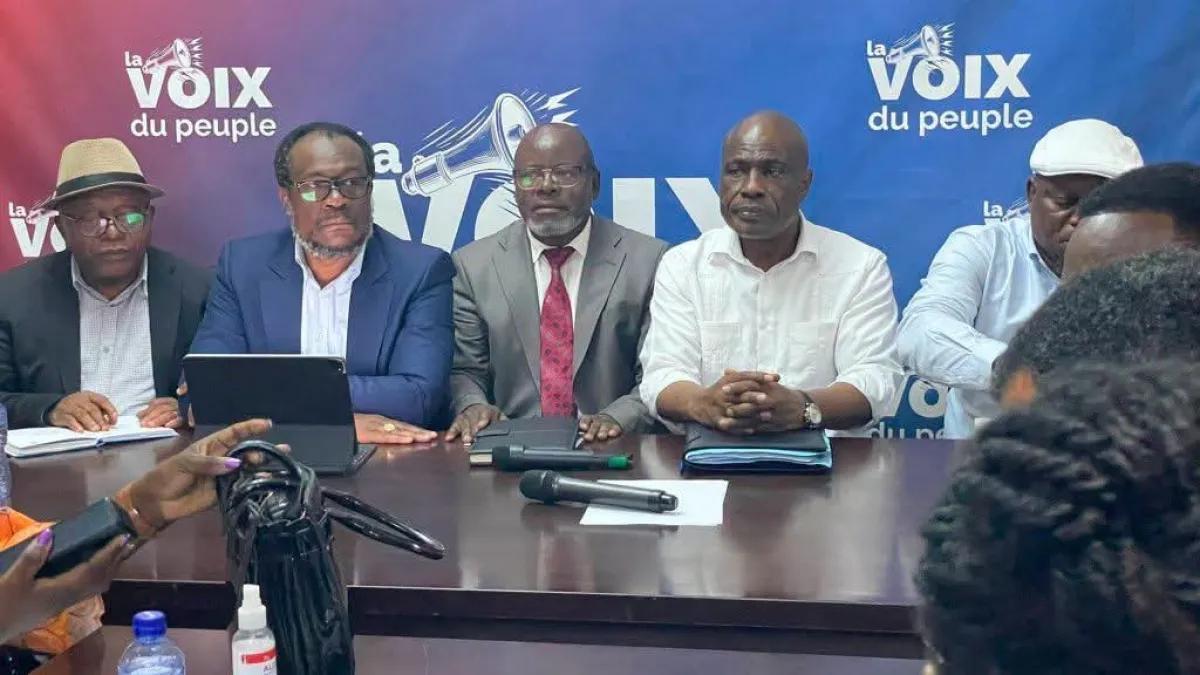
Africa-Press. The opposition coalition in the Democratic Republic of the Congo, known as “Coalition 64,” announced the postponement of a peaceful march that was scheduled to take place on Wednesday in front of the National Palace in the capital, Kinshasa. The march aimed to protest against a proposed constitutional amendment. This decision came after religious leaders called for dialogue, but it sparked a debate about the effectiveness of this step within the opposition itself.
According to a local source, the “Conference of Heads” of the parties within the coalition decided to postpone the march in response to a call from religious officials appointed by President Félix Tshisekedi to organize a national dialogue. They requested the opposition to suspend its actions to create a conducive atmosphere for discussion.
The coalition set a deadline of August 15, 2026, for President Tshisekedi to officially call for a comprehensive national dialogue, warning that if it does not convene by the specified date or if commitments remain unfulfilled, it will call on Congolese citizens to resume peaceful civil actions. The coalition announced that its structures, both domestically and abroad, would remain in a state of “maximum mobilization and vigilance.”
The coalition also established red lines, warning against what it deemed provocative actions, primarily the continuation of the constitutional amendment process, explicitly mentioning the possibility of issuing a referendum law.
Background of the Crisis
Tshisekedi announced on Friday the organization of a national dialogue following a meeting with representatives of religious communities. The government described this step as an opportunity to enhance national cohesion, stating that a roadmap would be issued in the coming days.
Tshisekedi has been in office since 2019, and his second and final term is expected to end in 2028, as the constitution limits the presidency to two terms of five years each. The presidential majority supports a controversial bill that calls for a referendum to amend the constitution, a move that could pave the way for a third term.
Divergence Within the Opposition
The postponement highlighted a divergence of views within the opposition. Opposition leader Laurent Onimba called for a “clear dissolution” of the coalition, arguing that the facade of unity within it has ended and no longer reflects the political reality. He pointed out the difficulty in reconciling the ambitions and visions of the leaders, urging the public to distance themselves from the coalition, according to a local source.
On another front, Kurnai Nanga, coordinator of the “Congo River Alliance/M23,” rejected participation in any dialogue with the Kinshasa authorities, asserting that political discussions do not provide a sustainable solution to the crisis. In a video clip, he accused the government of failing to honor its commitments and stated that priority should be given to rebuilding state institutions, outlining four priorities: a capable army to defend the region, police to protect citizens, an independent judiciary, and a more effective public administration.
For his part, the government spokesperson Patrick Muyaya stated that the proposed dialogue should contribute to building a “unified internal front” against what he described as “Rwandan aggression,” adding that participants should share a common commitment to defend the country.