By Hashim Ali Hamid
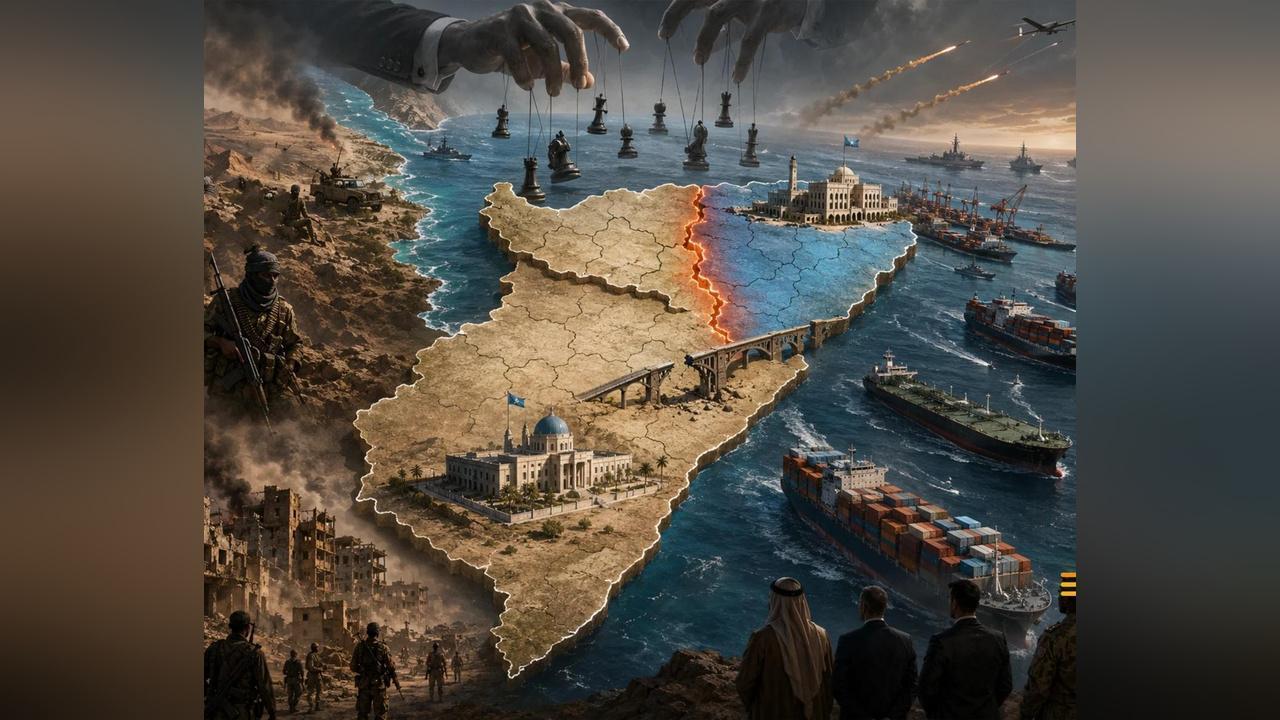
Africa-Press. The Horn of Africa is witnessing significant transformations amid escalating international and regional competition, as its strategic importance has doubled following the rapid developments in the region since 2023, including the Israeli aggression on Gaza and the subsequent escalation of confrontations in the area. Additionally, Yemen’s role in countering this aggression by targeting navigation in the Red Sea has placed this waterway and the Gulf of Aden at the center of geopolitical changes.
In this context, Somalia faces internal threats of fragmentation due to recurring disputes between Puntland and the federal government, raising questions about the potential for external parties to exploit these disagreements to push the region towards a split reminiscent of Somaliland. However, a careful reading of the scene reveals that Puntland, despite its escalation, is not a candidate for actual separation; rather, it is using this pressure tactic to achieve political gains in its negotiations with the center.
Puntland: Geography and Tribes
Puntland is located in northeastern Somalia, constituting about one-third of the country’s total area of 637,657 square kilometers. Its population is estimated at around 4.5 million, according to estimates from the regional government based on a census conducted in 2009, with a lack of accurate information about the nomadic Arabs who make up a significant portion of the population.
The region is inhabited by several tribes, with the majority of the population tracing their origins to the Darod clans, particularly the Majerteen tribe, which holds significant political and social influence, alongside the Dulbahante and Warsangali clans and other tribal branches. The region’s economy relies on livestock and marine resources, with Garowe as the political capital and Bosaso as the most important port and vital commercial center.
Historically, the relationship between Mogadishu and Puntland has seen cooperation and disputes over the division of powers and resources. In 1998, during the civil war and the collapse of the central state, Puntland declared a system of self-governance and managed to achieve relative political stability compared to other Somali regions.
Roots of the Crisis: Power Sharing and the Constitution
The roots of the current crisis date back to the approval by the federal parliament in March 2024 of constitutional amendments extending the president’s and parliament’s terms by an additional year, which Puntland authorities considered a “coup against the constitution.” In response, the region announced a temporary withdrawal of its recognition of the federal government and adopted what it described as “administrative independence” until a consensus on a new constitution is reached for a referendum.
The crisis further complicated when Mogadishu officially recognized the “Khatumo” administration in the disputed Sool region, which Puntland also claims, disrupting the foundations of the federal system and increasing tensions between the two sides.
External Interventions: The UAE and Israel
Analyses warn of interventions by international and regional parties aimed at destabilizing and fragmenting Somalia, primarily the UAE, which seeks to expand its influence through port agreements with several Somali regions, while the federal government aims to cancel them on the grounds of “violating national sovereignty.”
The Israeli presence, following Tel Aviv’s recognition of the separatist “Somaliland” and the exchange of ambassadors, represents a serious development threatening the unity of the Somali state in general, alongside the role of some neighboring countries seeking to enhance their influence in the region at the expense of Somali sovereignty.
The Historical and Geostrategic Dimension of the Horn of Africa
Medieval history confirms the richness of the Somali coast and its political and civilizational role, where Islamic cities such as Zaila, Berbera, and Mogadishu flourished, serving as major trade gateways linking East Africa with the Arabian Peninsula and India, contributing to the spread of Islam in the Horn of Africa. This historical background underscores that the region has never been isolated from its Arab and Islamic surroundings but has always been part of an extensive trade and civilizational network.
Currently, the importance of the Horn of Africa has doubled, making it one of the most significant arenas of geopolitical competition in the world, due to its control over the Bab el-Mandeb Strait, through which about 12% of global trade and 30% of container traffic and millions of barrels of oil pass daily.
Any disruption in this strait adds days to voyages and incurs additional financial costs, making the internationalization of the crisis inevitable, especially amid the current regional escalation and the military operations witnessed in the Red Sea. However, this strategic location, which could have been a source of strength for Somalia, has turned into an additional factor of weakness due to chronic internal challenges. Somalia reflects the most dramatic model of Horn of African countries torn apart by artificial colonial borders, as the civil war and the Ogaden War with Ethiopia led to the collapse of the central state, transforming traditional clan competition into a primary driver of polarization and violence.
The federal system established in 2012, despite being one of the most important governance systems capable of uniting states on major commonalities while respecting the uniqueness of components, has not been implemented effectively in Somalia. The constitution lacks a clear division of powers and resources, allowing regional states to surpass the central government and enter into direct security and economic agreements with external powers, known as “state diplomacy.”
Thus, the problem lies not in federalism as an option but in the absence of a comprehensive constitution that precisely defines the powers of each party and ensures a fair distribution of authorities and resources. This is the main entry point to overcome this issue and rebuild trust between the center and the regions.
Escalating Danger: Banning Federal Officials
Recently, the crisis has taken on a more dangerous dimension, as Puntland authorities announced a ban on the entry of any federal officials or security forces into its territory, based on information about a “coordinated plan” aimed at arming local groups and igniting clan tensions.
In contrast, the region’s political and scholarly council expressed concern over the deteriorating situation, accusing the administration of President Said Abdullah Deni of contributing to the exacerbation of the crisis through the abuse of power and violation of the constitution and local laws.
The Divergence Between Puntland and Somaliland
Puntland was established in 1998 as a self-governing region, based on a solid historical and tribal foundation, and its name is derived from “Land of Punt,” known as a prosperous trading kingdom along the Horn of Africa’s coasts. The area was home to ancient sultanates like the Majerteen Sultanate, which was a major trading power since the 17th century and remained an integral part of the unified Somali state from its independence in 1960 until its collapse in 1991.
When the state disintegrated, the Darod clans allied through the SSDF to enforce security and prevent armed factions from expanding northward, culminating in the Garowe constitutional conference in 1998, which resulted in the declaration of Puntland, with Garowe as its political capital and Bosaso as its main commercial port, within a federal framework not aimed at separation but at restoring stability within a unified Somalia. This distinguishes it from its western neighbor, Somaliland, which declared complete independence in 1991.
Analysts confirm that Puntland is not separatist; rather, it has a strong presence in the process of building the Somali state. Disputes with Mogadishu typically arise during each new presidential term regarding the division of power and resources. The current dispute centers on personal ambitions of Puntland’s President Said Abdullah Deni after failing to run for the federal presidency, alongside constitutional amendments and the upcoming elections.
The fundamental difference is that Puntland adopts a concept of separation that is entirely different from that of Somaliland; it is an administrative separation within the federal sovereignty, not a rupture with the mother state. This position prevents the crisis from escalating into an explosion and is supported by three fixed constraints:
First, Puntland was not established for separation but for restoring stability; thus, separation today would contradict its political history, as it was a pioneer in building the federal state when it established the first transitional federal system in the country.
Second, any separatist project cannot succeed without international and regional recognition, especially since the African Union and the Arab League, to which Somalia belongs, have a clear stance against fragmentation and division, depriving any potential separation of political cover or regional legitimacy, despite the efforts of some regional countries that seek to encourage separation and provide cover for it.
Third, Puntland fully understands that separation would lead to military confrontation with the center and open the door for extremist groups to exploit the security vacuum, which means the loss of the stability it has long enjoyed, turning it into a new battlefield that threatens its very existence.
Risks of Turning into a Proxy War
Analysts have warned against transforming the crisis from a constitutional dispute into a proxy war, as external parties are expected to intervene to exploit the crisis to destabilize the situation and widen the rift between Mogadishu and Bosaso.
These parties, which work to divide Somalia and fragment its unity, include the UAE, which seeks to consolidate its influence through port agreements, and Israel, which sees Somalia’s division as an opportunity to enhance its presence in the region after recognizing “Somaliland.”
This possibility makes Al-Shabaab and ISIS the biggest beneficiaries; the more Mogadishu is preoccupied with Bosaso, the more armed groups expand in Middle Shabelle and Jubba, and in the Puntland mountains where ISIS has limited pockets that exploit any security vacuum.
Is Puntland Approaching Separation?
Many analysts believe that the continuation of the escalation poses real dangers to the unity of the state, but the crisis is not necessarily heading towards separation. Opportunities for containment exist through political dialogue and constitutional settlement, redefining the relationship between the center and the regions, and ensuring the participation of states in major national decisions.
The main factor in resolving the crisis lies internally, represented in the weakness of political consensus and the continued influence of tribal affiliations. External parties are capable of creating and fabricating crises through tools of influence, money, and political cover, and they can exploit existing divisions, making internal political reform and rebuilding trust between the center and the regions the true entry point to fortify the state against any external intervention.
The pressing question today is: Are the Somali elites capable of prioritizing the higher interests of Somalia over factional interests and external interventions before Puntland transforms from a political pressure tactic into a new reality that reproduces the tragedy of division that has plagued Somalia for decades? Or will external parties succeed in leveraging internal disagreements to entrench a new division in the Horn of Africa at the expense of Somalia’s unity and stability?
The coming days seem poised to provide answers, but it is certain that national dialogue and genuine Somali consensus remain the least costly and most guaranteed path to preserving the cohesion of the Somali state before external bets impose new, undesirable realities on Somalia.