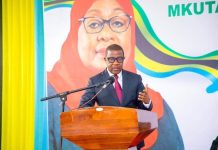


Africa-Press – Tanzania. TANZANIAN Vice President, Dr Emmanuel Nchimbi, has launched an educational reform programme aimed at strengthening cooperation between employers, vocational training institutions and universities to ensure graduates acquire skills suitable for the global labour demands.
Speaking today at the Julius Nyerere International Convention Centre (JNICC) in Dar es Salaam, Dr Nchimbi said the initiative is a fulfilment of President Samia Suluhu Hassan’s campaign pledge made during the 2025 general election, where she promised to establish a joint framework linking training institutions with employers.
He said the programme is designed to enhance strategic collaboration between education providers and the world of work, focusing on aligning training with priority national sectors, including energy, information and communication technology (ICT) and value-added industries.
“This programme lays a strong foundation for building a generation of graduates capable of being employed, self-employed and actively contributing to national development,” he said.
He noted that the government is determined to transform the education system from a largely theoretical model to one that promotes practical skills, innovation and wealth creation.
The Vice President further explained that the initiative emphasises broad participation of the production sector and close integration between education delivery and Tanzania’s economic priorities.
He added that implementation will be carried out in line with the 2014 Education and Training Policy, as revised in 2023, as well as Zanzibar’s education reform agenda.
Dr Nchimbi said the Sixth Phase Government has placed strategic priority on developing skills, competencies and employability qualifications for youth and graduates at different education levels, stressing that sustainable national development cannot be achieved without an educated and productive workforce.
He cited national demographic statistics showing that about 34 per cent of Tanzanians are youth aged between 15 and 35, highlighting the urgent need to prepare them for both local and international job markets.
He also revealed that currently more than 2.1 million students are enrolled in higher learning institutions, vocational colleges and skills development centres across the country.
“We have a responsibility to ensure that our education systems produce graduates who are competent, employable and capable of self-employment,” he said.
Dr Nchimbi said the government continues to improve education policies and curricula in response to rapid technological changes, while also increasing budget allocations year after year to strengthen practical training.
He added that the programme aligns with Tanzania’s long-term national development vision, including the goal of raising citizens’ income to 7,000 US dollars per capita, as well as Zanzibar Vision 2050 which targets reducing unemployment from 14.1 per cent to 6.2 per cent.
Earlier, the Deputy Permanent Secretary in the Ministry of Education, Science and Technology, Prof Daniel Mushi, said the programme has been developed through broad stakeholder engagement involving training institutions, public and private sector players, industries and development partners.
He said the initiative seeks to improve training quality and enhance youth employment opportunities.
Meanwhile, Deputy Minister for Education, Science and Technology, Ms Wanu Hafidh Ameir, said the education and training policy clearly emphasises that cooperation between training institutions and the production sector is a systemic obligation.
She said the collaboration is necessary to ensure that skills produced correspond with actual labour market needs and support economic growth.
Ms Ameir said in implementing President Samia’s directives, the ministry has already established 33 Industrial Advisory Committees and signed various cooperation agreements, including 50 Memoranda of Understanding (MoUs) between VETA and industries, more than 250 agreements between higher learning institutions and industries, and 76 agreements involving technical colleges and industrial partners.
The programme is expected to strengthen Tanzania’s workforce development agenda and improve graduates’ competitiveness in the evolving global economy.