
What You Need to Know
In South Africa, scientists have discovered microbialites, living rock formations that efficiently absorb carbon dioxide. These formations, created by microscopic organisms, convert dissolved carbon into stable calcium carbonate, potentially aiding in climate change mitigation.
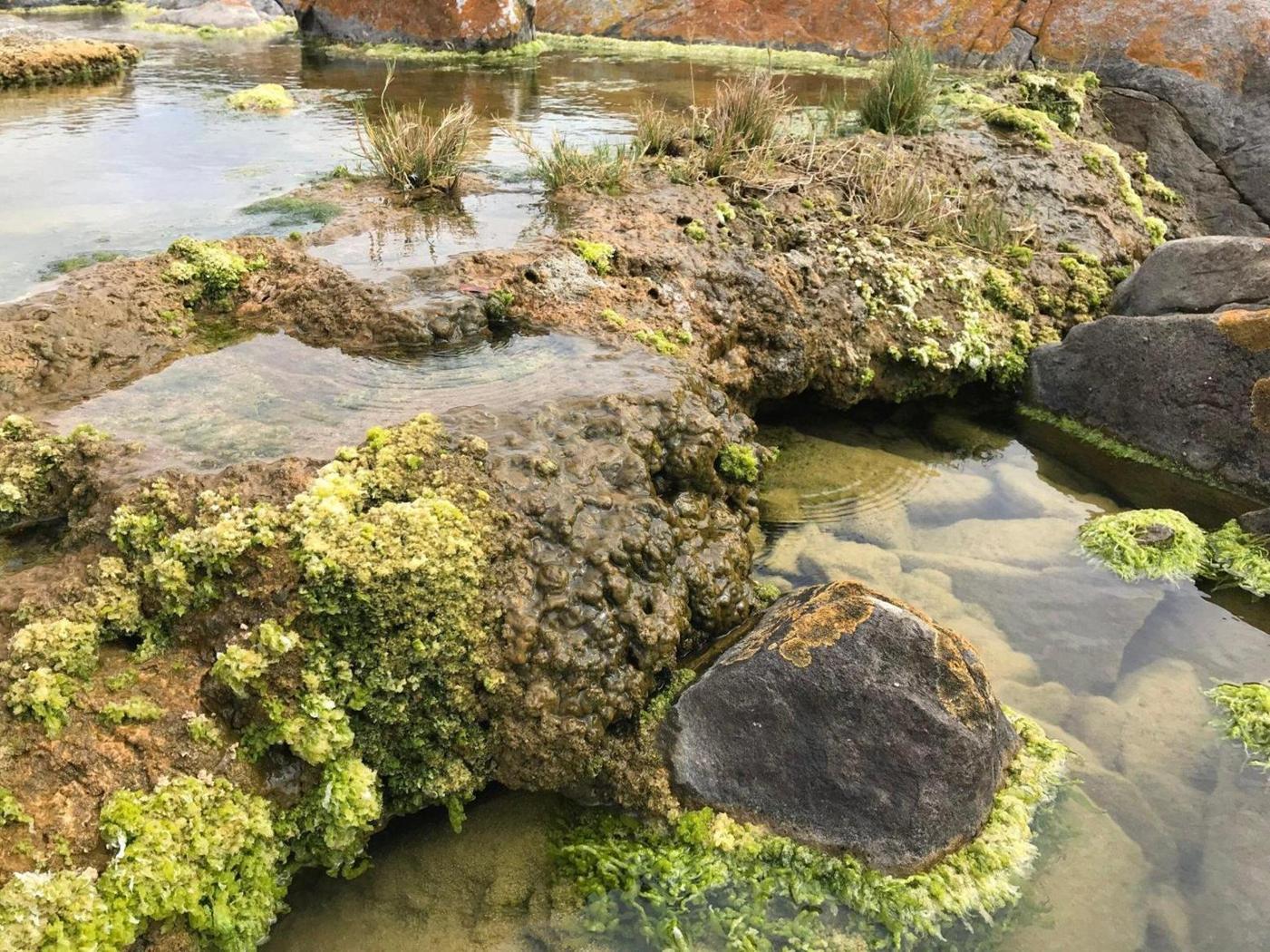
Africa. On the coasts of South Africa, in shallow pools that change salinity month by month and are subjected to drought, heat, and cold, there are rock formations that appear to be mere layered protrusions, but in reality, they are “living systems” built by microscopic organisms since ancient times.
These astonishing formations are called “microbialites,” which are microbial aggregates that “stone” themselves, meaning they transform their biological activity into solid layers of minerals over time.
Carbon Absorbers
In a new study published in *Nature Communications*, scientists found that microbialites in South Africa absorb carbon efficiently and trap it in the form of calcium carbonate, a stable and long-term mineral deposition.
In other words, part of the dissolved carbon in the water does not remain in a quick cycle that could return it to the atmosphere, but is locked away in stone, thanks to these fossilized bacteria.
This is important, as we know that carbon dioxide is one of the main gases contributing to the global warming crisis, and thus its absorption will undoubtedly help address this issue.
The basic idea is similar to what coral reefs do, but through microbes, as these tiny organisms absorb carbon and deposit minerals, leading to the accumulation of successive layers.
Day and Night
What is new here is that the research team linked the rates of carbon absorption and deposition to the genetic and functional capabilities of the microbial community. They did not just measure the amount of absorption but also tried to understand how it occurs and who is responsible within this complex community.
Even more surprisingly, absorption does not rely solely on photosynthesis (which stops at night); results indicate that photosynthesis is also supported by non-light-dependent mechanisms, meaning that the “carbon capture factory” may continue to operate day and night.
According to estimates based on daily rates, these microbialites can absorb the equivalent of 9 to 16 kilograms of carbon dioxide annually per square meter, a remarkable figure considering that this is a small natural system operating under harsh conditions.
Researchers from the Bigelow Laboratory for Ocean Sciences in the United States liken it to a tennis court-sized area of these formations being equivalent to the carbon absorption of about 3 acres of forest annually.
Scientific Value
Note that what is happening here is not biological storage; the carbon is not stored in biomass that could decompose and return to nature, but rather mineral fixation, which involves converting “carbon” into “carbonate” within layers that grow over time.
This type of trapping is more stable, and it is one of the reasons why microbialites are part of the Earth’s long story with carbon and the story of life itself.
Does this mean that these descending formations represent a magical solution to the climate problem? Not so simply; the study shows strong natural potentials, but it does not claim that we can “offset” global emissions merely by relying on these formations, as area, spread, and ecological sensitivity are critical factors.
The closest practical value today is to understand the mechanisms of natural trapping more accurately and to consider these sites as systems worthy of protection because they provide a real environmental service, in addition to their scientific value as one of the oldest constructive life forms on Earth.
In a future phase, scientists may develop the matter further, perhaps by innovating “biomineralization” techniques that mimic the aforementioned processes to capture carbon dioxide as carbonates in reactors or artificial ponds.
Scientists may also exploit specific enzymes or certain microbes to accelerate carbonate deposition, which would have a positive impact on global warming.
Microbialites have existed for billions of years, playing a crucial role in Earth’s carbon cycle. These structures are formed by the activity of microorganisms that trap and bind sediments, creating layered rock formations. Their study offers insights into ancient life and the evolution of ecosystems, as well as potential applications in modern environmental science.