
What You Need to Know
A new book by historian Brooke Newman reveals Britain’s significant role in the transatlantic slave trade, challenging the traditional narrative that associates the country solely with the abolition of slavery. The book, titled “The Crown’s Silence,” details how the British crown was not only a participant but a major buyer of enslaved individuals, purchasing around 13,000 men for military …
Africa-Press. A new book by American historian Brooke Newman reveals the pivotal role played by the British crown and the Royal Navy in expanding and protecting the African slave trade over centuries, presenting a different picture from the traditional narrative that links Britain solely to the abolition of slavery.
According to a report by a local source, the book “The Crown’s Silence,” set to be released next week, clarifies that the royal institution was not merely a bystander in this trade but was directly and systematically involved.
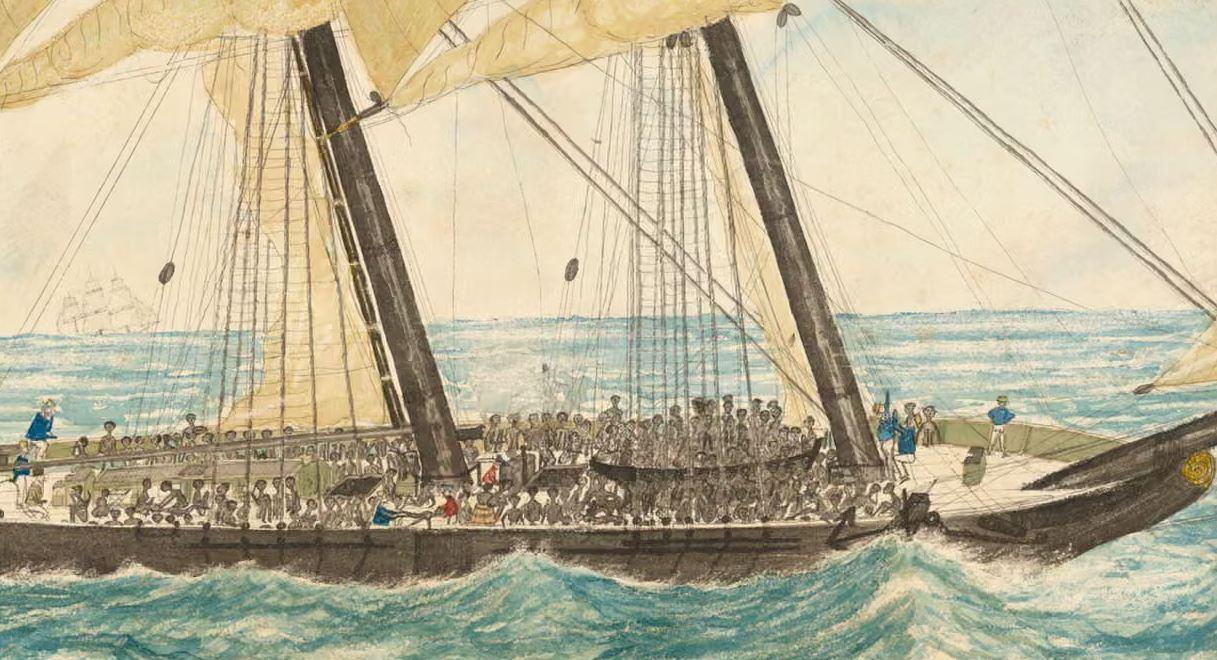
The Royal Navy was “crucially involved in expanding the slave trade and protecting slave ships,” as it lent its ships to slave trading companies and supplied them with men and provisions from the time of Elizabeth I until the 18th century, with profits flowing to the crown.
According to Newman, by 1807—the year Britain abolished the slave trade within its empire—the British crown had become the largest buyer of slaves in the world, purchasing around 13,000 men for military use at a cost of approximately £900,000.
These findings build on a previous investigation by a local source in 2023 regarding the hidden links between the British monarchy and the transatlantic slave trade.
The researcher notes that the monarchy openly declared its connection to the slave trade, giving it a “royal character,” not only through monopolistic companies like the “Royal African Company” but also by directly owning enslaved individuals, particularly in Caribbean colonies.
The documents reviewed by Newman revealed that the crown owned thousands of enslaved individuals until 1831, even as the Royal Navy proclaimed its fight against the slave trade.
The book also presents secret correspondence from the era of King George IV (1820-1830), reflecting his fears of a repeat of the Haitian slave revolt in Jamaica.
Furthermore, the book explains that the enslaved individuals owned by the crown worked on plantations seized after revolts or in strategic facilities like royal shipyards, where they were employed as carpenters, shipbuilders, and skilled laborers to serve the naval fleet, as it became evident that European workers were dying in large numbers due to diseases.
The book does not stop at the pre-abolition phase but also highlights what followed, showing that many Africans freed by the Royal Navy from slave ships were later forced into indentured labor or conscripted into the British army, particularly in West Indian regiments, according to a local source.
The American historian emphasized that slavery was a fundamental pillar for the prosperity of the British economy in the 18th century, contributing to the growth of major cities like Liverpool and Bristol, as well as the development of insurance and finance sectors.
She concluded that the conditions of the enslaved were not better, whether owned by individuals or the crown itself, asserting that the “Crown’s Silence” regarding the pleas of abolition advocates reveals a dark side of British imperial history.
Calls for Compensation
Prominent International Court of Justice judge Patrick Robinson confirmed in 2023 that the United Kingdom would not be able to ignore the growing calls for compensation for the victims of the transatlantic slave trade.
A local source reported at the time that Robinson—who presided over the trial of former Yugoslav President Slobodan Milosevic—stated that the international stance on the issue of reparations related to slavery is changing rapidly and urged Britain to alter its position on this matter.
Reuters revealed in 2024 that at least 12.5 million Africans were forcibly taken by European ships and traders and sold as slaves between the 15th and 19th centuries. Those who survived the brutal journeys ended up working on plantations in the Americas under inhumane conditions.
A report discussed by a local source in 2023 indicated that the United Kingdom alone is liable to pay $24 trillion to 14 countries as compensation for the slave trade it practiced across the Atlantic. Approximately $9.6 trillion of this amount is owed by Britain to Jamaica.
The transatlantic slave trade was a pivotal part of British economic expansion from the 16th to the 19th centuries. The British monarchy and the Royal Navy played crucial roles in both the expansion and protection of this trade, which involved the forced transportation of millions of Africans to the Americas. Despite the eventual abolition of slavery in 1807, the legacy of this trade continues to impact discussions around reparations and historical accountability today.
Recent scholarship has begun to shed light on the complexities of Britain’s involvement in slavery, revealing that the monarchy was deeply intertwined with the slave economy.