What You Need to Know
Libya hosted an energy and economy summit in Tripoli, attended by key officials and international companies. The summit resulted in agreements worth over $20 billion, focusing on oil production and exploration, with significant involvement from US and Egyptian firms. The agreements aim to enhance Libya’s energy sector and economic stability.
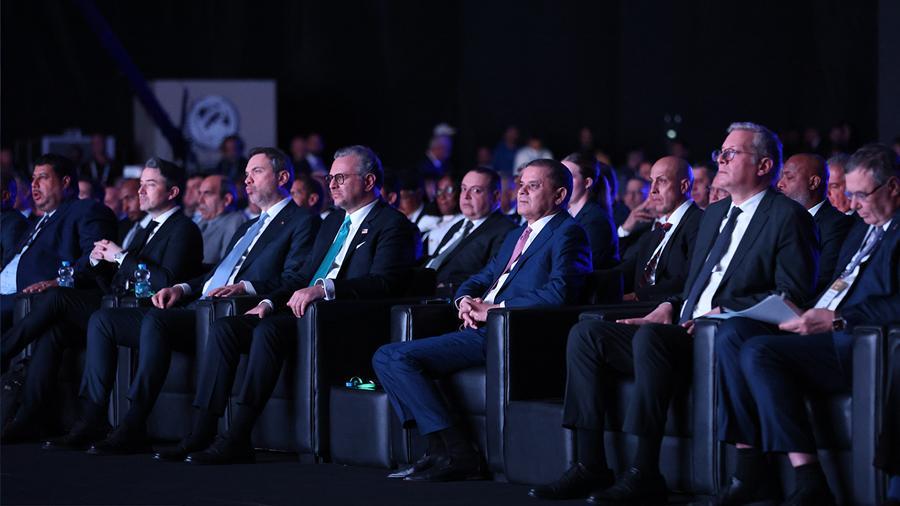
Africa-Press. Tripoli hosted the Libya Energy and Economy Summit today, attended by Prime Minister Abdul Hamid Dbeibeh, Egyptian Petroleum Minister Karim Badawi, Turkish Energy Minister Alparslan Bayraktar, and senior advisor to former President Donald Trump, Moussa Boules, alongside extensive international participation from dozens of companies from France, the United States, Britain, Italy, and Turkey.
The summit included the signing of a package of agreements, the most notable being a long-term development agreement over 25 years with Waha Oil Company in partnership with French Total Energies and American ConocoPhillips.
According to a government statement, the investments from this agreement exceed $20 billion, funded externally without burdening the public budget. The goal is to raise Waha’s production to 850,000 barrels per day, with projected net revenues for the state exceeding $376 billion.
The summit also witnessed the signing of a memorandum of understanding with American Chevron to explore opportunities for field development, in addition to a cooperation memorandum with the Egyptian Ministry of Energy in exploration, production, and logistics services.
Moussa Boules stated that “the United States is ready to cooperate and wants Libya to succeed,” describing the summit as “a major return for Libya to the energy market.”
On the sidelines of the summit, Dbeibeh held a meeting with Boules, during which they discussed cooperation in energy and defense. The government noted that both parties agreed on the importance of a “unified development program” as a step to unify spending paths and enhance financial discipline. Dbeibeh expressed hope that the agreement would address economic issues resulting from “parallel spending.”
Dbeibeh praised the cooperation between AFRICOM and the Ministry of Defense to support building military institutions.
In his speech, Dbeibeh confirmed that 2025 recorded the highest daily production rate of 1,374,000 barrels, the highest in over 12 years, announcing the launch of a public tender for exploration on land and submerged waters for the first time in 17 years.
Oil Minister Khalifa Abdeslam revealed that the Libyan gas pipeline is currently operating at only 10% of its capacity, noting plans to exploit gas in several fields to increase production by an additional 400 million cubic feet.
Patrick Pouyanné, CEO of Total Energies, stated that Libya represents “a significant asset for the world,” affirming his company’s support for increasing production and working towards “zero emissions” despite challenges.
Meanwhile, the acting head of the National Oil Corporation, Masoud Suleiman, described the phase as “critical,” indicating that the corporation produced over 500 million barrels last year and resumed operations at several wells despite price fluctuations.
Dbeibeh also announced the launch of Libya’s renewable energy strategy and the “Green Libya” initiative to plant 100 million trees, calling on international partners to actively contribute to these projects.
Libya has long been a significant player in the global energy market, particularly due to its vast oil reserves. The country’s economy heavily relies on oil exports, which have fluctuated due to political instability and conflicts. Recent efforts to stabilize the economy and attract foreign investments are crucial for Libya’s recovery and growth in the energy sector.
The energy summit reflects Libya’s strategic initiatives to revitalize its oil production capabilities and foster international partnerships. With the involvement of major companies like Total Energies and ConocoPhillips, Libya aims to enhance its production capacity and secure financial investments that can support its long-‐