Africa-Press. Makoko, a vast informal waterfront settlement in Lagos, Nigeria, is undergoing one of the most severe waves of demolitions and forced displacement in its history. Thousands of wooden homes built on stilts over a lagoon have been torn down by state authorities, leaving large numbers of residents homeless and deepening an already acute housing crisis in the country’s largest city.
The Lagos State government argues that the demolitions are necessary for public safety. Officials say parts of Makoko have expanded dangerously close to high-voltage power lines and vital waterways, creating serious health and infrastructure risks. According to the authorities, allowing people to live under high-tension cables or obstructing waterways would be irresponsible and could lead to catastrophic loss of life.
Residents, community leaders, and civil society groups strongly dispute this justification. They argue that the demolitions are part of a broader strategy of forced urban restructuring aimed at clearing valuable waterfront land for future private and elite developments. Makoko occupies a prime location in Lagos, where demand for land is intense and waterfront property is among the most desirable in the city.
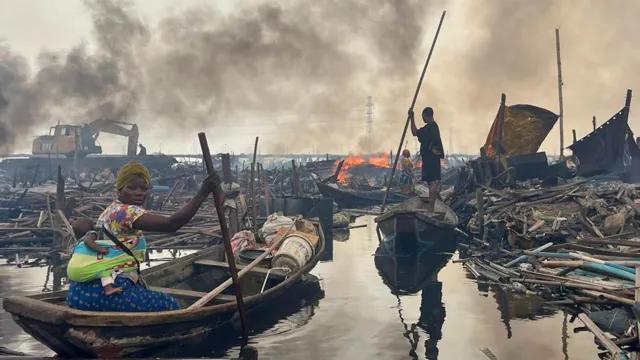
The demolitions reportedly began just days before Christmas, when excavation teams accompanied by security forces entered parts of the settlement, particularly areas facing the Atlantic Ocean. Residents say homes were destroyed rapidly, often with little or no warning. Some houses were allegedly set on fire, in certain cases while people were still inside, creating panic and chaos across the community.
Within days, Makoko was transformed into a landscape of rubble. Smoke hung over the lagoon as wooden structures collapsed into the water. Corrugated metal roofs drifted between boats, and excavators continued pulling down homes built on stilts along the shoreline. Despite the scale of the destruction, the state government has not released official figures on the number of buildings demolished.
Makoko traces its origins to the 19th century, when it was founded by fishing communities. Over time, it became home to low-income families and migrants drawn to Lagos in search of work and opportunity. As Lagos expanded and housing costs rose, Makoko came to symbolize both the city’s rapid growth and its deep social inequalities.
A central point of contention is ownership of the lagoon. The government maintains that it is public land occupied without legal planning permission or formal rights. Long-time residents counter that Makoko predates modern Lagos and that they possess customary rights to the area based on generations of continuous settlement.
Population estimates for Makoko range widely, from about 80,000 to as many as 200,000 people. Civil society organizations estimate that more than 10,000 residents have been displaced during the latest demolitions alone, along with the destruction of schools, clinics, and places of worship. Many families are now sleeping outdoors, on broken wooden platforms, or wherever temporary shelter can be found.
The humanitarian impact has been severe. Many children have stopped attending school, either because schools were demolished or because families can no longer afford fees or transportation. Some children now help their parents salvage wood from collapsed homes to sell for income. Numerous small traders lost their goods and livelihoods when their houses were destroyed or burned, although limited canoe-based trading continues in parts of the settlement that remain.
Anger and frustration have fueled protests. More than a thousand residents marched toward the state legislature, demanding to meet the governor and halt the demolitions. Security forces dispersed the demonstration using tear gas, resulting in injuries. Community members also allege that tear gas was used during demolition operations, causing deaths, including children. Authorities deny these claims, stating they have no confirmed reports of such incidents and promising investigations if evidence is presented.
The state government has pledged financial grants and assistance to affected families, insisting that the operation is not intended to destroy Makoko but to push residents away from zones deemed dangerous. Officials have emphasized concerns about the settlement’s proximity to major bridges and high-tension power lines, warning that a structural failure could kill hundreds of people in a single incident.
Despite these assurances, distrust remains high. Activists and residents argue that no meaningful resettlement plan has been offered and that compensation, if provided at all, is insufficient. They see the demolitions as part of a rapid and harsh model of urban development that prioritizes investment and aesthetics over human welfare, pushing the urban poor out of central areas to make room for wealthier interests.
The events in Makoko reflect broader structural problems in Lagos. Although housing supply has increased in recent years, it has not kept pace with population growth. Rising rents, limited access to formal housing, and inadequate urban planning have forced millions into informal settlements, particularly along waterfronts and transport corridors.
Makoko has faced demolitions before, most notably in 2017, when residents secured a court order prohibiting forced evictions without adequate notice, compensation, and resettlement. Community advocates argue that the principles behind that ruling have not been respected in the current operations, raising concerns about long-term damage to livelihoods, family structures, and social cohesion.
Today, life in Makoko is marked by insecurity and hardship. Families sleep on damp ground, struggle to cook or find food, and face growing health risks as debris and rodents spread through the area. The situation highlights a stark contradiction at the heart of Lagos’s development: a city striving for global status while leaving tens of thousands of its poorest residents exposed to displacement, poverty, and uncertainty.