Thabet Al-Amour
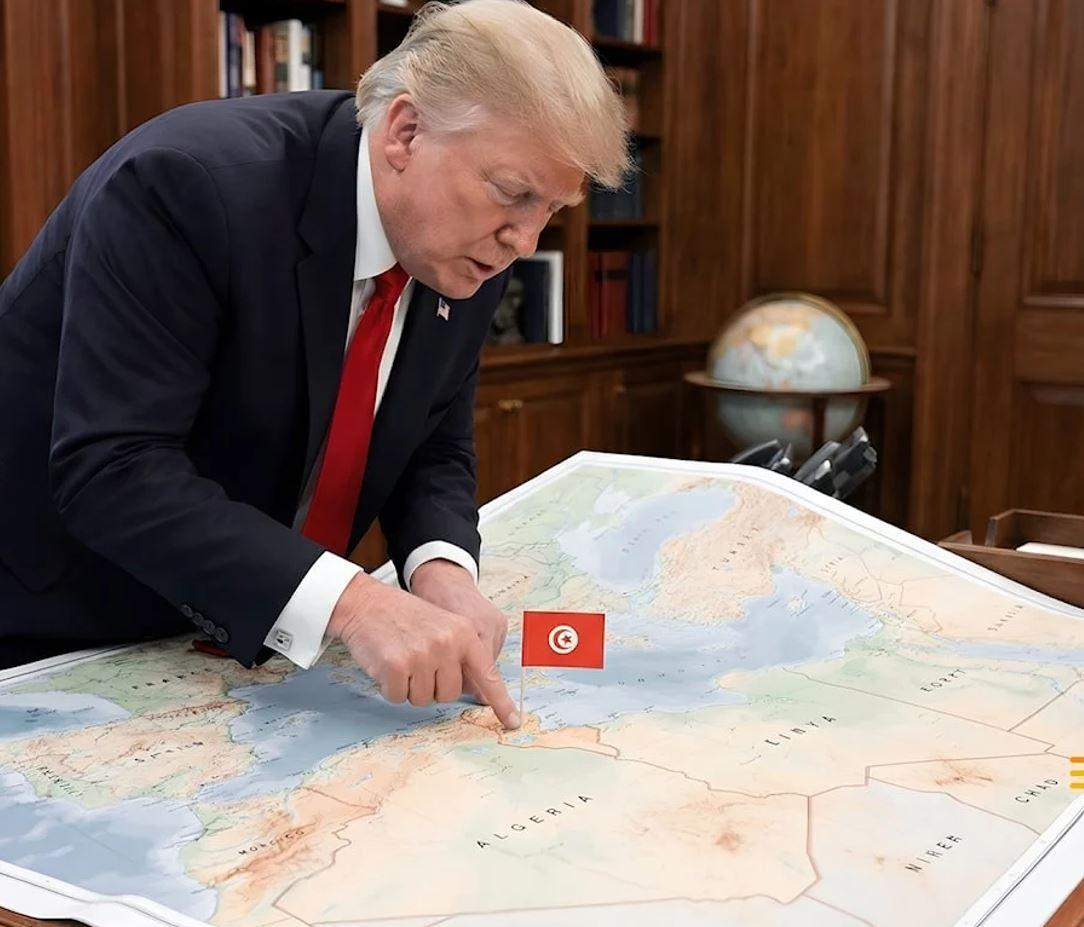
Africa-Press. Tunisian–American relations have recently seen noticeable diplomatic activity and frequent shuttle visits. This was reflected in repeated trips to Tunisia by the U.S. president’s adviser for Arab and African affairs, Massad Boulos, who visited the country twice within six months. What lies behind this growing U.S. interest in Tunisia—and is it a partnership approach or an effort at containment?
This recent U.S. focus on Tunisia cannot be understood in isolation from the fast-moving political shifts in North Africa, the Mediterranean, and the African Sahel, as well as Washington’s broader repositioning in the international system—especially in regions where global competition for influence is intensifying, including Tunisia.
Understanding the drivers of U.S. interest in Tunisia involves three dimensions. The first relates to Tunisia itself and its complex domestic political scene. Boulos’s repeated visits evoke memories of Condoleezza Rice’s visits during Zine El Abidine Ben Ali’s rule, which often boiled down to recommendations and demands. Ben Ali did not pay attention to them, and it appears that Tunisia’s current president, Kais Saied, likewise does not want to heed Boulos’s recommendations, pressures, or demands. Part of the U.S. interest in Tunisia, therefore, looks more like pressure and demands than clear priorities; a sanctions proposal targeting Tunisia is reportedly under discussion in Congress.
The second driver is Washington’s effort to curb Russian and Chinese influence across North Africa in general and Tunisia in particular. The U.S. appears to want to start from Tunisia, viewing it as a political bloc with calculations different from, for example, Algeria and Morocco. The third dimension is drawing Tunisia into a distinctly American sphere of influence. In other words, U.S. interest in Tunisia is shaped by multiple political, economic, security, and strategic considerations—especially given the timing of the visits and their regional context.
Boulos’s second visit to Tunisia comes amid rapid regional developments: the situation in Libya, which could further deteriorate, and the intensifying international competition for influence in North Africa between the United States on one side and Russia and China on the other.
His visit also took place as part of a broader tour that included several North African countries, suggesting it is tied to U.S. priorities that extend beyond Tunisia’s internal situation to North Africa as a whole. U.S. interest in Tunisia is connected to Washington’s broader pivot toward North Africa, yet Tunisia seems to be at the center of attention—and at the heart of the storm.
This is particularly so as Trump’s focus has shifted toward multiple regions beyond Venezuela and Iran, and may extend to areas that are hard to predict, within a plan aimed at containing—and halting—Russian and Chinese expansion. Trump’s approach appears to rely on containment rather than direct confrontation with Russia and China.
Interpretations of Boulos’s second visit have multiplied, even to the point of contradiction, particularly regarding its motivations. While Boulos met President Kais Saied during the first visit, the second visit was limited to a meeting with Tunisia’s foreign minister only.
One of the first visit’s key signals was an openly visible tension: Boulos remained standing while the Tunisian president chose to invoke the killing, starvation, and destruction faced by Palestinians in Gaza, using it as an official Tunisian message to the U.S. administration.
President Saied reportedly showed Boulos images depicting scenes of killing, starvation, and devastation in Gaza—implying that U.S. support for what is happening there undermines Washington’s claim to be a global advocate of democracy or a guardian of human rights. The anger appears to have been mutual, with each man provoking the other.
In the context of the first visit, Boulos reportedly arrived with several demands linked to the first dimension mentioned earlier—the complexities of Tunisia’s domestic political landscape. Among the U.S. demands he carried were a resumption of democracy and a handover of power to young people. There also appears to have been an indirect U.S. message hinting that President Kais Saied should step down, which helps explain why tensions escalated to the point of angering Saied. Tunisia’s presidency published a statement saying that “Tunisia stressed non-interference in the internal affairs of the region’s countries,” and that it had begun “reshaping its international alliances,” in a reference to Iran, Russia, and China.
During the second visit, Boulos did not meet the Tunisian president, suggesting that tensions had intensified and that the president was not interested in receiving him. The reason, the text argues, is U.S. pressure on Tunisia through what became known as the U.S. congressional initiative to “restore democracy in Tunisia.” The initiative was introduced by two lawmakers from both parties—the Republican Joe Wilson and the Democrat G. Wilson Crow—and submitted to the Speaker of the U.S. House of Representatives. It is pending referral to the House Foreign Affairs and Judiciary committees for discussion, as a step toward adoption and a plenary vote, before being sent to the Senate and then placed on U.S. President Donald Trump’s desk for signature.
The initiative, the text says, contains serious provisions. It starts from the premise that President Saied’s government is “authoritarian,” violates human rights, and acts in ways that contradict the constitution. It therefore calls for restoring Tunisia’s democracy and holding elections under the 2014 constitution, which Saied abolished. If the proposal is passed, Tunisia would face sanctions lasting four years, including harsh measures and strict penalties, at a time when the country is already struggling economically.
Tunisian–American tensions then deepened further. After the lawmakers’ initiative, a U.S. congressional delegation visited Tunisia on August 28, 2025, and was received by Foreign Minister Mohamed Ali Nafti. Publicly, the visit was framed around investment and bilateral cooperation, but the unspoken agenda, according to Tunisian assessments, was that the delegation reiterated U.S. demands related to democracy. In this reading, Washington concluded that President Saied had pushed out Tunisian politicians close to the United States—meaning what is happening is not partnership, but pressure and leverage.
Repeated U.S. visits to Tunisia do not necessarily indicate a positive interest, nor do they mean the relationship is based on equality. The dynamic is portrayed as closer to tutelage and dictates than to partnership or containment: Washington is dissatisfied with Tunisia’s growing closeness to China and Russia, seeing it as a threat to its influence—especially since Tunisian voices aligned with President Saied are calling for new alliances with Beijing and Moscow as an alternative to the United States.
Any Tunisian move closer to Russia or China would mean distancing—and potentially sidelining—the United States. This, the text argues, is precisely what explains the core of Washington’s interest in Tunisia, viewed as a geographically important pivot point in the U.S. approach to North Africa.
The U.S. pivot toward Tunisia thus carries two opposite tracks: on the one hand, pressure through demands and the threat of sanctions; on the other, placing Tunisia within the circle of active U.S. attention. The tension is clear, but it does not necessarily imply a complete rupture.
U.S. interest in Tunisia cannot be reduced to domestic issues and a return to democracy alone. That factor is present, but it is directly connected to U.S. influence within Tunisia’s decision-making circles. The key drivers, however, are broader: Tunisia’s geopolitics, its relations with neighboring countries—especially Algeria and Libya—and its ties with Russia and China and the expansion of their influence.
The text also does not rule out that one of Washington’s objectives could be to pull Tunisia—through intimidation or incentives—into the path of normalization.