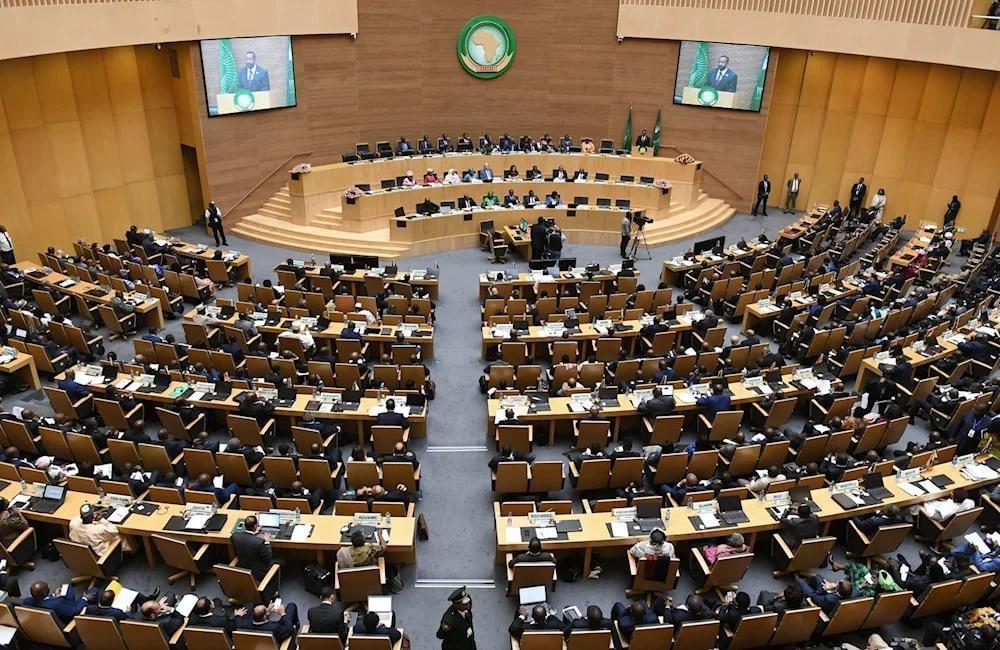
Africa-Press. Egyptian Foreign Minister Badr Abdelatty chaired the informal ministerial-level consultations held by the African Union Peace and Security Council on developments in Sudan, as part of Egypt’s presidency of the Council during February.
The consultations were attended by the foreign ministers of Tanzania, Sierra Leone, Nigeria, Ethiopia, Angola, Botswana, Côte d’Ivoire, Equatorial Guinea, Cameroon, Eswatini, and The Gambia, as well as representatives from Uganda and the Democratic Republic of the Congo. The chairperson of the African Union Commission and the AU commissioner for peace and security also took part. Non–Council member states joined as well, including Djibouti, Kenya, Somalia, and Burundi, alongside representatives of the League of Arab States, the United Nations, and the Intergovernmental Authority on Development (IGAD).
Supporting Sudan’s unity and rejecting partition
In his remarks, Abdelatty said Sudan’s stability is a regional priority to prevent the spread of chaos and rising terrorist threats, and he expressed hope for shaping a shared vision that would help end the conflict.
He stressed Egypt’s longstanding position in support of Sudan’s unity, territorial integrity, and the preservation of its national institutions, rejecting any attempts to divide the country or undermine its sovereignty. He also renewed Egypt’s condemnation of violations in El Fasher and Kordofan, affirming full solidarity with the Sudanese people.
He called for a comprehensive ceasefire and the launch of a humanitarian track that ensures aid reaches those in need without obstacles, in parallel with creating conditions for an inclusive political process with full Sudanese ownership. He also voiced support for the “quartet mechanism” and urged stronger coordination between regional and international tracks.
For his part, Sudanese Foreign Minister Mohi al-Din Salem Ahmed briefed participants on battlefield and humanitarian developments, and said he looked forward to intensifying consultations with the Council to support de-escalation and strengthen humanitarian efforts, paving the way for a political process that would restore security and stability in the country.