Al-Mustafa Al-Mu’tasim
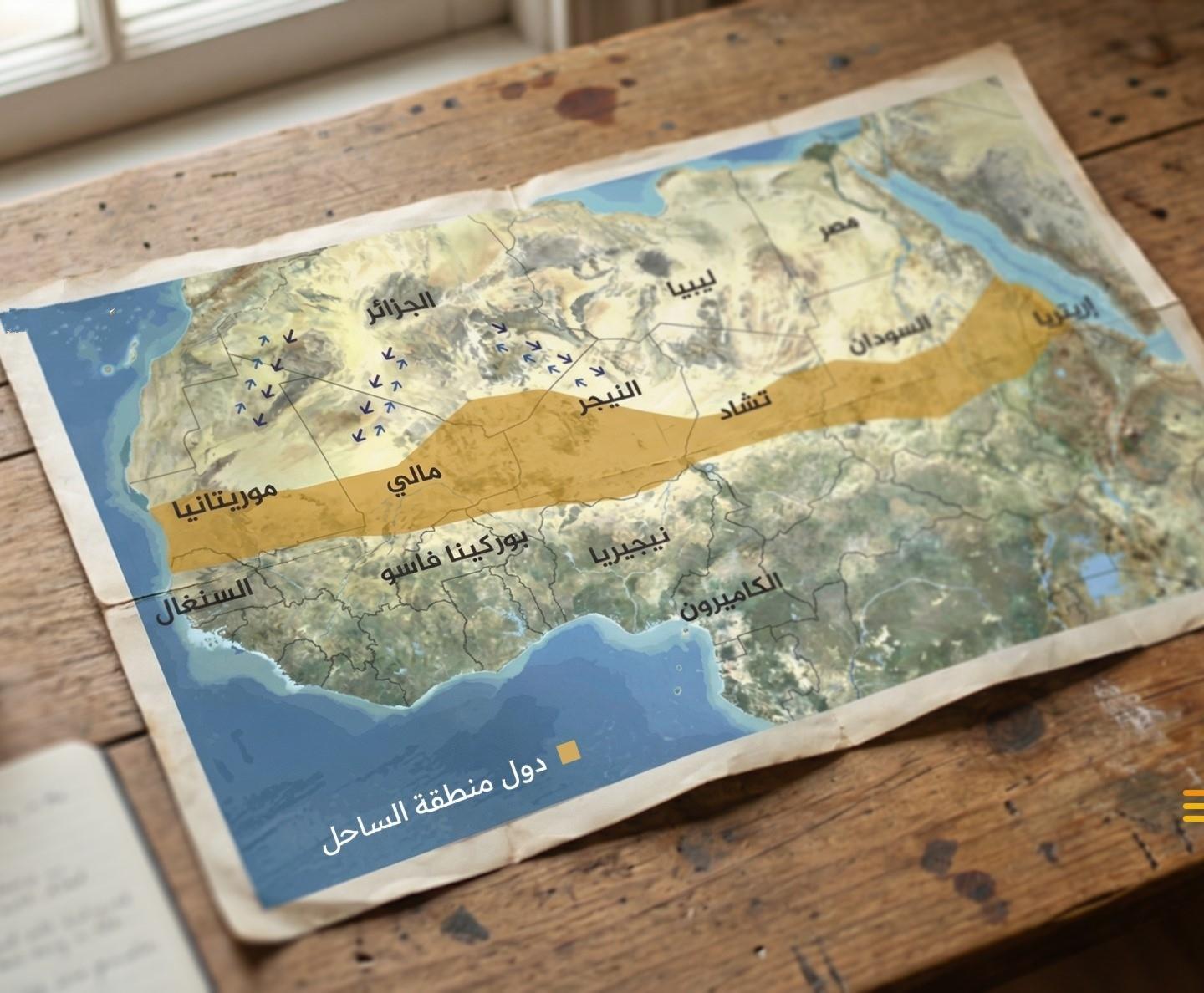
Africa-Press. The region known as the “African Sahel” stretches about 5,900 kilometers, from the Atlantic Ocean in the west to the Red Sea near Eritrea in the east. It is a belt ranging from several hundred to around a thousand kilometers in width, covering an area of about 3,053,200 square kilometers. It runs through northern Senegal, Mauritania, Mali, Burkina Faso, Niger, Chad, Sudan, and Eritrea, and also extends across far southern Algeria and far northern Nigeria.
It is an ecological transition zone of semi-arid lands between the wooded savanna to the south and the Sahara Desert to the north. Since Sahel countries gained independence in the 1950s and 1960s, the region has lived with persistent security and humanitarian crises. Over the past two decades, weak states and governance institutions, economic deterioration, the effects of climate change, international intervention, and the rise of extremism, terrorism, and transnational organized crime have further complicated the situation.
West Africa’s Sahel includes Mauritania, Mali, Burkina Faso, Niger, and Chad. All of these countries were French colonies and remained, after independence, within France’s sphere of influence.
Over the past five years, the western Sahel has seen a wave of coups—some successful, others failed—including Mali’s coup led by Colonel Assimi Goïta (May 24, 2021), Burkina Faso’s coup led by Ibrahim Traoré (September 2022), and Niger’s coup led by General Abdourahamane Tiani (July 2023). The drivers ranged from accusations that ruling regimes had failed, were corrupt, and mismanaged the state, to claims that they allowed France to exploit national resources, and to frustration over the inability to confront armed separatist and jihadist movements. Given the complex and intense regional and international competition over the area, international reactions to these coups have varied.
1) ECOWAS pressure
ECOWAS, the Economic Community of West African States, was founded in May 1975 and is headquartered in Abuja, Nigeria. Its members include Cabo Verde, The Gambia, Guinea, Guinea-Bissau, Liberia, Mali, Senegal, Sierra Leone, Benin, Burkina Faso, Ghana, Côte d’Ivoire, Niger, Nigeria, and Togo. Mauritania was a member until 2000, when it withdrew.
ECOWAS has institutions including the ECOWAS Commission, the Community Court of Justice, the ECOWAS Parliament, the ECOWAS Bank for Investment and Development (EBID), the West African Health Organization (WAHO), and the Inter-Governmental Action Group against Money Laundering and Terrorism Financing in West Africa (GIABA). It also includes two monetary and economic blocs: the West African Economic and Monetary Union (UEMOA) and the West African Monetary Zone (WAMZ).
ECOWAS also acts as a peacekeeping force in West Africa, intervening in recent years in Côte d’Ivoire (2003), Liberia (2003), Guinea-Bissau (2012), Mali (2013), and The Gambia (2017).
After the coups in Mali, Niger, and Burkina Faso, ECOWAS refused to recognize the takeovers and demanded a return to the previous order. The three coup leaders rejected this, accusing the organization of following Western—especially French—colonial directives. ECOWAS then imposed a series of punitive measures against Mali, Burkina Faso, and Niger, including economic sanctions, border closures, asset freezes, the withdrawal of ambassadors, and threats of military intervention. The three countries responded by announcing their withdrawal from ECOWAS on January 28, 2024.
2) French and European withdrawal from the Western Sahel
In general, the Sahel has experienced instability since independence for multiple reasons. But since the collapse of Muammar Gaddafi’s regime in Libya in 2011, the border area between Burkina Faso, Mali, and Niger has seen rising tension and instability, which has fueled a major spread of separatist and terrorist armed groups. The region has also become a corridor used by organized crime networks to move hard drugs coming from South America, alongside trafficking rings involved in smuggling and human trafficking.
Under the banner of counterterrorism and fighting transnational organized crime, the region witnessed a European military intervention led by France, as Sahel states—and much of West Africa—were viewed as an important part of France’s “backyard” in Africa, remaining under French influence after independence at the economic, military, and cultural levels.
France imposed its language on its former colonies, as well as the use of the CFA franc. It was among the main beneficiaries of the mineral wealth of countries that experienced coups—for example, Mali’s gold and lithium, Niger’s uranium, Burkina Faso’s gold, silver, and borax, and Mauritania’s iron—while the peoples of these countries continued to suffer poverty, vulnerability, illiteracy, and underdevelopment.
Support for corrupt, authoritarian, unpopular regimes, economic exploitation—indeed looting—and historical grievances all fueled popular anger against former colonial powers, especially France. In addition, the failure of the French army, backed by European partners, to defeat terrorism created distrust and suspicion about the goals of this foreign military presence. A growing conviction took hold among West Sahel populations that terrorism might be a colonial manufacture, and that the declared “war on terror” serves as a pretext to entrench the French military presence and its allies in order to maintain control over the region’s resources.
France condemned the coups and coup leaders in Mali, Niger, and Burkina Faso, and held to its support for friendly regimes that were overthrown since 2020. As a result, French/European relations with Sahel states deteriorated. Tensions rose further when Mali invited fighters from Russia’s private military group Wagner to support it in fighting Azawad rebels.
On February 18, 2022, Mali cancelled all military agreements with France and European partners, ending the Barkhane mission in Mali, which France launched on January 11, 2013 at the request of Mali’s government at the time to stop the advance of terrorist groups and Tuareg rebels toward Bamako and other major cities. Barkhane consisted of 5,500 troops deployed in Mali, Niger, and Chad, under a partnership with the G5 Sahel countries (Mauritania, Mali, Burkina Faso, Niger, and Chad).
In Mali, Barkhane operated three military bases, the most important being the Gao base, which also hosted the European “Takuba” force, made up of soldiers—about half of them French—and others from Belgium, the Czech Republic, Denmark, Estonia, Germany, Italy, Hungary, the Netherlands, Portugal, and Sweden.
In August 2022, France announced the completion of its troop withdrawal from Mali, alongside the withdrawal of German forces. Tensions between Paris and Bamako reached their peak when the two countries exchanged expulsions of ambassadors in September 2025.
Burkina Faso also cancelled the December 17, 2018 agreement related to the presence of France’s “Sabre” forces, which included about 400 troops. On February 18, 2023, Burkina Faso officially announced the completion of the French withdrawal.
Niger, for its part, demanded the departure of French forces from its territory, which took place in December 2023. Senegalese President Bassirou Diomaye Faye also announced his intention to close French military bases in Senegal. Chad set December 31, 2024 as the date for the last French soldier to leave its territory.
3) Declining U.S. presence
After the September 11, 2001 attacks, Washington launched a series of military cooperation agreements with Mali, Niger, Chad, and Mauritania, mainly focused on training local security forces. But with the establishment of the U.S. Africa Command (AFRICOM) in 2008, training missions were expanded to include all countries bordering the Sahara, especially in West Africa.
Less than a year after France’s withdrawal, U.S. forces pulled out from drone bases in Niamey and Agadez in Niger, which had been used in operations against al-Qaeda and ISIS in the Sahel, West Africa, and Libya. Notably, the U.S. presence in the western Sahel was closely tied to supporting Operation Barkhane through satellite intelligence.
Conclusion
Up to 2024, French and European presence—and to some extent U.S. presence—receded significantly in the western Sahel and West Africa. This gives the impression that the coups seen in Mali, Niger, Burkina Faso, and some West African states (Gabon 2023 and Guinea-Bissau 2025) are part of an arrangement that could lead to a reshaping of the geopolitical map in the Sahel and West Africa.
Clearly, the French, European, and U.S. pullback does not mean these traditional colonial powers have abandoned this strategic, resource-rich region. They know that international powers—especially Russia—see the area as a strategic gateway to expand influence into sub-Saharan Africa and aim to fill the vacuum created by the apparent withdrawal of Western powers. They also know that China, through the Belt and Road initiative, has similar ambitions, as do regional powers such as Morocco, Algeria—which is stepping up economic cooperation with its neighbors despite recent tensions with Mali—and Turkey, which seeks to build influence in the region through a strong economic and military presence.