
Africa-Press. Egypt and Eritrea have reiterated their rejection of any regional or security arrangements concerning the Red Sea involving non-coastal parties; a joint stance reflecting the growing coordination between Cairo and Asmara regarding developments in the Horn of Africa and the escalating competition over strategic maritime routes.
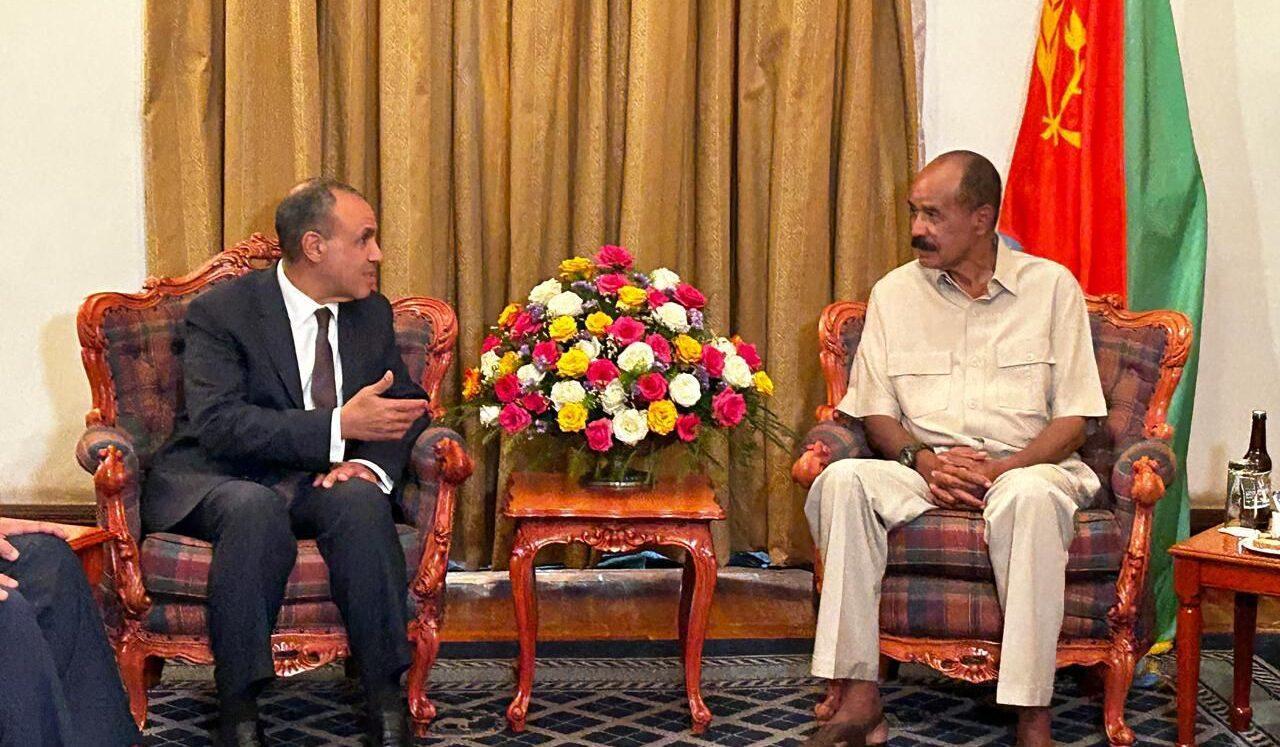
This came during a visit by a high-level Egyptian delegation led by Foreign Minister Badr Abdel Atti and Transport Minister Kamel al-Wazir to the Eritrean capital Asmara, according to an official statement.
During the visit, the Egyptian ministers met with Eritrean President Isaias Afwerki and his Foreign Minister Osman Saleh, affirming Egypt’s full support for Eritrea in maintaining its sovereignty, unity, and territorial integrity, and emphasizing the importance of enhancing economic and trade cooperation between the two countries.
The visit discussed strengthening the bilateral partnership in several sectors, including mining, transport, pharmaceutical industries, and fisheries, as well as supporting capacity-building and training programs to qualify Eritrean personnel in various sectors, according to the official statement.
Regarding the security of the Red Sea, Minister Abdel Atti emphasized during his discussions with the Eritrean president that the governance and security of the Red Sea remain the exclusive responsibility of the coastal states, as it is a strategic passage directly linked to the national security of those countries.
Abdel Atti stated that it is unacceptable for any non-coastal parties to engage in arrangements or understandings concerning it, reaffirming Egypt’s support for the Eritrean vision regarding the management of the Red Sea and its emphasis on the unity and sovereignty of the countries bordering it.
In a meeting between the foreign ministers of Egypt and Eritrea, Abdel Atti and his Eritrean counterpart Osman Saleh stressed that the security and management of the Red Sea remain the exclusive responsibility of the coastal states, rejecting any attempts by non-coastal parties to impose arrangements or security roles in this context.
In this context, the Egyptian delegation reviewed developments in the Horn of Africa during the visit, where Minister Abdel Atti presented the Egyptian vision regarding the situation in Sudan and Somalia.
He stated that Egypt’s position is firm regarding the maintenance of security and stability in the Horn of Africa, considering it a “direct extension of Egyptian national security, and the importance of supporting national state institutions and preserving the unity, sovereignty, and territorial integrity of the countries in the region,” according to the statement.
Economically, the visit carried clear indicators of Cairo’s efforts to expand its economic partnership with Asmara, as the Egyptian delegation included several businessmen and representatives from the private sector; a step aimed at enhancing joint investments and opening new areas for cooperation.
The Egyptian Foreign Minister confirmed Cairo’s interest in supporting cooperation in the sectors of mining, transport, pharmaceutical industries, fisheries, and infrastructure, in addition to training and capacity-building programs for Eritrean personnel.
In this context, the visit witnessed the signing of an agreement for cooperation in the field of maritime transport between the two countries in the presence of President Afwerki, which was described as an important step to enhance logistical connectivity and economic integration across the Red Sea.
Egyptian Transport Minister Kamel al-Wazir stated that the agreement includes establishing a shipping line connecting Egyptian and Eritrean ports, which contributes to supporting trade and investment movement and enhancing the strategic geographical advantage of both countries.
For his part, the Eritrean president praised the “Egyptian role” in supporting security and stability in the Horn of Africa and the Red Sea, emphasizing his country’s commitment to continue coordination and cooperation with Cairo in various political, economic, and security fields.
He also expressed appreciation for the Egyptian delegation’s inclusion of several businessmen and representatives from the private sector, considering that this reflects Cairo’s seriousness in advancing bilateral relations to broader levels, according to the statement.
The economic delegation also presented its visions regarding commercial and investment partnership opportunities with the Eritrean side, within a shared approach to enhance economic cooperation and open new investment areas between the two countries.
The visit of the Egyptian delegation to Eritrea comes amid ongoing Ethiopian discussions about the desire for maritime access and seeking alternatives to reach ports, a privilege that it lost after Eritrea’s independence in 1993.
Since then, Ethiopia has had to rely on Djibouti ports for over 95% of its imports and exports, making Addis Ababa vulnerable to fluctuations in fees, local disturbances, and high economic costs.
Repeatedly, Ethiopian Prime Minister Abiy Ahmed has stated that lasting peace in the Horn of Africa cannot be achieved as long as Ethiopia lacks direct access to the sea, reiterating his country’s longstanding strategic ambition for a maritime outlet.
In a recent interview with Ethiopian national television, Abiy Ahmed considered that the absence of direct access to ports restricts Ethiopia’s economic expansion and its ability to compete internationally, describing maritime access as a vital element for achieving sustainable development and self-sufficiency.